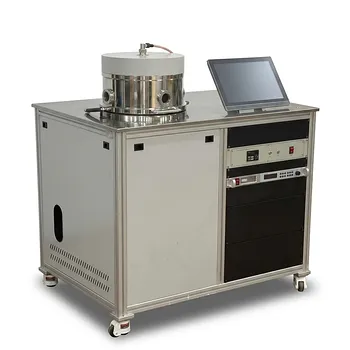
Industrial-grade Chemical Vapor Deposition (CVD) equipment serves as a precision thermal reactor designed to drive the diffusion of aluminum vapor into a pre-electroplated rhodium layer and an underlying alloy substrate. By maintaining a strictly controlled high-temperature environment, the equipment facilitates the thermodynamic and kinetic conditions necessary to bond these elements into a unified, high-performance coating.
Core Takeaway The equipment's primary function is not merely adding material, but orchestrating a deep diffusion process through precise management of heat and gas flow. This transforms the rhodium and substrate into a specific double-layer microstructure, ensuring uniform elemental distribution and superior bonding.
The Mechanics of the Reaction Environment
Precise Parameter Management
The fundamental role of the CVD equipment is the rigorous control of reaction variables. To achieve a successful rhodium-modified coating, the system must maintain specific conditions, such as reaction temperatures around 1040 ºC.
It also regulates reaction times—often spanning up to 600 minutes—and hydrogen flow rates. These parameters are not arbitrary; they are the critical levers that determine the quality of the final modification.
Precursor Generation and Transport
While the reaction happens in the main chamber, the equipment also functions as a generator. An external reactor typically houses high-purity aluminum pellets in an independent heating zone.
Here, the equipment facilitates a reaction with gases (such as hydrogen chloride) to produce the necessary precursors (like aluminum trichloride). The system then effectively transports these precursors via carrier gases into the main chamber to interact with the rhodium layer.
Microstructural Formation
Driving Diffusion and Bonding
The equipment ensures that aluminum vapor does not simply sit on top of the surface. Instead, the high thermal energy drives the aluminum to diffuse uniformly.
This diffusion process allows the aluminum to chemically bond with both the pre-electroplated rhodium layer and the base alloy substrate. This bonding is essential for the durability of the coating.
Defining the Coating Architecture
The ultimate output of the equipment’s control is the formation of a distinct double-layer microstructure.
Through the managed thermodynamic and kinetic conditions, the equipment creates an outer layer and a diffusion layer. This structure defines the overall elemental distribution, which is critical for the coating's performance characteristics.
Understanding the Trade-offs
High Thermal Demands
The process requires subjecting the substrate to extreme temperatures (e.g., 1040 ºC). This limits the types of substrate materials you can use; they must be capable of withstanding this thermal load without degrading or warping.
Process Duration
Achieving the correct diffusion profile is time-intensive. With reaction times extending to 600 minutes, this is a slow-batch process rather than a rapid-throughput technique. This duration is necessary to ensure the thermodynamic equilibrium required for the double-layer structure.
Making the Right Choice for Your Goal
To determine if this specific CVD process aligns with your fabrication requirements, consider your desired outcome:
- If your primary focus is coating adhesion: The equipment’s ability to drive deep diffusion bonding ensures the rhodium-modified layer is integral to the substrate, preventing delamination.
- If your primary focus is microstructural precision: The rigorous control over hydrogen flow and temperature is the key to achieving the specific double-layer architecture required for high-performance applications.
The value of industrial CVD equipment lies in its ability to turn a chemical reaction into a highly repeatable manufacturing standard.
Summary Table:
| Feature | Function in Rhodium Coating Process | Impact on Quality |
|---|---|---|
| Temperature Control | Maintains stable environment at ~1040 ºC | Drives thermodynamic diffusion and bonding |
| Gas Flow Management | Regulates hydrogen and precursor transport | Ensures uniform elemental distribution |
| Precursor Generation | Converts Al pellets to AlCl3 gas | Provides necessary material for modification |
| Diffusion Control | Orchestrates 600-minute reaction cycles | Creates durable double-layer microstructure |
Elevate Your Material Science with KINTEK Precision
Unlock the full potential of your coating research and industrial fabrication with KINTEK’s advanced CVD and PECVD systems. Whether you are developing rhodium-modified coatings or complex alloy substrates, our equipment provides the rigorous thermal and gas flow control required for superior diffusion bonding.
As specialists in laboratory and industrial thermal solutions, KINTEK offers a comprehensive range of high-performance tools, including:
- High-Temperature Furnaces: Muffle, Tube, and Vacuum systems for precise heat treatment.
- Advanced Reactors: CVD, PECVD, and MPCVD systems designed for microstructural precision.
- High-Pressure Solutions: Autoclaves and HTHP reactors for demanding environments.
- Material Processing: From crushing and milling to hydraulic pellet presses and essential ceramics.
Ready to achieve repeatable manufacturing excellence? Contact KINTEK today to consult with our experts on the ideal equipment for your specific fabrication requirements.
References
- Maryana Zagula-Yavorska, J. Romanowska. The effect of precious metals in the NiAl coating on the oxidation resistance of the Inconel 713 superalloy. DOI: 10.2298/jmmb220427011z
This article is also based on technical information from Kintek Solution Knowledge Base .
Related Products
- HFCVD Machine System Equipment for Drawing Die Nano-Diamond Coating
- Chemical Vapor Deposition CVD Equipment System Chamber Slide PECVD Tube Furnace with Liquid Gasifier PECVD Machine
- Customer Made Versatile CVD Tube Furnace Chemical Vapor Deposition Chamber System Equipment
- Multi Heating Zones CVD Tube Furnace Machine Chemical Vapor Deposition Chamber System Equipment
- Split Chamber CVD Tube Furnace with Vacuum Station Chemical Vapor Deposition System Equipment Machine
People Also Ask
- What is the full form of HFCVD? A Guide to Hot Filament Chemical Vapor Deposition
- What are the disadvantages and challenges of the HFCVD method? Overcome Growth Limits and Filament Issues
- What is the function of tungsten filaments in HFCVD? Powering Diamond Film Synthesis with Thermal Excitation
- Why is Chemical Vapor Deposition (CVD) equipment uniquely suited for constructing hierarchical superhydrophobic structures?
- What is the chemical vapor deposition growth process? Build Superior Thin Films from the Atom Up