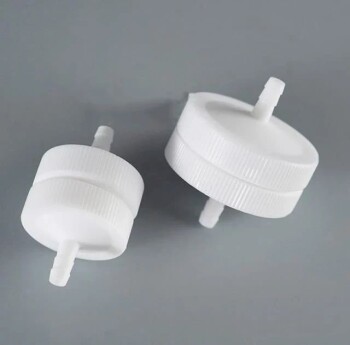
Microporous membrane filters are the critical control mechanism for freezing a chemical reaction in time. In the context of catalytic oxidation, these high-precision filters are used to physically separate solid catalysts from the reaction liquid immediately upon sampling. This separation instantly halts the heterogeneous catalytic reaction, preventing the catalyst from continuing to degrade the sample after it has been removed from the reactor.
The core function of the microporous filter is to eliminate post-sampling data bias. By rapidly removing the catalyst, you ensure that analytical results—such as Chemical Oxygen Demand (COD)—reflect the true state of the system at the exact moment of sampling, rather than a distorted value caused by continued reaction in the sample vial.
The Mechanism of Action
Separating the Catalyst from the Medium
Catalytic oxidation relies on a heterogeneous reaction, meaning the catalyst (a solid) and the reactants (liquids) are in different phases. As long as the solid catalyst remains in contact with the liquid, the reaction proceeds.
The "Stop Button" Effect
Using a filter with a specific pore size, typically 0.45 micrometers, creates a physical barrier. The liquid sample passes through for analysis, while the solid catalyst is trapped and removed. This effectively acts as a "stop button" for the chemical process within that specific sample volume.
Why Immediate Separation Matters
Preventing Data Bias
If a sample is drawn but not filtered immediately, the catalyst continues to break down pollutants inside the sample container. This leads to artificially low concentration readings, creating a false representation of the system's efficiency at that specific time point.
Accurate Parameter Measurement
Precise measurement of parameters like Chemical Oxygen Demand (COD) and total phenols relies on a static sample. Filtration ensures that the chemistry of the sample remains stable from the moment of collection until the moment of analysis in the lab.
Understanding the Risks and Trade-offs
The Risk of Delayed Filtration
Speed is just as critical as the filter itself. If the filtration process is slow, the reaction continues during the filtering step. This introduces a margin of error where the "measured time" does not perfectly align with the "chemical state" of the fluid.
Pore Size Precision
The integrity of the separation depends entirely on the pore size relative to the catalyst particle size. If the membrane pores are larger than 0.45 micrometers (or the specific size of your catalyst particles), fine catalyst dust may pass through. This results in a "leaky" stop mechanism where the reaction slowly continues in the filtrate, compromising data accuracy.
Ensuring Experimental Integrity
To guarantee accurate kinetic data in catalytic oxidation studies, precise handling of the sampling phase is non-negotiable.
- If your primary focus is Kinetic Accuracy: Ensure the filtration occurs within seconds of sampling to establish a true "zero-point" for that data interval.
- If your primary focus is Analytical Precision: Verify that your membrane pore size (e.g., 0.45 micrometers) is sufficiently small to capture 100% of the solid catalyst particulate.
By rigorously applying immediate filtration, you transform a dynamic, changing mixture into a stable, quantifiable snapshot of your reaction's performance.
Summary Table:
| Feature | Function in Catalytic Oxidation | Impact on Data Integrity |
|---|---|---|
| Mechanism | Physical separation of solid catalyst from liquid | Stops heterogeneous reaction instantly |
| Pore Size (0.45µm) | Traps even fine catalyst particulates | Prevents "leaky" reactions in filtrate |
| Immediate Use | Eliminates post-sampling chemical degradation | Reflects true system state at time of sampling |
| Analytical Focus | Stabilizes parameters like COD and total phenols | Ensures high kinetic accuracy and precision |
Precision Results Start with Superior Lab Tools
Don't let post-sampling reactions compromise your research data. KINTEK provides high-performance laboratory equipment and consumables tailored for the most demanding catalytic studies. From precision microporous filtration solutions and PTFE consumables to advanced high-temperature high-pressure reactors and catalyst crushing systems, we equip your lab with the tools needed for uncompromising accuracy.
Whether you are conducting battery research, material synthesis, or environmental analysis, KINTEK’s comprehensive portfolio—including muffle furnaces, rotary evaporators, and hydraulic presses—is designed to enhance your experimental efficiency and reliability.
Ready to elevate your analytical precision? Contact KINTEK experts today and find the perfect equipment for your sampling and reaction workflows.
References
- Ana S. Fajardo, Rosa M. Quinta‐Ferreira. Treatment of a simulated phenolic effluent by heterogeneous catalytic ozonation using Pt/Al<sub>2</sub>O<sub>3</sub>. DOI: 10.1080/09593330.2012.692720
This article is also based on technical information from Kintek Solution Knowledge Base .
Related Products
- Custom PTFE Teflon Parts Manufacturer for Sampling Filters
- Custom PTFE Teflon Parts Manufacturer for PTFE Buchner Funnel and Triangular Funnel
- Customizable PEM Electrolysis Cells for Diverse Research Applications
- Shortpass Filters for Optical Applications
People Also Ask
- What are the advantages of using PTFE filters for ionic component analysis? Ensure Accurate Sample Quantification
- Why are PTFE membrane filters selected for rice husk fractionation? Ensuring Purity in Harsh Separation Stages
- Is PTFE corrosion resistant? Discover the Ultimate Chemical Resistance for Your Lab
- What are the specific applications of PTFE in micro-batch slug flow systems? Enhance Your Microfluidic Reaction Purity
- How is PTFE utilized for insulation in Alloy 22 corrosion setups? Ensure Signal Purity & Accuracy