
Molds & Accessories
Cylindrical Press Mold with Scale for Lab
Item Number : PCMC
Price varies based on specs and customizations
- Die heating
- Alloy tool steel :Cr12MoV
- Indenter hardness
- HRC60-HRC62
- Sample size
- Φ10、Φ12、Φ13、Φ15、Φ18、Φ20 mm (M)
- Cavity depth
- 100mm (N)
- Dimensions
- Φ53*220mm(L*H)

Shipping:
Contact us to get shipping details Enjoy On-time Dispatch Guarantee.
Why Choose Us
Easy ordering process, quality products, and dedicated support for your business success.
Introduction
The cylindrical press mold with scale is a versatile tool designed for high-pressure molding of powders into various shapes and sizes, including round, square, and hexagonal forms. It features electric heating for precise temperature control during the molding process. This mold is particularly useful for applications requiring large cross-sectional areas or high pressure, such as the production of spark plugs and other industrial components. The system includes an automatic press control device for setting multiple pressure regulation steps, ensuring repeatable and stable results.
Applications
Cylindrical press molds with scale application are versatile tools used in various industries for creating precise and uniform shapes from powders or granules. These molds are particularly useful in scenarios requiring high pressure and large cross-sectional areas, ensuring stability and uniformity in the final product. Below are some key application areas and related long-tail keywords:
-
Pharmaceutical Tablet Manufacturing:
- Tablet Compression Molding: Utilized for pressing powders into tablets of various shapes and sizes.
- Uniform Dosage Formulation: Ensures consistent drug distribution in each tablet.
-
Ceramic Product Production:
- Ceramic Tile Pressing: Forming ceramic tiles with precise dimensions and shapes.
- Advanced Ceramic Components: Manufacturing components for electronics and automotive industries.
-
Powder Metallurgy:
- Metal Powder Compaction: Creating metal parts with high density and strength.
- Custom Metal Shapes: Producing intricate metal shapes for specialized applications.
-
Food Industry:
- Confectionery Pressing: Forming candies and other food items into specific shapes.
- Nutritional Supplement Tablets: Ensuring uniform size and shape for easy consumption and dosing.
-
Research and Development:
- Material Science Experiments: Testing the properties of new materials under controlled pressure conditions.
- Prototype Development: Quickly producing samples for testing and validation.
These applications highlight the versatility and precision of cylindrical press molds, making them essential equipment in numerous industrial and research settings.
Detail & Parts
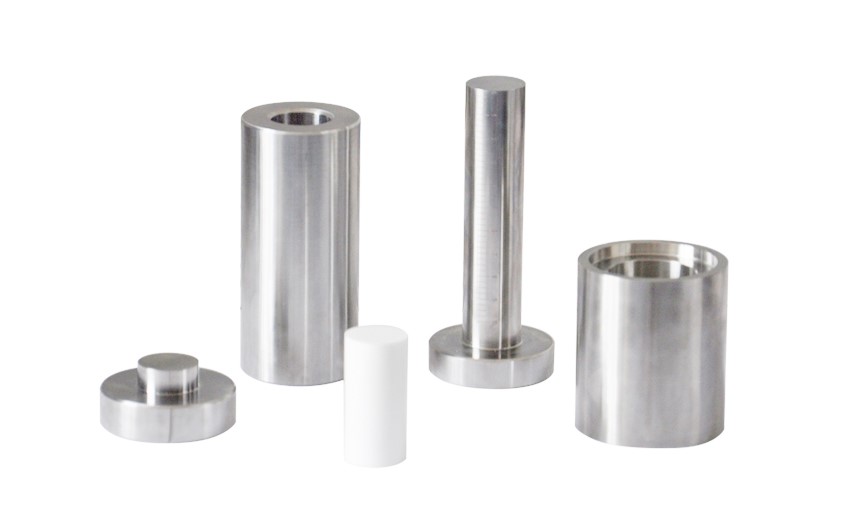

Technical specifications
| Instrument model | PCMC |
|---|---|
| Sample shape | 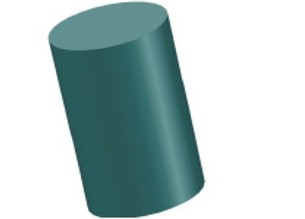 |
| Die heating | Alloy tool steel :Cr12MoV |
| Indenter hardness | HRC60-HRC62 |
| Sample size | Φ10、Φ12、Φ13、Φ15、Φ18、Φ20 mm (M) |
| Cavity depth | 100mm (N) |
| Dimensions | Φ53*220mm(L*H) |
| Weight | 4.8Kg |
| Diagram of hydraulic powder press size | 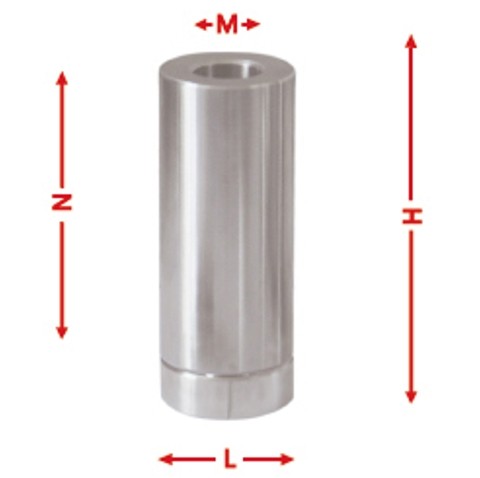 |
Operation steps

1.Assemble the die according to the operation diagram and install the sample in the cavity.

2.Put the die in the center of the hydraulic press and pressurize to required pressure.

3.Assemble the die according to the release diagram , eject the sample out of the die bushing with the screw rod.

4.Take out the die from the hydraulic press , and remove the sample gently.
Principle
The cylindrical press mold operates on Pascal's principle, which ensures uniform pressure distribution across the entire surface of the enclosed incompressible fluid. This principle is utilized in the molding process where powder materials are sealed in a low-deformation mold, typically a rubber bag, and subjected to uniform compression by transmitting liquid pressure. This method ensures stability and uniformity in the molded pieces, making it suitable for producing various shapes and sizes with high precision.
Advantages
-
Enhanced Stability and Uniformity: The cylindrical press mold ensures that samples are compacted uniformly from each side, leading to increased stability and uniformity. This is crucial for subsequent processing stages, especially in industries where precision is paramount.
-
Versatility in Shape and Size: With the ability to use different shapes of molds, this press can produce a variety of shapes and sizes, including round, square, rectangular, circular, hexagonal, and flat shapes. This versatility is essential for industries that require diverse product forms.
-
High Aspect Ratio Pellet Production: The mold's design allows for the pressing of very long aspect ratio pellets, which is particularly beneficial in industries like ceramics and spark plug manufacturing. This capability ensures that long, thin items can be pressed without compromising on quality or stability.
-
Repeatable Process: Once the initial setup is calibrated for specific dimensions, the process becomes highly repeatable. This is advantageous for mass production where consistency is key.
-
Electric Heating Capabilities: The inclusion of electric heating in the mold allows for the heating process to be integrated into the pressing stage. This feature streamlines the production process, reducing the need for separate heating equipment.
-
Large Tonnage Machine Compatibility: The mold is designed to work with large tonnage machines, making it suitable for high-pressure applications. This is essential for industries that require high force to mold large cross-sectional areas.
-
Energy Efficient Operation: The circuit principle and operational steps ensure efficient energy storage and release, contributing to a more energy-efficient operation. This is beneficial for reducing operational costs and environmental impact.
-
Suitable for Irregular Shapes: The mold can handle irregular shapes such as donuts or items with varying dimensions along their length. This flexibility is crucial for industries that produce complex-shaped products.
By leveraging these advantages, the cylindrical press mold offers a robust solution for industries requiring precise, versatile, and efficient pressing processes.
Trusted by Industry Leaders

FAQ
What Is A Press Mold?
What Is Press Mould In Ceramics?
How Are Pellet Molds Used?
What Types Of Materials Can Be Pelletized Using Pellet Molds?
How Can One Select The Appropriate Pellet Mold For Their Specific Application?
REQUEST A QUOTE
Our professional team will reply to you within one business day. Please feel free to contact us!
Related Products

Cylindrical Lab Electric Heating Press Mold for Laboratory Applications
Efficiently prepare samples with Cylindrical Lab Electric Heating Press Mold. Fast heating, high temp & easy operation. Custom sizes available. Perfect for battery, ceramic & biochemical research.
Cylindrical Press Mold for Lab Applications
Efficiently form and test most samples with Cylindrical Press Molds in a range of sizes. Made of Japanese high-speed steel, with long service life and customizable sizes.
Assemble Lab Cylindrical Press Mold
Get reliable and precise molding with Assemble Lab Cylindrical Press Mold. Perfect for ultra-fine powder or delicate samples, widely used in material research and development.

Round Bidirectional Press Mold for Lab
The round bidirectional press mold is a specialized tool used in high-pressure molding processes, particularly for creating intricate shapes from metal powders.
Square Bidirectional Pressure Mold for Lab Use
Discover precision in molding with our Square Bidirectional Pressure Mold. Ideal for creating diverse shapes and sizes, from squares to hexagons, under high pressure and uniform heating. Perfect for advanced material processing.
Square Lab Press Mold for Laboratory Applications
Create uniform samples easily with Square Lab Press Mold - available in various sizes. Ideal for battery, cement, ceramics, and more. Custom sizes available.

Assemble Square Lab Press Mold for Laboratory Applications
Achieve perfect sample preparation with Assemble Square Lab Press Mold. Quick disassembly eliminates sample deformation. Perfect for battery, cement, ceramics, and more. Customizable sizes available.

Ring Press Mold for Lab Applications
Ring Press Dies, also known as Circular Pellet Press Die Sets, are integral components in various industrial and laboratory processes.
Special Shape Press Mold for Lab
Discover high-pressure special shape press molds for diverse applications, from ceramics to automotive parts. Ideal for precise, efficient molding of various shapes and sizes.
Isostatic Molding Pressing Molds for Lab
Explore high-performance isostatic pressing molds for advanced material processing. Ideal for achieving uniform density and strength in manufacturing.

Anti-Cracking Press Mold for Lab Use
The anti-cracking press mold is a specialized equipment designed for molding various shapes and sizes of film using high pressure and electric heating.
Polygon Press Mold for Lab
Discover precision polygon press molds for sintering. Ideal for pentagon-shaped parts, our molds ensure uniform pressure and stability. Perfect for repeatable, high-quality production.

XRF Boric Acid Lab Powder Pellet Pressing Mold for Laboratory Use
Get accurate results with our XRF Boric Acid lab Powder Pellet Pressing Mold. Perfect for preparing samples for X-ray fluorescence spectrometry. Custom sizes available.
XRF & KBR steel ring lab Powder Pellet Pressing Mold for FTIR
Produce perfect XRF samples with our steel ring lab powder pellet pressing mold. Fast tableting speed and customizable sizes for accurate molding every time.

Ball Press Mold for Lab
Explore versatile Hydraulic Hot Press molds for precise compression molding. Ideal for creating various shapes and sizes with uniform stability.
Multi-Punch Rotary Tablet Press Mold Ring for Rotating Oval and Square Molds
The multi-punch rotary tablet press mold stands as a pivotal component in pharmaceutical and manufacturing industries, revolutionizing the process of tablet production. This intricate mold system comprises multiple punches and dies arranged in a circular fashion, facilitating rapid and efficient tablet formation.

Double Plate Heating Press Mold for Lab
Discover precision in heating with our Double Plate Heating Mold, featuring high-quality steel and uniform temperature control for efficient lab processes. Ideal for various thermal applications.
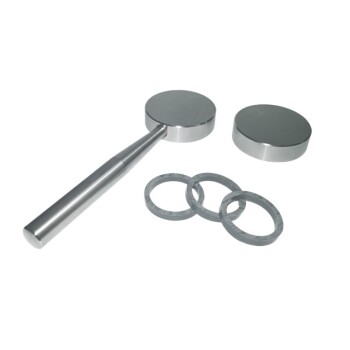
XRF & KBR plastic ring lab Powder Pellet Pressing Mold for FTIR
Get precise XRF samples with our plastic ring lab powder pellet pressing mold. Fast tableting speed and customizable sizes for perfect molding every time.
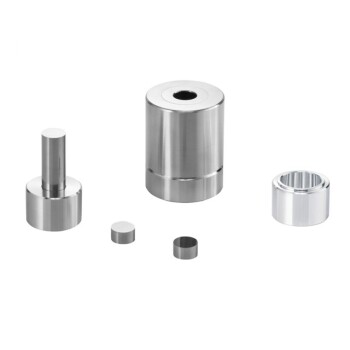
Carbide Lab Press Mold for Laboratory Applications
Form ultra-hard samples with Carbide Lab Press Mold. Made of Japanese high-speed steel, it has a long service life. Custom sizes available.
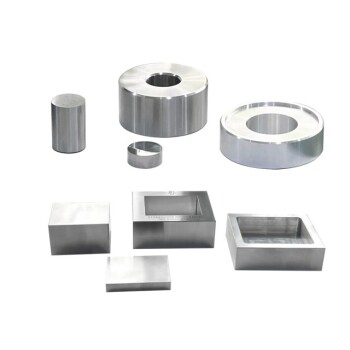
Special Heat Press Mold for Lab Use
Square, round and flat plate forming dies for hot presses.
Related Articles

Comprehensive Guide to Cylindrical Lab Electric Heating Press Mold: Technology and Applications
Explore the advanced features and applications of cylindrical lab electric heating press molds. Learn about their working principles, types of heating technologies, and key benefits for precise sample preparation.
Hazards and Safety Precautions of Laboratory Pressure Vessels
An overview of the dangers and safety measures for pressure vessels in laboratory settings.
Classification of tablet press molds and precautions for use
During the stamping process.A stamping die is a tablet press die that compresses a sample or tablet during the stamping process. The stamping die is placed on top of the tablet press and the sample is placed on top of the die. The die is then compression molded to the desired shape and size. here are some classification of tablet press molds and precautions for use.
CIP vs. Metal Mold Pressing What's the Difference
CIP and Metal Mold Pressing are used to create high-density components, but they differ in terms of the level of complexity required and the final outcome. Understanding these differences can help manufacturers determine which method is best suited for their needs.
Overview of Basic Laboratory Pumps
An overview of various types of laboratory pumps including constant flow, oil-free vacuum, rotary vane, diaphragm, chemical hybrid, molecular, injection, and circulating water pumps.
Infrared Press Mold Techniques for Non-Demolding Applications
Explore advanced infrared press mold techniques without demolding. Learn about the benefits, applications, and best practices for non-demolding lab processes.
Lab Scale Mini Tablet Press: Applications, Processes, and Features
Laboratory scale small tablet presses are versatile and essential tools for the pharmaceutical and related industries. It plays a vital role in producing simple yet precise tablets from powders, making it an integral part of research and development.
How CVD is Used in the Semiconductor Industry
CVD has revolutionized the semiconductor industry, enabling the production of high-performance electronic devices with enhanced functionality and reliability.
CVD Machines for Thin Film Deposition
Chemical Vapor Deposition (CVD) is a widely used technique for deposition of thin films on various substrates.
Coating Methods for Growing Single Crystal Films
An overview of various coating methods like CVD, PVD, and Epitaxy for growing single crystal films.
Advantages and Disadvantages of Chemical Vapor Deposition (CVD)
Chemical vapor deposition (CVD) is a versatile thin-film deposition technique widely used in various industries. Explore its advantages, disadvantages, and potential new applications.
Technical Overview of Silicon-Carbon Anode Materials Prepared by CVD Method
This article discusses the key technical aspects of silicon-carbon anode materials prepared via CVD, focusing on their synthesis, performance improvements, and industrial application potential.