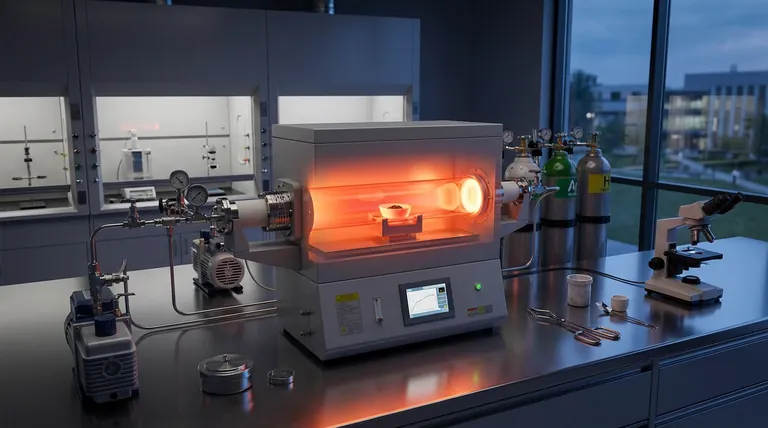
The Unseen Enemy in the Lab
Imagine spending weeks designing a new alloy. The calculations are perfect. The raw materials are of the highest purity. You place them in a furnace, heat them to 1500°C, and wait.
When you open the chamber, the result is a failure. The material is brittle, discolored, and oxidized.
The culprit wasn't a flaw in your math or your materials. It was the air itself. At high temperatures, the oxygen and water vapor we breathe become aggressive contaminants, undermining the very structure of the materials you’re trying to create. This is the fundamental battle of advanced material science: a fight not just for the right temperature, but against the environment itself.
Engineering Purity: The Anatomy of Control
A standard oven is a blunt instrument. It heats things. A tube furnace, by contrast, is a surgical tool. Its purpose is not merely to apply heat, but to create a perfect, isolated universe where a process can unfold without contamination.
Its design is an elegant expression of this purpose.
The Chamber of Isolation
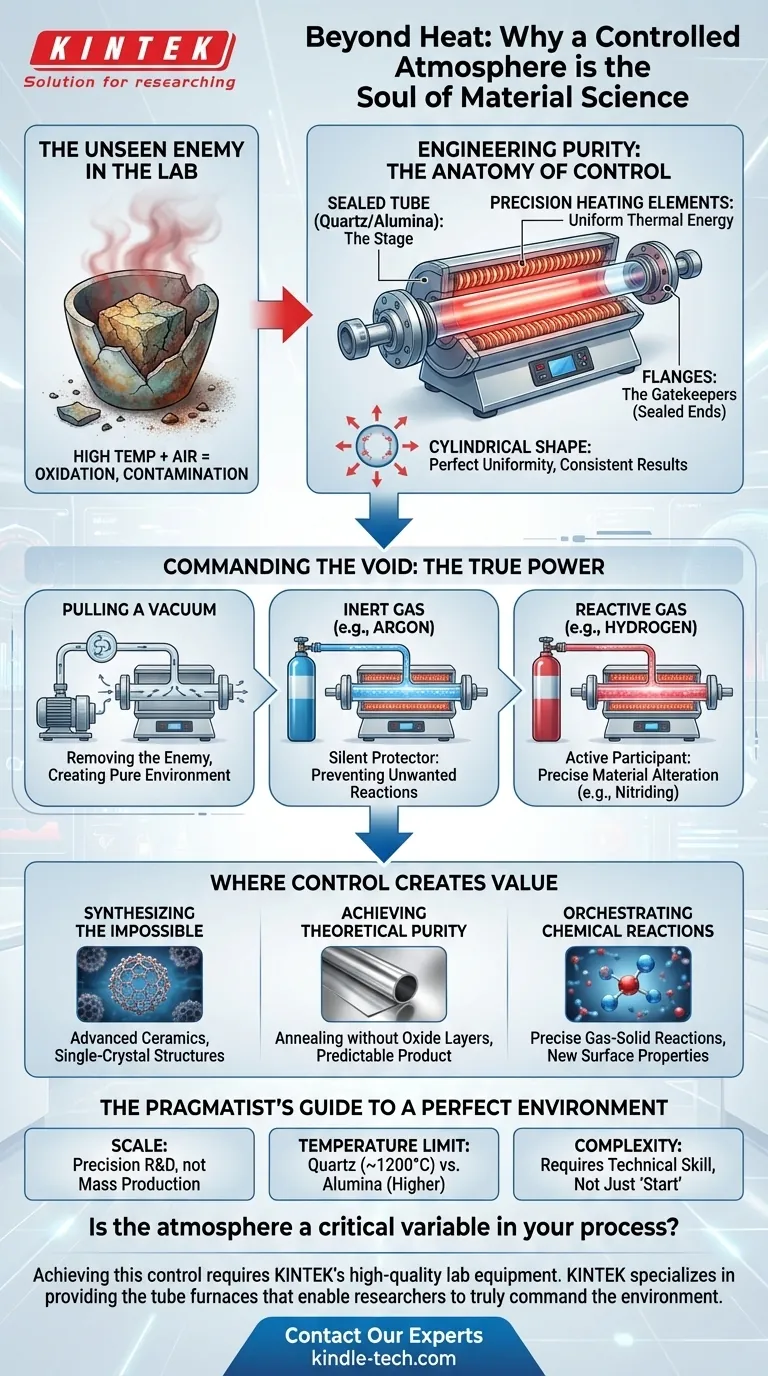
At the heart of the system is a sealed tube—often made of quartz or high-purity alumina. This is the stage. Everything outside—the air, the dust, the humidity—is the audience, and it is not invited to participate.
Surrounding this tube are precision heating elements, governed by a thermocouple that acts as a vigilant sensor. But the most critical components are the flanges that seal the ends of the tube. They are the gatekeepers, allowing you to decide what—if anything—is allowed inside.
The Pursuit of Perfect Uniformity
The furnace’s cylindrical shape is not an aesthetic choice; it’s a solution in physics. By arranging the heating coils around the tube, it delivers uniform thermal energy from all directions.
This ensures that one side of your sample isn’t cooking faster than the other. It’s a quiet, geometric guarantee of consistency, which is the bedrock of repeatable science.
Commanding the Void
The true power of the tube furnace is activated when you connect a vacuum pump to its flanges. The act of pulling a vacuum is the act of removing the enemy. You are creating a small pocket of near-nothingness, an environment purer than anything found in nature.
Only then, with the chaotic variable of ambient air removed, can you take command. You can choose to conduct your process in this vacuum, or you can introduce a specific, chosen gas.
- An inert gas, like Argon, becomes a silent protector, blanketing the material to prevent any unwanted reactions.
- A reactive gas, like Hydrogen, becomes an active participant, precisely altering the material's surface in a process like nitriding or carburization.
This is the difference between letting nature take its course and directing a specific outcome at the atomic level.
Where Control Creates Value
This level of atmospheric and thermal control is not a theoretical luxury; it is the prerequisite for modern material innovation.
- Synthesizing the Impossible: It allows for the creation of advanced ceramics, single-crystal structures, and nanomaterials that would instantly oxidize or become contaminated if exposed to air at synthesis temperatures. The furnace acts as a sterile womb for new materials.
- Achieving Theoretical Purity: When annealing a metal, the goal is to relieve internal stresses. Doing this in a vacuum or inert atmosphere means you can achieve this without forming a single-micron-thick oxide layer, resulting in a cleaner, more predictable final product.
- Orchestrating Chemical Reactions: A tube furnace transforms from a simple oven into a chemical reactor. It's how we perform gas-solid reactions with precision, instructing a specific gas to bond with a solid substrate to create new surface properties.
The Pragmatist's Guide to a Perfect Environment
Like any specialized tool, a tube furnace comes with trade-offs born from its focused design. Understanding them is key to using it effectively.
| Consideration | Implication |
|---|---|
| Scale | Designed for precision, not volume. It is a scalpel for R&D and specialized processes, not a factory floor forge. |
| Temperature Limit | The maximum heat is defined by the tube material. Quartz is a workhorse up to ~1200°C; alumina is required for higher temperatures. |
| Complexity | Operating a vacuum and managing gas flow requires more technical skill than simply pressing "start" on a box furnace. |
The decision to use one comes down to a single question: Is the atmosphere a critical variable in your process?
If you are simply drying a sample or heat-treating a non-reactive material in air, a simpler box furnace may suffice. But if you are trying to prevent oxidation, synthesize a pure compound, or control a chemical reaction at high temperatures, then mastering the atmosphere is not optional. It is the entire point.
Achieving this level of control requires equipment built with the same precision you demand from your results. KINTEK specializes in high-quality lab equipment, providing the tube furnaces that enable researchers to move beyond simple heating and truly command the environment of their experiments.
Let us help you create the perfect conditions for your next breakthrough. Contact Our Experts
Visual Guide
Related Products
- 1200℃ Controlled Atmosphere Furnace Nitrogen Inert Atmosphere Furnace
- 1700℃ Controlled Atmosphere Furnace Nitrogen Inert Atmosphere Furnace
- 1400℃ Controlled Atmosphere Furnace with Nitrogen and Inert Atmosphere
- Controlled Nitrogen Inert Hydrogen Atmosphere Furnace
- Mesh belt controlled atmosphere furnace
Related Articles
- Controlled Atmosphere Furnace: Comprehensive Guide to Advanced Heat Treatment
- The Benefits of Controlled Atmosphere Furnaces for Sintering and Annealing Processes
- How Controlled Atmosphere Furnaces Improve Quality and Consistency in Heat Treatment
- The Silent Saboteur in Your Furnace: Why Your Heat Treatment Fails and How to Fix It
- The Importance of Inert Atmosphere Gases in Furnace Atmospheres



















