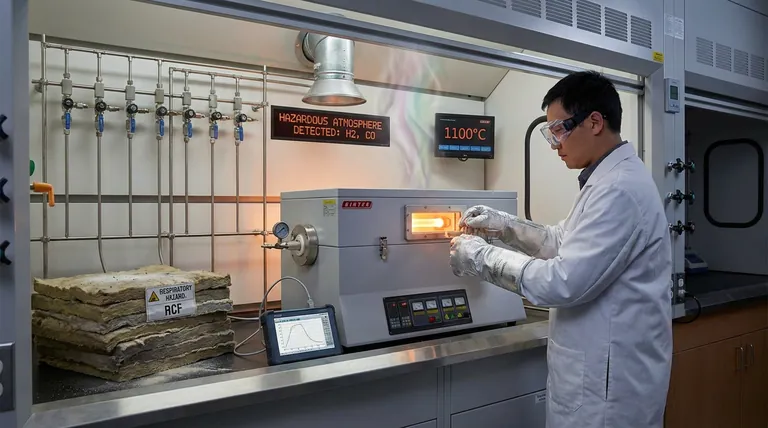
The Illusion of Obvious Danger
Picture a tube furnace in operation. The first thing that comes to mind is the intense, radiating heat—the vibrant orange glow of the heating elements, the shimmering air around the chassis. This is the danger we can see, feel, and instinctively respect.
Our minds are wired to prioritize immediate, tangible threats. This psychological quirk, known as salience bias, makes us experts at avoiding a hot surface. But it also creates a critical blind spot. The most insidious hazards of a tube furnace are not the ones that announce themselves with a wave of heat, but the ones that are silent, invisible, and cumulative.
Focusing solely on the burn risk is a dangerous oversimplification. A truly safe laboratory environment is built on understanding the furnace not as a simple heater, but as a complex system where the greatest risks are often hidden in plain sight.
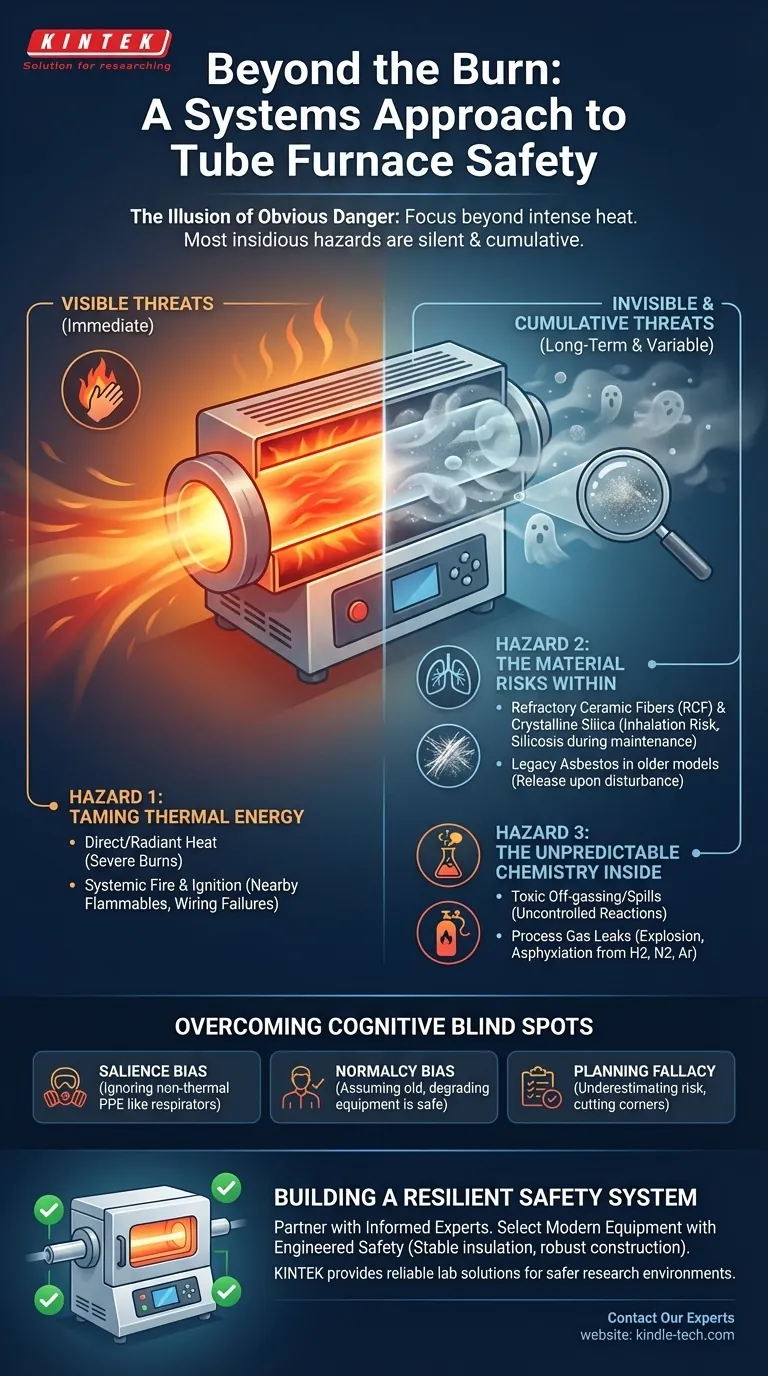
Hazard 1: Taming Thermal Energy
While not the only danger, the immense thermal energy is the most immediate. Managing it is the first layer of a comprehensive safety strategy.
The Obvious Risk: Direct and Radiant Heat
The surfaces of the furnace, the process tube, and the samples themselves can reach temperatures that inflict instantaneous, severe burns. This danger persists long after the power is shut down, a lingering trap for the unwary. Even at a distance, intense infrared radiation can cause skin damage and eye injury.
The Systemic Risk: Fire and Ignition
A high-temperature furnace is a constant ignition source. The risk of fire isn't just about a single misplaced flammable item. It's a systemic failure—a solvent used too close, incompatible sample materials reacting unexpectedly, or wiring not rated for the ambient temperature.
Hazard 2: The Material Risks Within
Some of the most serious long-term threats come from the very materials used to construct the furnace. These hazards become prominent during maintenance, repair, or decommissioning—tasks often perceived as low-risk because the heat is off.
A Maintenance Story: The Dust That Doesn't Settle
Imagine a technician opening an older furnace to replace a thermocouple. They notice some of the white, fibrous insulation has become brittle and dusty. Without a second thought, they might blow the dust away to get a clearer view.
That seemingly harmless dust can be a cloud of microscopic refractory ceramic fibers (RCF). When inhaled, these fibers, which can contain crystalline silica, lodge themselves deep in the lungs. They don't settle. The damage is not immediate or painful; it is a silent, cumulative assault that can lead to chronic diseases like silicosis. RCF is classified as a possible human carcinogen. This invisible threat poses a far greater long-term danger than a minor burn.
The Ghost of Equipment Past: Asbestos
Older furnace models may contain asbestos insulation. While stable during operation, any disturbance during servicing or disposal can release fibers with devastating health consequences. An old furnace isn't just old; it's a potential legacy hazard that demands professional respect and handling.
Hazard 3: The Unpredictable Chemistry Inside
The furnace is only half of the system. The other half is the process—the samples and atmospheres you introduce. This is where the variables, and the variable risks, lie.
When Controlled Reactions Go Wrong
Heating materials can trigger unexpected chemical reactions, produce toxic off-gassing, or lead to spills of hazardous substances inside a tube heated to over 1000°C. The controlled experiment can become an uncontrolled release of toxic or corrosive vapors, demanding robust ventilation and exhaust systems.
The Invisible Atmosphere: Process Gases
Many applications require controlled atmospheres using flammable (hydrogen), inert (argon, nitrogen), or reactive gases. A small, undetected leak in a gas supply line presents a silent threat. Depending on the gas, the risk could be a sudden explosion, a fire, or quiet asphyxiation in an oxygen-depleted room.
Overcoming Our Cognitive Blind Spots
Our instinct is to fear the glowing tube, not the degrading insulation or the odorless gas. To build a truly resilient safety culture, we must consciously override our cognitive biases.
| Cognitive Bias | Common Pitfall in the Lab |
|---|---|
| Salience Bias | Focusing exclusively on thermal PPE (gloves, shields) while neglecting respiratory protection during maintenance. |
| Normalcy Bias | Assuming an older furnace that "still works" is safe, ignoring the degradation of internal materials like insulation. |
| Planning Fallacy | Using improper handling tools "just this once" because the correct ones are unavailable, underestimating the risk of catastrophic failure. |
Building a Resilient Safety System
Effective safety isn't just a checklist of rules; it's a deep understanding of the system's interconnected risks—thermal, material, and chemical. It requires designing safety into the process from the very beginning.
This starts with selecting the right equipment. Modern laboratory furnaces are engineered with these hidden hazards in mind, often utilizing newer insulation materials that are more stable and pose a lower respiratory risk than traditional RCF. Reliable construction minimizes the physical hazards of sharp edges and ensures the integrity of gas flow systems.
Managing these complex risks is a partnership between informed scientists and engineers, and equipment designed for the realities of the modern lab. At KINTEK, we provide reliable, modern lab equipment and consumables that form the foundation of a safer research environment. To ensure your systems are built on a foundation of modern design and safety, Contact Our Experts.
Visual Guide
Related Products
- Rotary Tube Furnace Split Multi Heating Zone Rotating Tube Furnace
- Laboratory Vacuum Tilt Rotary Tube Furnace Rotating Tube Furnace
- 1200℃ Split Tube Furnace with Quartz Tube Laboratory Tubular Furnace
- 1400℃ Laboratory High Temperature Tube Furnace with Alumina Tube
- 1700℃ Laboratory High Temperature Tube Furnace with Alumina Tube
Related Articles
- The Geometry of Heat: Why Motion Matters in Material Synthesis
- Exploring the Advantages of Rotary Tube Furnaces in Industrial and Laboratory Applications
- The Geometry of Heat: Engineering the Perfect Thermal Environment
- Exploring the Functions and Advantages of Rotary Tube Furnaces
- Exploring Rotary Tube Furnaces: A Comprehensive Guide



















