The Hidden Enemy in Plain Sight
Imagine a mission-critical turbine blade, flawlessly machined to sub-micron tolerances. To the naked eye, it is perfect. But deep within its metallic structure, microscopic voids—remnants of its casting process—lie in wait. These tiny pockets of nothingness are stress concentrators, the starting points for catastrophic fatigue failure.
This scenario reveals a fundamental truth in materials science: visible perfection is an illusion if the internal structure is compromised. The most dangerous flaws are the ones we cannot see. The battle for material integrity isn't fought on the surface; it's won by eliminating the empty space within.
A War on Voids: The Goal of Densification
At its core, creating a high-performance material from powder or a casting is a war on voids. The strategy is simple: apply intense heat and immense pressure.
Heat makes the material pliable, lowering its yield strength and encouraging atoms to move. Pressure then provides the force to collapse the empty spaces between particles, forging them into a single, dense, and robust solid.
But how that pressure is applied is everything. This single detail splits the world of material consolidation into two distinct philosophies.
Two Philosophies of Pressure
The choice isn't just about how much force to use, but from which direction it comes. This distinction defines the outcome, the material's properties, and its ultimate reliability.
The Architect's Tool: Uniaxial Hot Pressing
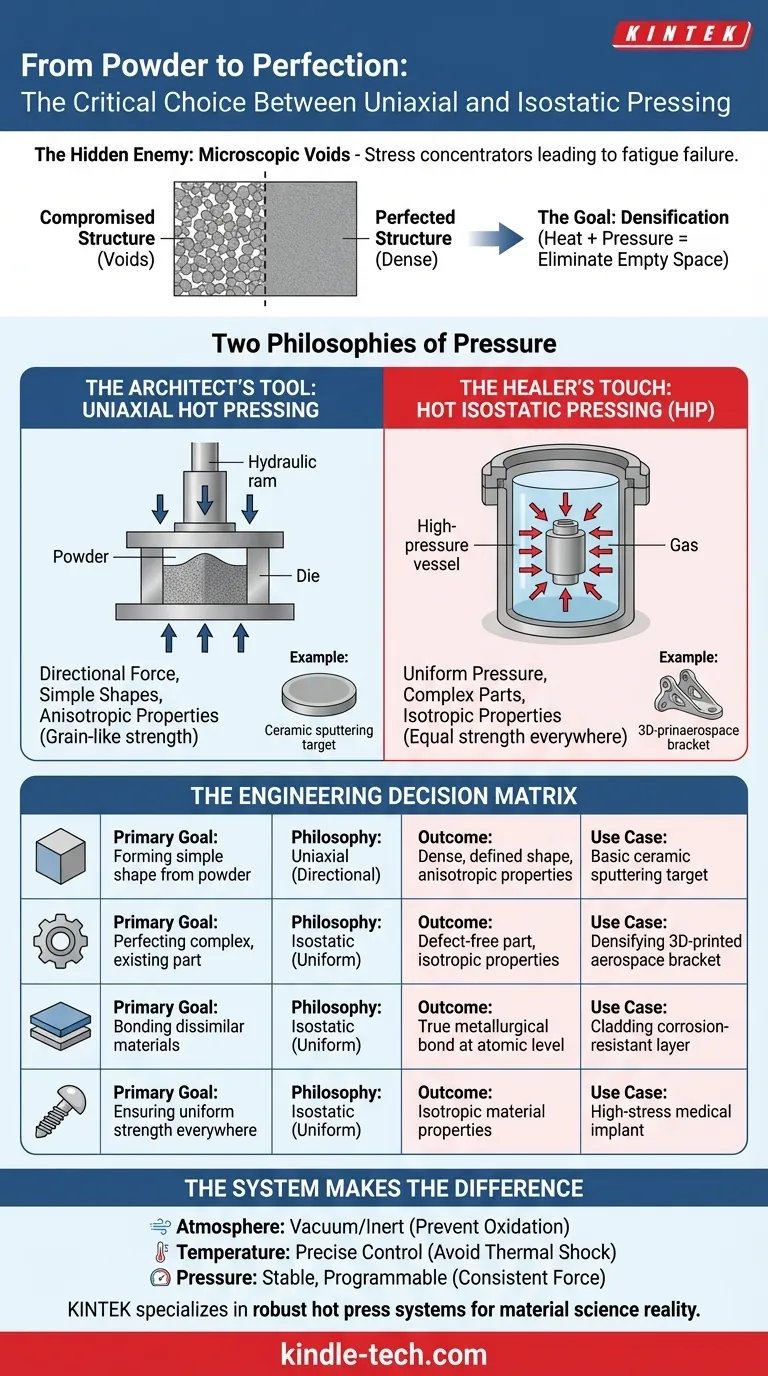
Standard hot pressing is like an architect's press. It applies force in a single direction (uniaxially), typically using hydraulic rams to squeeze powdered material within a die.
It is direct, powerful, and incredibly effective for its primary purpose: forming a solid, dense object into a specific, simple shape like a disc or a block. It takes loose powder and gives it form and structure.
But this directional force has a hidden consequence. It can create anisotropic properties, meaning the material is stronger along one axis than another, much like wood has a grain. For some applications this is acceptable, but for others, it's a non-starter.
The Healer's Touch: Hot Isostatic Pressing (HIP)
Hot Isostatic Pressing (HIP) operates on a completely different principle. Imagine submerging an object in the deepest ocean trench. The pressure is astronomical, and it comes from every direction at once—perfectly uniform, or isostatic.
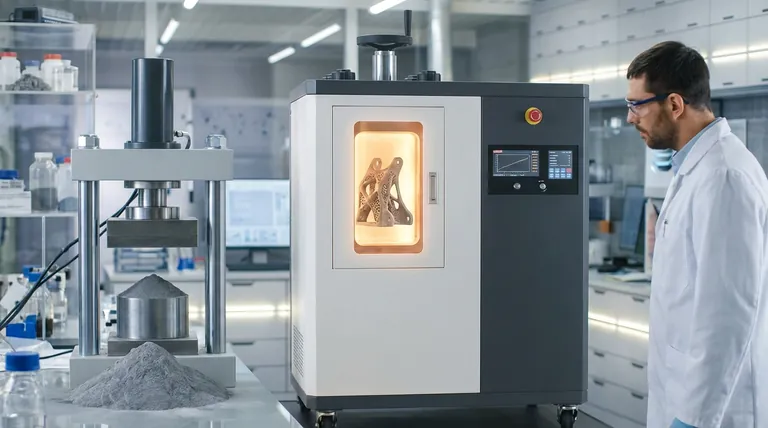
In a HIP system, the component is placed in a high-pressure vessel filled with an inert gas like Argon. As the vessel is heated, the gas pressure builds, squeezing the part evenly from all sides.
This method isn't for creating an initial shape. It's for perfecting one that already exists. The uniform pressure collapses internal voids and microshrinkage without altering the part's external geometry. It is a healing process, erasing the hidden flaws that compromise strength and fatigue life. The result is a fully dense part with isotropic properties—equally strong in all directions.
The Engineering Decision Matrix
Choosing the right method is a critical engineering decision based entirely on your end goal. The question is not which is "better," but which is correct for the job.
| Your Primary Goal | The Right Philosophy | The Outcome | Use Case Example |
|---|---|---|---|
| Forming a simple shape from powder | Uniaxial (Directional) Press | A dense, defined shape with anisotropic properties | Creating a basic ceramic sputtering target |
| Perfecting a complex, existing part | Isostatic (Uniform) Press | A defect-free part with isotropic properties | Densifying a 3D-printed aerospace bracket |
| Bonding dissimilar materials | Isostatic (Uniform) Press | A true metallurgical bond at the atomic level | Cladding a corrosion-resistant layer |
| Ensuring uniform strength everywhere | Isostatic (Uniform) Press | Isotropic material properties | A high-stress medical implant |
The System Makes the Difference
These advanced processes are not possible without an equally advanced system. Success depends on absolute control over the environment.
- Atmosphere: Reactive materials must be processed in a vacuum or inert environment to prevent oxidation that would ruin their properties.
- Temperature: Advanced pulse heating and multi-stage controllers are needed to manage thermal cycles with precision, avoiding thermal shock.
- Pressure: Stable, programmable hydraulic systems are required to apply and maintain immense pressures consistently.
Achieving this level of material integrity isn't just a theoretical exercise; it requires lab equipment built for precision, reliability, and control. At KINTEK, we specialize in providing the robust hot press systems and consumables that turn material science theory into manufacturing reality.
Whether you are shaping new materials from powder or eliminating hidden flaws in critical components, the right equipment is paramount. Contact Our Experts
Visual Guide
Related Products
- Automatic Lab Cold Isostatic Press CIP Machine Cold Isostatic Pressing
- Warm Isostatic Press for Solid State Battery Research
- Isostatic Molding Pressing Molds for Lab
- Electric Split Lab Cold Isostatic Press CIP Machine for Cold Isostatic Pressing
- Manual Cold Isostatic Pressing Machine CIP Pellet Press
Related Articles
- Perfect Density, Imperfect Form: The Hidden Trade-Offs of Cold Isostatic Pressing
- Cold Isostatic Pressing A Game Changer in Material Science
- Principle and Process of Cold Isostatic Pressing
- Automatic isostatic press operation steps
- Beyond Brute Force: The Physics of Perfect Density in Cold Isostatic Pressing