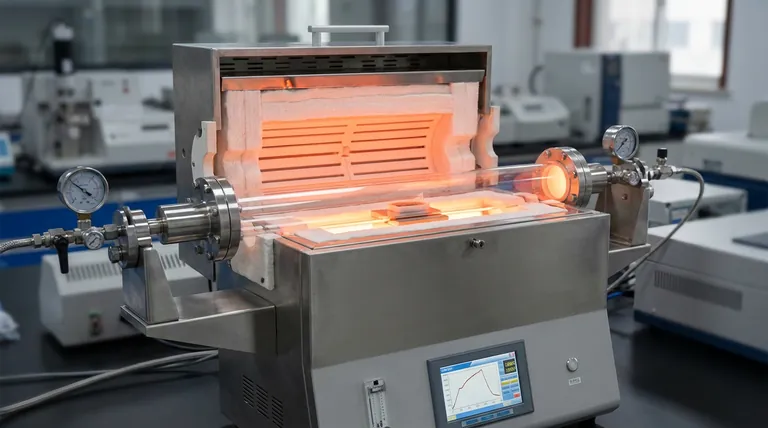
The Scientist's Dilemma: Containing Chaos
Every high-temperature experiment is a battle against chaos. The universe trends toward disorder, but the goal of material science, synthesis, or annealing is to impose perfect, predictable order on a small scale.
To do this, you need to create a tiny, self-contained universe—one where temperature is the only variable you allow to change. Everything else—atmosphere, pressure, contaminants—must be held at bay.
This is the fundamental problem a tube furnace is engineered to solve. It’s not just an oven; it’s an architecture of isolation.
The Architecture of Isolation: A Layer-by-Layer Breakdown
Viewed from the outside, a tube furnace appears to be a simple box. But its true genius lies in a series of concentric layers, each designed to systematically wall off the internal environment from the external world.
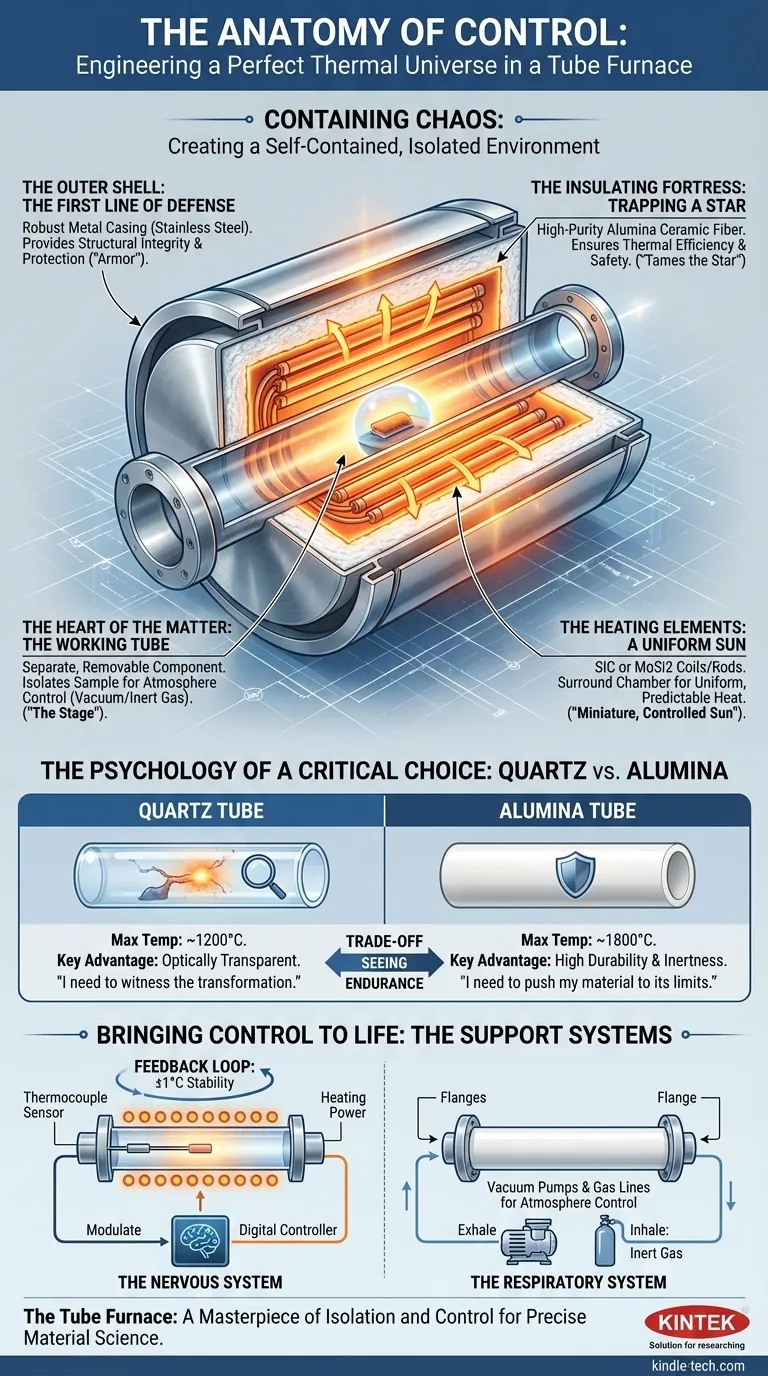
H3: The Outer Shell: The First Line of Defense
The outermost layer is a robust metal casing, usually stainless steel. Its job is simple but critical: provide structural integrity and protect the delicate internal components from the bumps, spills, and corrosive nature of a lab environment.
It is the armor. It doesn't participate in the heating, but without it, the entire system would be compromised.
H3: The Insulating Fortress: Trapping a Star
Inside the shell lies a thick wall of high-purity alumina ceramic fiber. This is not just insulation; it's a thermal fortress.
Its purpose is twofold. First, it ensures staggering efficiency by preventing the immense energy generated within from bleeding out into the lab. This keeps operational costs down and heating rates high.
Second, it’s a matter of safety. While the core may be glowing at 1700°C, the outer shell remains cool enough to touch. The insulation tames the star burning at its center.
H3: The Heating Elements: A Uniform Sun
Nestled within this fortress are the heating elements themselves—often coils or rods of silicon carbide (SiC) or molybdenum disilicide (MoSi2).
Their design is not accidental. They are arranged to completely encircle the central chamber, ensuring that heat is applied uniformly from all directions. This avoids "hot spots" and guarantees that a sample placed in the center experiences a consistent, predictable thermal environment. They are the furnace's miniature, perfectly controlled sun.
The Heart of the Matter: The Working Tube
At the very center of this layered system is the working tube. This is the stage where the actual science happens.
Crucially, the tube is a separate, removable component. It slides through the center of the heating chamber, isolating the sample from direct contact with the heating elements and insulation. This brilliant separation is what allows a researcher to control the atmosphere. By sealing the ends of the tube, one can pull a vacuum or introduce a perfectly pure, inert gas like argon.
The sample doesn't just get hot; it gets hot in the exact environment you have designed for it.
The Psychology of a Critical Choice: Quartz vs. Alumina
The material of this central tube is perhaps the most significant decision a researcher makes. It represents a fundamental trade-off between two different scientific priorities: the need to see versus the need to endure.
| Tube Material | Max Temperature (Typical) | Key Advantage | The Psychological Choice |
|---|---|---|---|
| Quartz | ~1200°C | Optically transparent | "I need to witness the transformation as it happens." |
| Alumina | ~1800°C | High thermal durability & inertness | "I need to push my material to its absolute limits." |
H3: The Case for Seeing: Quartz
A quartz tube is a window into the reaction. It allows you to visually monitor for melting, color changes, or sintering in real-time. This is invaluable for process development and for materials that undergo visible transformations. The choice for quartz is a choice for direct, empirical observation.
H3: The Case for Endurance: Alumina
An alumina ceramic tube is opaque. It hides the process from view. In exchange, it offers access to much higher temperatures and superior chemical resistance. The choice for alumina is an act of faith in your instruments and your process—a belief that the data from your controller and thermocouple is enough to guide you to the desired outcome at extreme conditions.
Bringing Control to Life: The Support Systems
The furnace body is a masterpiece of passive design, but it requires an active brain and lungs to function.
-
The Nervous System: A thermocouple acts as a nerve ending, constantly sensing the temperature at the tube's surface. It feeds this data to a digital controller—the brain—which modulates power to the heating elements. This constant feedback loop is what allows for a temperature stability of ±1°C.
-
The Respiratory System: Flanges and fittings on the ends of the tube connect to vacuum pumps and gas lines. This is the system's respiratory tract, allowing it to "exhale" atmospheric air and "inhale" a precisely controlled gas mixture.
Ultimately, the physical structure of a tube furnace is a testament to an engineer's obsession with control. Every layer, every material, and every component is chosen to create a stable, predictable, and isolated environment, empowering researchers to conduct their work with precision. Selecting the right combination of these components is crucial for success.
At KINTEK, we provide the tools to build your perfect experimental universe, from high-purity alumina tube furnaces for high-temperature synthesis to quartz systems for visual process analysis. Contact Our Experts
Visual Guide
Related Products
- Rotary Tube Furnace Split Multi Heating Zone Rotating Tube Furnace
- Laboratory Vacuum Tilt Rotary Tube Furnace Rotating Tube Furnace
- 1200℃ Split Tube Furnace with Quartz Tube Laboratory Tubular Furnace
- 1400℃ Laboratory High Temperature Tube Furnace with Alumina Tube
- 1700℃ Laboratory High Temperature Tube Furnace with Alumina Tube
Related Articles
- The Geometry of Heat: Why Motion Matters in Material Synthesis
- Exploring the Advantages of Rotary Tube Furnaces in Industrial and Laboratory Applications
- The Geometry of Heat: Engineering the Perfect Thermal Environment
- Exploring the Functions and Advantages of Rotary Tube Furnaces
- Exploring Rotary Tube Furnaces: A Comprehensive Guide



















