The High Stakes of a Single Degree
Imagine a materials scientist carefully cultivating a single crystal. Weeks of work have led to this final stage: a slow, meticulously controlled cooling process inside a tube furnace. A deviation of just a few degrees—a slight overshoot—could introduce imperfections, rendering the entire sample useless.
This isn't just about getting something hot. It's about commanding temperature with absolute authority.
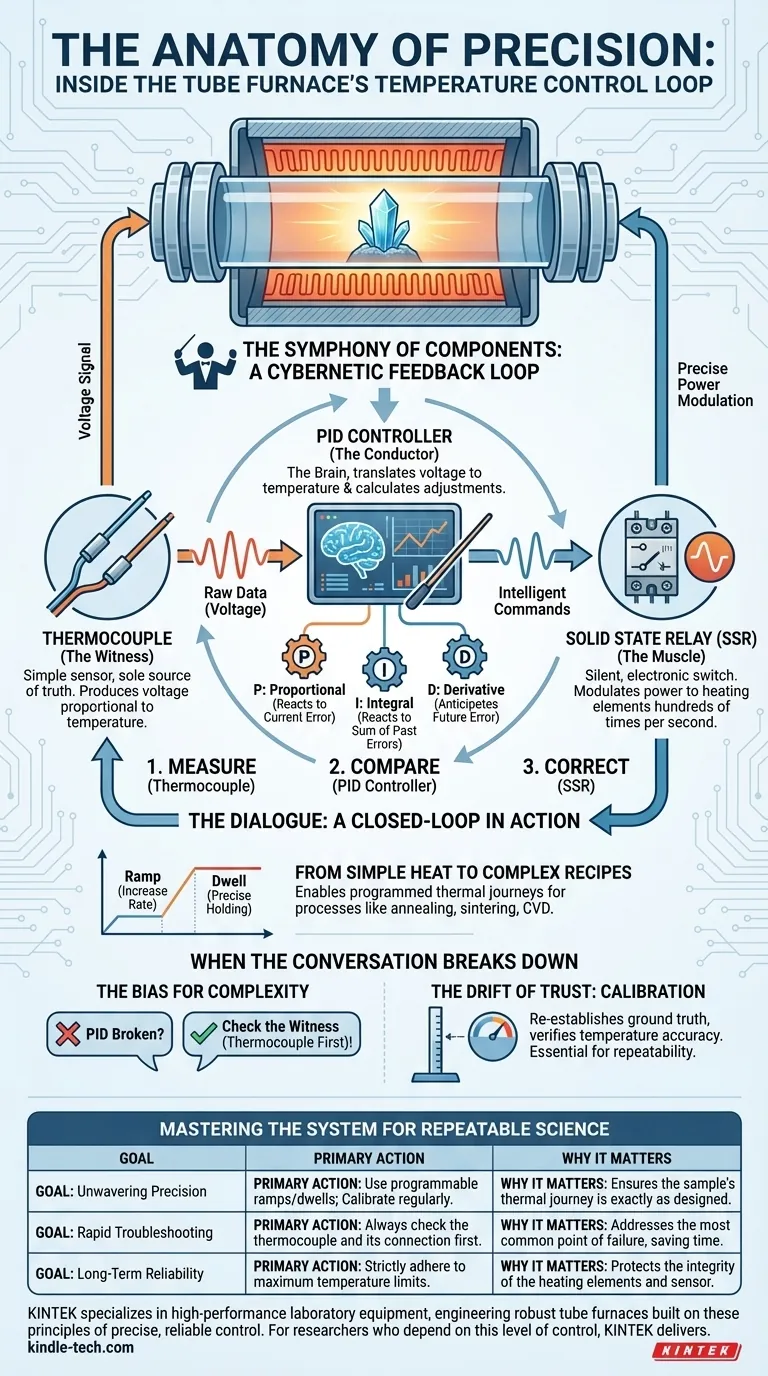
This level of control doesn't come from a single, powerful component. It arises from an elegant, high-speed dialogue between three parts working in perfect harmony. It's a cybernetic system—a continuous feedback loop that measures, compares, and corrects, ensuring the reality inside the furnace precisely matches the user's intent.
The Symphony of Components
Think of the furnace's temperature control system as a small, dedicated orchestra. Each member has a distinct role, and the final performance—stable, accurate temperature—depends on their flawless coordination.
The Witness: The Thermocouple
The thermocouple is the system's sole source of truth. It's a simple sensor, constructed from two dissimilar metals joined at a single point. When heated, this junction produces a tiny voltage directly proportional to the temperature.
This voltage is the raw, unfiltered data from the front lines. Psychologically, we must trust this witness completely. If it's damaged, misplaced, or its signal is noisy, the entire system is operating on flawed intelligence, no matter how sophisticated the other components are.
The Conductor: The PID Controller
The PID (Proportional-Integral-Derivative) controller is the brain, the conductor of the symphony. It receives the thermocouple's voltage signal and translates it into a temperature reading.
But it does far more than a simple on/off thermostat. The PID algorithm is a model of foresight:
- Proportional: It reacts to the current error.
- Integral: It reacts to the sum of past errors, eliminating steady-state drift.
- Derivative: It anticipates future error by reacting to the rate of temperature change.
This allows the controller to make smooth, intelligent adjustments, preventing the overshoots and undershoots that plague simpler systems. It learns the furnace's thermal inertia—how fast it heats and cools—and adapts its commands accordingly.
The Muscle: The Solid State Relay (SSR)
The PID controller's decisions would be meaningless without a way to execute them. The Solid State Relay (SSR) is the silent, responsive muscle that carries out the conductor's commands.
As an electronic switch with no moving parts, the SSR can modulate power to the furnace's heating elements hundreds of times per second. This speed is what allows the PID's nuanced calculations to translate into incredibly fine-tuned energy delivery.
The Dialogue: A Closed-Loop in Action
These three components are locked in a perpetual, self-correcting conversation.
- Measure: The thermocouple reports the current temperature.
- Compare: The PID controller analyzes the difference between this report and the desired setpoint.
- Correct: The controller calculates the precise power adjustment needed and instructs the SSR.
This cycle repeats relentlessly, forming a closed-loop system that is constantly vigilant. This ceaseless dialogue is the hallmark of a high-quality laboratory furnace, like those engineered by KINTEK, where reliable thermal processing is the foundation of repeatable science.
From Simple Heat to Complex Recipes
This dynamic control loop is what enables complex thermal profiles. Scientists can program:
- Ramps: Specific rates of temperature increase or decrease.
- Dwells: Precise holding times at a target temperature.
The furnace isn't just maintaining a setpoint; it's guiding a sample through a pre-determined thermal journey. For processes like annealing, sintering, or chemical vapor deposition, the history of the temperature is as important as the final temperature itself.
When the Conversation Breaks Down
Even the most elegant systems can face issues. A psychological approach to troubleshooting—understanding our own biases—is often the quickest path to a solution.
The Bias for Complexity
When temperature becomes unstable, our minds often jump to the most complex component: "The PID controller must be broken." This is a cognitive shortcut that is usually wrong.
The most rational first step is to question the source of information. Check the witness. Is the thermocouple securely connected? Is it positioned correctly? Has the wire become frayed or damaged? More often than not, the problem lies with the simple sensor, not the complex brain.
The Drift of Trust: The Role of Calibration
Over time, even the best systems can drift. Thermal cycling can subtly alter a thermocouple's voltage response. Calibration is the act of re-establishing ground truth. It's the process of verifying that the temperature displayed on the controller is a true reflection of the physical reality inside the furnace tube. For any work requiring certification or strict repeatability, periodic calibration isn't just good practice; it's essential for maintaining trust in your results.
Mastering the System for Repeatable Science
Achieving mastery over your thermal processes means understanding this system's logic. Your goals should dictate your operational focus.
| Goal | Primary Action | Why It Matters |
|---|---|---|
| Unwavering Precision | Use programmable ramps/dwells; Calibrate regularly. | Ensures the sample's thermal journey is exactly as designed. |
| Rapid Troubleshooting | Always check the thermocouple and its connection first. | Addresses the most common point of failure, saving time and cost. |
| Long-Term Reliability | Strictly adhere to the furnace's maximum temperature limits. | Protects the integrity of the heating elements and the sensor. |
Understanding this intricate dialogue between sensor, controller, and relay is the key to unlocking the full potential of your tube furnace. It transforms the equipment from a simple heater into a precision instrument for discovery and innovation. For researchers who depend on this level of control, the quality and reliability of the equipment are paramount.
KINTEK specializes in high-performance laboratory equipment, engineering robust tube furnaces built on these principles of precise, reliable control. To ensure your results are accurate and repeatable, you need a system you can trust. Contact Our Experts to discuss your specific thermal processing needs.
Visual Guide
Related Products
- Rotary Tube Furnace Split Multi Heating Zone Rotating Tube Furnace
- Laboratory Vacuum Tilt Rotary Tube Furnace Rotating Tube Furnace
- 1200℃ Split Tube Furnace with Quartz Tube Laboratory Tubular Furnace
- 1400℃ Laboratory High Temperature Tube Furnace with Alumina Tube
- 1700℃ Laboratory High Temperature Tube Furnace with Alumina Tube
Related Articles
- The Geometry of Heat: Why Motion Matters in Material Synthesis
- Exploring the Functions and Advantages of Rotary Tube Furnaces
- Exploring the Benefits and Applications of Rotary Furnaces: A Comprehensive Guide
- The Physics of Perfection: How Rotary Furnaces Eliminate Randomness in Material Processing
- The Geometry of Heat: Engineering the Perfect Thermal Environment



















