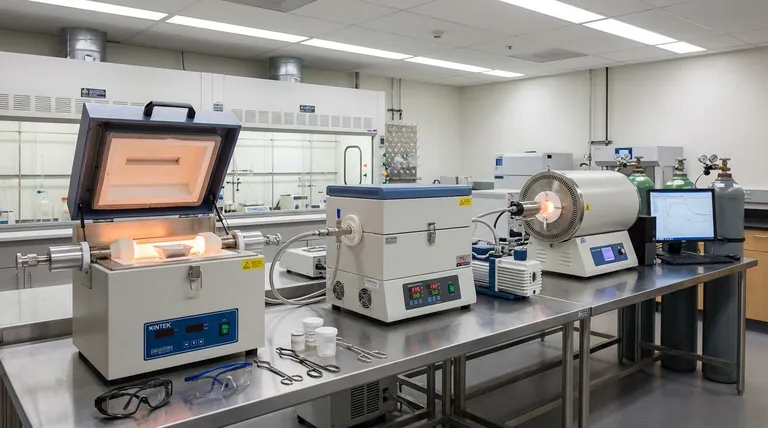
The difference between heating and processing
There is a fundamental difference in materials science between making something hot and controlling its thermal environment.
A standard oven heats the air. It is a blunt instrument. It works through convection and radiation, but it accepts the chaos of the surrounding atmosphere. For many tasks, this is fine.
But for advanced materials research, "fine" is a failure.
If you are synthesizing a new superconductor or growing a crystal, oxygen is often the enemy. A temperature fluctuation of five degrees is a disaster.
This is where the tube furnace enters the equation. It is not designed for volume; it is designed for isolation. It is the engineer’s answer to the problem of chaotic variables.
The Geometry of Consistency
The first thing you notice about a tube furnace is the shape. It isn't a stylistic choice.
In a square box furnace, corners create thermal shadows. Heat distribution becomes uneven.
A tube furnace uses a cylindrical chamber—usually ceramic or quartz—surrounded by heating elements. Geometrically, this ensures that heat radiates toward the center from all directions equally.
The result is a uniform hot zone.
When your sample sits in this zone, every micron of the material experiences the exact same thermal history. This consistency allows for rapid heat-up and cool-down cycles without the risk of thermal shock that plagues less precise equipment.
The Sanctity of the Atmosphere
The true romance of the tube furnace, however, lies in what isn't there.
The defining feature of this equipment is the sealed tube. It allows you to divorce your sample from the laboratory air. By connecting a vacuum pump or a gas delivery system, you create a micro-world governed entirely by your own rules.
This capability is non-negotiable for specific applications:
- Vacuum: You remove reactive gases to prevent oxidation.
- Inert Gas: You flow nitrogen or argon to create a neutral shield.
- Reactive Gas: You introduce precise chemical vapors for Chemical Vapor Deposition (CVD).
In this sealed environment, you aren't just heating a material; you are purifying it. You are defining the atomic landscape it lives in.
Orchestrating Temperature: Zonal Heating
Standard heating treats temperature as a flat line. You set it to 1000°C, and you want the whole chamber to be 1000°C.
Advanced tube furnaces allow you to play a different game.
By utilizing multi-zone heating, these furnaces can maintain different temperatures along the length of the tube. You can create a precise gradient—hot at one end, cooler at the other.
This is essential for crystal growth and chemical transport reactions, where the material must migrate from a hot zone to a cold zone to deposit correctly. It turns temperature into a vehicle for movement, not just a state of energy.
Gravity and Orientation: The Vertical vs. Horizontal Choice
Most tube furnaces are horizontal. They are the workhorses. They are easy to load, excellent for batch processing, and ideal for general annealing or sintering.
But sometimes, gravity fights you.
If a sample is delicate, or if you are working with powders that might spread unevenly, a vertical furnace uses gravity as an ally. It is the preferred orientation for:
- Pyrolysis (Thermal Decomposition): Allowing off-gases to rise naturally.
- Quench Experiments: Dropping a heated sample directly into a cooling medium below.
- Vertical Alignment: For tests requiring specific geometric orientation relative to gravity.
The Trade-off: When Not to Use a Tube Furnace
Psychologically, we are drawn to the most precise tool. We want the "best" one. But in engineering, "best" is relative to the constraint.
Tube furnaces have clear limitations that you must respect:
- Size: The diameter of the tube is a hard physical limit. You cannot process large, bulky parts.
- Throughput: These are batch processing tools. They are not conveyor belts.
- Complexity: The systems that give you control—gas mixing, vacuum seals—require maintenance and expertise.
If your goal is simply to harden a large steel gear, a tube furnace is the wrong tool. It is too expensive and too small. A box furnace is better.
But if your goal is the synthesis of a nano-material where a single molecule of oxygen ruins the batch, the tube furnace is the only tool.
Summary: The Decision Matrix
To simplify the selection process, consider the primary driver of your experiment:
| If your priority is... | The Ideal Solution | Why? |
|---|---|---|
| Material Purity / CVD | Tube Furnace (Sealed) | Absolute atmospheric control (Vacuum/Inert gas). |
| Complex Synthesis | Multi-Zone Tube Furnace | Creates precise temperature gradients for transport. |
| General Heat Treatment | Horizontal Tube Furnace | Balances uniformity with ease of loading. |
| Throughput / Large Parts | Box Furnace | Cost-effective for larger volumes and geometries. |
The KINTEK Solution
At KINTEK, we understand that you aren't buying a furnace; you are buying a controlled environment.
Whether you are pushing the boundaries of materials science with CVD or conducting routine thermocouple calibrations, our tube furnaces are engineered to provide the thermal uniformity and atmospheric integrity your data requires. We build the architecture of control so you can focus on the discovery.
Don't settle for "hot enough." precise control is within reach.
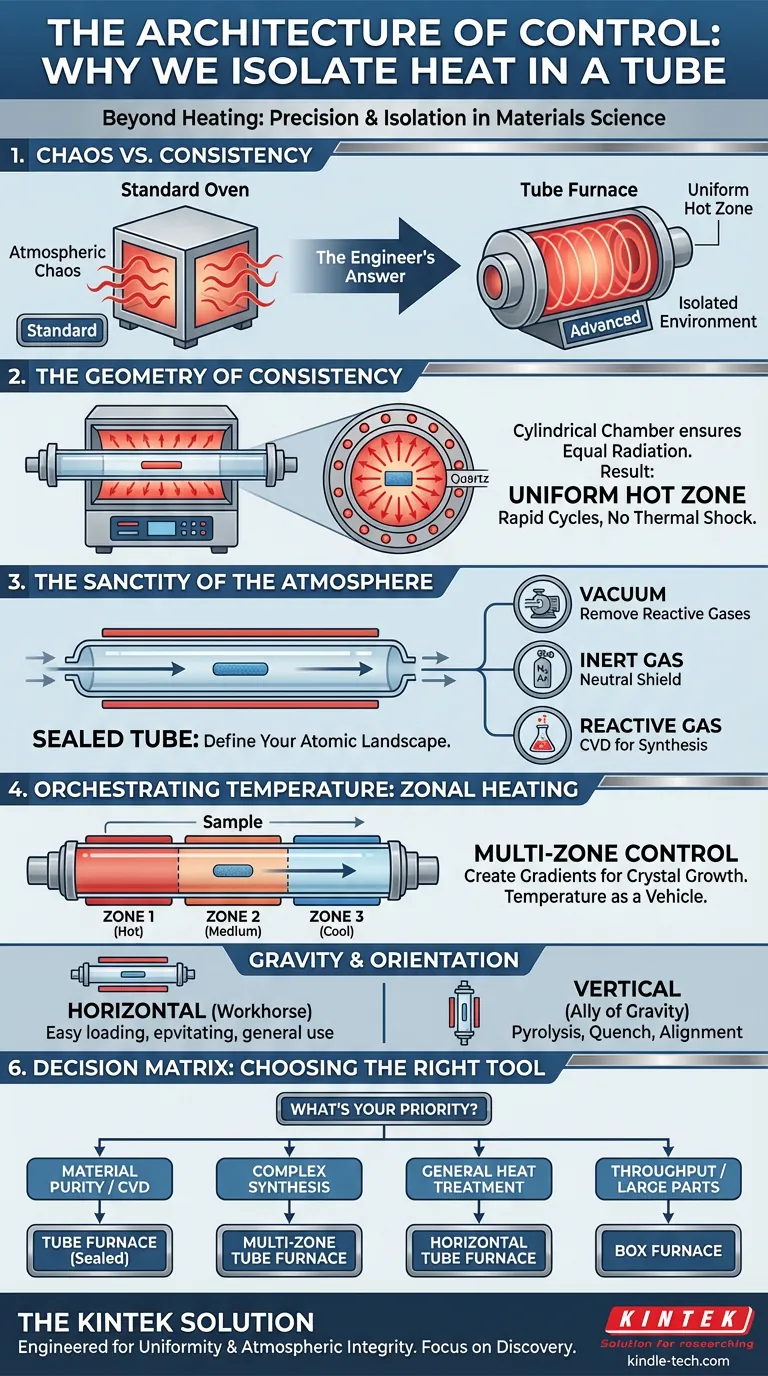
Visual Guide
Related Products
- Rotary Tube Furnace Split Multi Heating Zone Rotating Tube Furnace
- Laboratory Vacuum Tilt Rotary Tube Furnace Rotating Tube Furnace
- 1200℃ Split Tube Furnace with Quartz Tube Laboratory Tubular Furnace
- 1400℃ Laboratory High Temperature Tube Furnace with Alumina Tube
- 1700℃ Laboratory High Temperature Tube Furnace with Alumina Tube
Related Articles
- The Geometry of Heat: Why Motion Matters in Material Synthesis
- Exploring the Advantages of Rotary Tube Furnaces in Industrial and Laboratory Applications
- The Geometry of Heat: Engineering the Perfect Thermal Environment
- Exploring the Functions and Advantages of Rotary Tube Furnaces
- Exploring Rotary Tube Furnaces: A Comprehensive Guide



















