Blog The Art of the Void: Mastering Vacuum Furnace Leak Detection
The Art of the Void: Mastering Vacuum Furnace Leak Detection

The Art of the Void: Mastering Vacuum Furnace Leak Detection

2 weeks ago

The Invisible Enemy of Precision

In the world of material science, nothing is perfect. But the vacuum furnace attempts to get closer than anything else.

Its primary function is not just to heat, but to exclude. It creates a sanctuary where atmospheric chaos—oxygen, nitrogen, moisture—cannot enter. When that sanctuary is breached, you don’t just lose vacuum pressure. You lose the integrity of your experiment.

Entropy is always knocking at the door.

A leak is rarely catastrophic in a dramatic, explosive sense. Instead, it is a silent thief. It steals repeatability. It oxidizes high-value alloys. It creates "ghost" results that send researchers down the wrong path for weeks.

To maintain the purity of the void, we must adopt a mindset that is part detective, part doctor. We need a systemic protocol for diagnosis.

The Cost of a Compromised Seal

Why do we obsess over leaks? Because the atmosphere is chemically aggressive.

When air enters a vacuum chamber, it isn't just "filling space." It is reacting.

Contamination: Oxygen reacts with metals at high temperatures. Discoloration is the visual symptom; structural weakness is the hidden disease.

Inconsistency: If your leak rate fluctuates, your process baseline shifts. You cannot claim scientific repeatability if your environment changes from Tuesday to Wednesday.

Equipment Suicide: In severe cases, poor vacuum leads to electrical arcing between heating elements. This isn't just a bad data day; it’s a capital expense disaster.

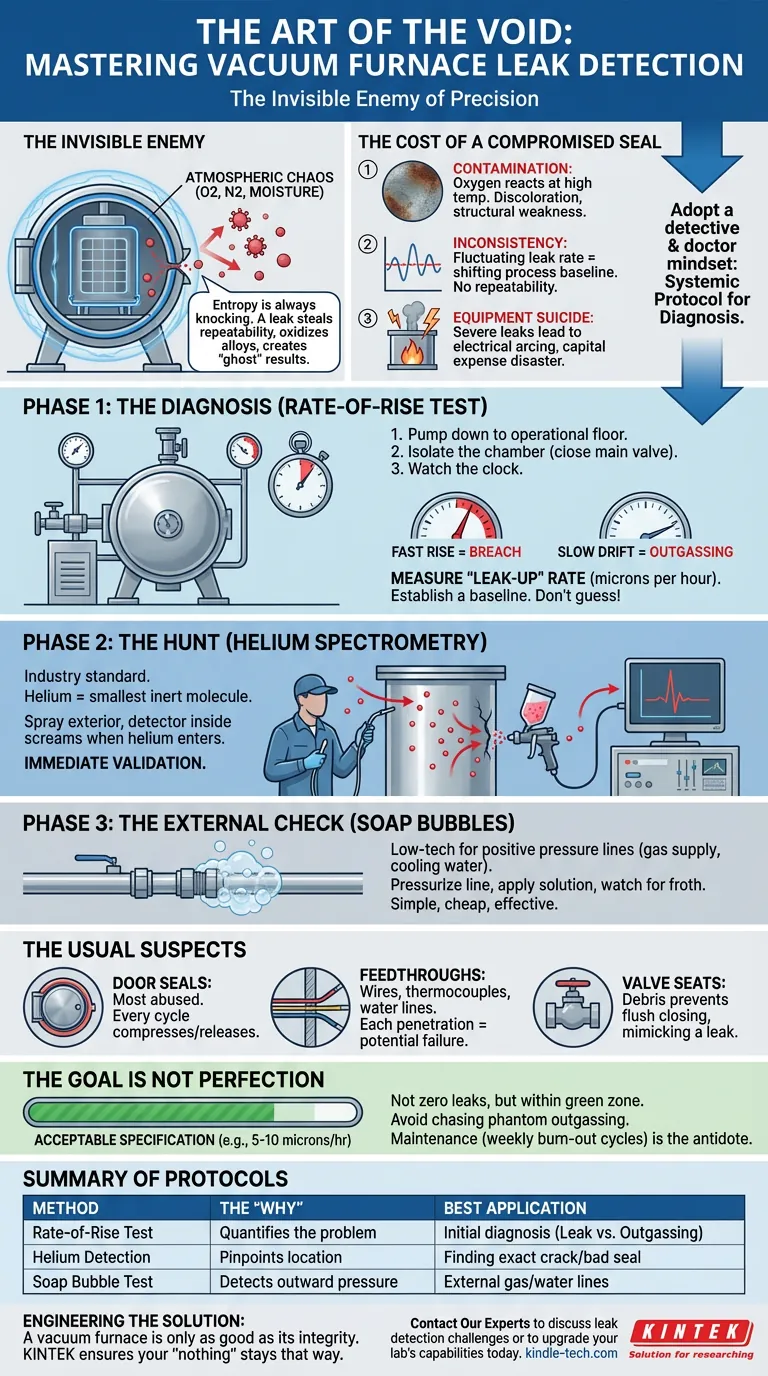
Phase 1: The Diagnosis (Rate-of-Rise)

Before you attempt to fix a problem, you must quantify it.

Many operators skip this step. They suspect a leak and immediately start tightening bolts. This is a mistake. You need a baseline. You need the Rate-of-Rise (ROR) test.

The logic is simple:

  1. Pump the furnace down to its operational floor.
  2. Isolate the chamber (close the main valve).
  3. Watch the clock.

You are measuring the "leak-up" rate. Pressure will rise—that is physics. But how fast is it rising?

If the pressure spikes within minutes, you have a breach. If it drifts slowly over an hour, you may just have outgassing. The ROR test gives you a number (microns per hour). Without this number, you are guessing.

Phase 2: The Hunt (Helium Spectrometry)

Once the ROR test confirms the enemy is inside the gates, you must find where they entered.

The industry standard is the Helium Mass Spectrometer. It is elegant in its precision.

Helium is the smallest inert molecule we can easily use. It can wiggle through gaps that water or nitrogen cannot. By attaching a detector to the vacuum system and spraying helium on the exterior of the furnace, we wait.

If helium flows through a microscopic crack in a weld or an O-ring, the spectrometer screams. It is immediate validation.

Phase 3: The External Check (Soap Bubbles)

Do not despise low-tech solutions. They have their place.

Helium finds leaks into the vacuum. But what about the pressurized lines feeding the system?

Gas supply lines and cooling water fittings are under positive pressure. Helium won't help here. For these, the classic "soap bubble" test remains king. Pressurize the line, apply the solution, and watch for the tell-tale froth.

It is simple, cheap, and effective.

The Usual Suspects

Where do leaks happen? Usually, right where human hands have touched the machine.

Entropy attacks the interfaces. When troubleshooting, start here:

  • Door Seals: The most abused part of the furnace. Every cycle compresses and releases this O-ring.
  • Feedthroughs: Every wire, every thermocouple, every water line that enters the chamber requires a penetration. Each one is a potential failure point.
  • Valve Seats: Debris can prevent a valve from closing flush, mimicking a leak.

The Goal is Not Perfection

There is a psychological trap in leak testing: the desire for zero.

No furnace is hermetically sealed forever. The goal is not a perfect seal; the goal is an acceptable specification.

Manufacturers define a "leak-up rate" tolerance (e.g., 5-10 microns per hour). As long as you are within this green zone, your process is safe. Do not waste days chasing a phantom leak that is actually just normal outgassing.

Maintenance is the antidote. Weekly "burn-out" cycles (high heat, high vacuum) help vaporize contaminants that mimic leaks.

Summary of Protocols

Method The "Why" Best Application
Rate-of-Rise Test Quantifies the problem. Initial diagnosis. Is it a leak or outgassing?
Helium Detection Pinpoints the location. Finding the exact crack or bad seal.
Soap Bubble Test detects outward pressure. Checking external gas and water lines.

Engineering the Solution

A vacuum furnace is only as good as its integrity. When you control the atmosphere, you control the material properties.

At KINTEK, we understand that lab equipment is the foundation of discovery. Whether you are dealing with complex metallurgy or routine heat treatment, the reliability of your seals determines the reliability of your data.

We specialize in high-performance lab equipment and the consumables required to keep them running. From O-rings to expert advice on vacuum integrity, we are here to ensure your "nothing" stays that way.

Contact Our Experts to discuss your leak detection challenges or to upgrade your lab's capabilities today.

Visual Guide
The Art of the Void: Mastering Vacuum Furnace Leak Detection Visual Guide

Related Products

Related Articles

Related Products

Small Vacuum Heat Treat and Tungsten Wire Sintering Furnace

Small Vacuum Heat Treat and Tungsten Wire Sintering Furnace

The small vacuum tungsten wire sintering furnace is a compact experimental vacuum furnace specially designed for universities and scientific research institutes. The furnace features a CNC welded shell and vacuum piping to ensure leak-free operation. Quick-connect electrical connections facilitate relocation and debugging, and the standard electrical control cabinet is safe and convenient to operate.

Laboratory Vacuum Tilt Rotary Tube Furnace Rotating Tube Furnace

Laboratory Vacuum Tilt Rotary Tube Furnace Rotating Tube Furnace

Discover the versatility of Laboratory Rotary Furnace: Ideal for calcination, drying, sintering, and high-temperature reactions. Adjustable rotating and tilting functions for optimal heating. Suitable for vacuum and controlled atmosphere environments. Learn more now!

Vacuum Heat Treat Sintering Brazing Furnace

Vacuum Heat Treat Sintering Brazing Furnace

A vacuum brazing furnace is a type of industrial furnace used for brazing, a metalworking process that joins two pieces of metal using a filler metal that melts at a lower temperature than the base metals. Vacuum brazing furnaces are typically used for high-quality applications where a strong, clean joint is required.

Graphite Vacuum Furnace Bottom Discharge Graphitization Furnace for Carbon Materials

Graphite Vacuum Furnace Bottom Discharge Graphitization Furnace for Carbon Materials

Bottom-out graphitization furnace for carbon materials, ultra-high temperature furnace up to 3100°C, suitable for graphitization and sintering of carbon rods and carbon blocks. Vertical design, bottom discharging, convenient feeding and discharging, high temperature uniformity, low energy consumption, good stability, hydraulic lifting system, convenient loading and unloading.

Molybdenum Vacuum Heat Treat Furnace

Molybdenum Vacuum Heat Treat Furnace

Discover the benefits of a high-configuration molybdenum vacuum furnace with heat shield insulation. Ideal for high-purity, vacuum environments like sapphire crystal growth and heat treatment.

Vacuum Heat Treat Furnace with Ceramic Fiber Liner

Vacuum Heat Treat Furnace with Ceramic Fiber Liner

Vacuum furnace with polycrystalline ceramic fiber insulation liner for excellent heat insulation and uniform temperature field. Choose from 1200℃ or 1700℃ max. working temperature with high vacuum performance and precise temperature control.

Graphite Vacuum Furnace High Thermal Conductivity Film Graphitization Furnace

Graphite Vacuum Furnace High Thermal Conductivity Film Graphitization Furnace

The high thermal conductivity film graphitization furnace has uniform temperature, low energy consumption and can operate continuously.

Vacuum Sealed Continuous Working Rotary Tube Furnace Rotating Tube Furnace

Vacuum Sealed Continuous Working Rotary Tube Furnace Rotating Tube Furnace

Experience efficient material processing with our vacuum-sealed rotary tube furnace. Perfect for experiments or industrial production, equipped with optional features for controlled feeding and optimized results. Order now.

1200℃ Controlled Atmosphere Furnace Nitrogen Inert Atmosphere Furnace

1200℃ Controlled Atmosphere Furnace Nitrogen Inert Atmosphere Furnace

Discover our KT-12A Pro Controlled atmosphere furnace - high precision, heavy duty vacuum chamber, versatile smart touch screen controller, and excellent temperature uniformity up to 1200C. Ideal for both laboratory and industrial application.

Ultra-High Temperature Graphite Vacuum Graphitization Furnace

Ultra-High Temperature Graphite Vacuum Graphitization Furnace

The ultra-high temperature graphitization furnace utilizes medium frequency induction heating in a vacuum or inert gas environment. The induction coil generates an alternating magnetic field, inducing eddy currents in the graphite crucible, which heats up and radiates heat to the workpiece, bringing it to the desired temperature. This furnace is primarily used for graphitization and sintering of carbon materials, carbon fiber materials, and other composite materials.

Horizontal High Temperature Graphite Vacuum Graphitization Furnace

Horizontal High Temperature Graphite Vacuum Graphitization Furnace

Horizontal Graphitization Furnace: This type of furnace is designed with the heating elements placed horizontally, allowing for uniform heating of the sample. It's well-suited for graphitizing large or bulky samples that require precise temperature control and uniformity.

Graphite Vacuum Furnace Negative Material Graphitization Furnace

Graphite Vacuum Furnace Negative Material Graphitization Furnace

Graphitization furnace for battery production has uniform temperature and low energy consumption. Graphitization furnace for negative electrode materials: an efficient graphitization solution for battery production and advanced functions to enhance battery performance.

2200 ℃ Graphite Vacuum Heat Treat Furnace

2200 ℃ Graphite Vacuum Heat Treat Furnace

Discover the power of the KT-VG Graphite Vacuum Furnace - with a maximum working temperature of 2200℃, it's perfect for vacuum sintering of various materials. Learn more now.

Vacuum Heat Treat Furnace and Levitation Induction Melting Furnace

Vacuum Heat Treat Furnace and Levitation Induction Melting Furnace

Experience precise melting with our Vacuum Levitation Melting Furnace. Ideal for high melting point metals or alloys, with advanced technology for effective smelting. Order now for high-quality results.

Vacuum Hot Press Furnace Machine for Lamination and Heating

Vacuum Hot Press Furnace Machine for Lamination and Heating

Experience clean and precise lamination with Vacuum Lamination Press. Perfect for wafer bonding, thin-film transformations, and LCP lamination. Order now!

Dental Porcelain Zirconia Sintering Ceramic Vacuum Press Furnace

Dental Porcelain Zirconia Sintering Ceramic Vacuum Press Furnace

Get precise dental results with Dental Vacuum Press Furnace. Automatic temperature calibration, low noise tray, and touch screen operation. Order now!

Sub-Lance Probe for Molten Steel Temperature Carbon Content Oxygen Content Measurement and Steel Sample Collection

Sub-Lance Probe for Molten Steel Temperature Carbon Content Oxygen Content Measurement and Steel Sample Collection

Optimize steelmaking with sub-lance probes for precise temperature, carbon, and oxygen measurements. Enhance efficiency and quality in real-time.

Custom PTFE Teflon Parts Manufacturer for PTFE Mesh F4 Sieve

Custom PTFE Teflon Parts Manufacturer for PTFE Mesh F4 Sieve

PTFE mesh sieve is a specialized test sieve designed for particle analysis in various industries, featuring a non-metallic mesh woven from PTFE filament. This synthetic mesh is ideal for applications where metal contamination is a concern . PTFE sieves are crucial for maintaining the integrity of samples in sensitive environments, ensuring accurate and reliable results in particle size distribution analysis.

Square Lab Press Mold for Laboratory Applications

Square Lab Press Mold for Laboratory Applications

Create uniform samples easily with Square Lab Press Mold - available in various sizes. Ideal for battery, cement, ceramics, and more. Custom sizes available.

Oxygen Probe to Measure Temperature and Active Oxygen Content in Molten Steel

Oxygen Probe to Measure Temperature and Active Oxygen Content in Molten Steel

Optimize steelmaking with our high-accuracy oxygen probe. Fast, reliable, and essential for precise oxygen and temperature control. Enhance quality and efficiency today.


Leave Your Message