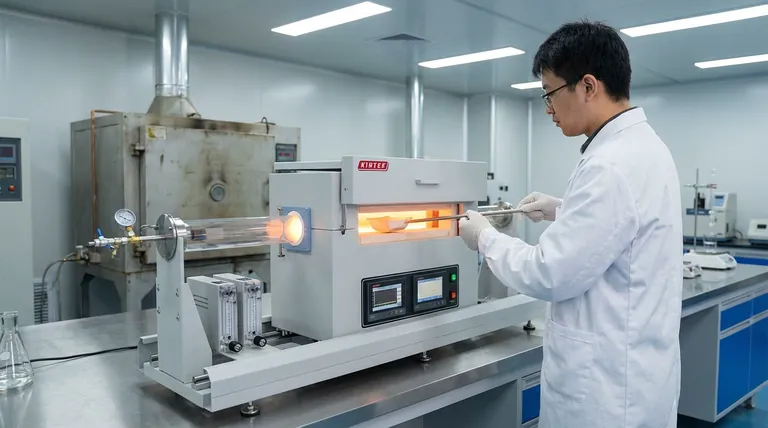
Blog The Geometry of Control: Why the Tube Furnace is the Engineer’s Scalpel
The Geometry of Control: Why the Tube Furnace is the Engineer’s Scalpel

The Geometry of Control: Why the Tube Furnace is the Engineer’s Scalpel

4 hours ago

Making things hot is easy. Any resistance coil and a power source can generate heat.

Making things hot exactly the same way twice is incredibly difficult.

In the world of material science and chemical engineering, heat is not just a utility; it is a variable. If that variable fluctuates—if the temperature at the center of your sample differs from the temperature at the edge by even a few degrees—your data is compromised. Uncertainty is the enemy of the laboratory.

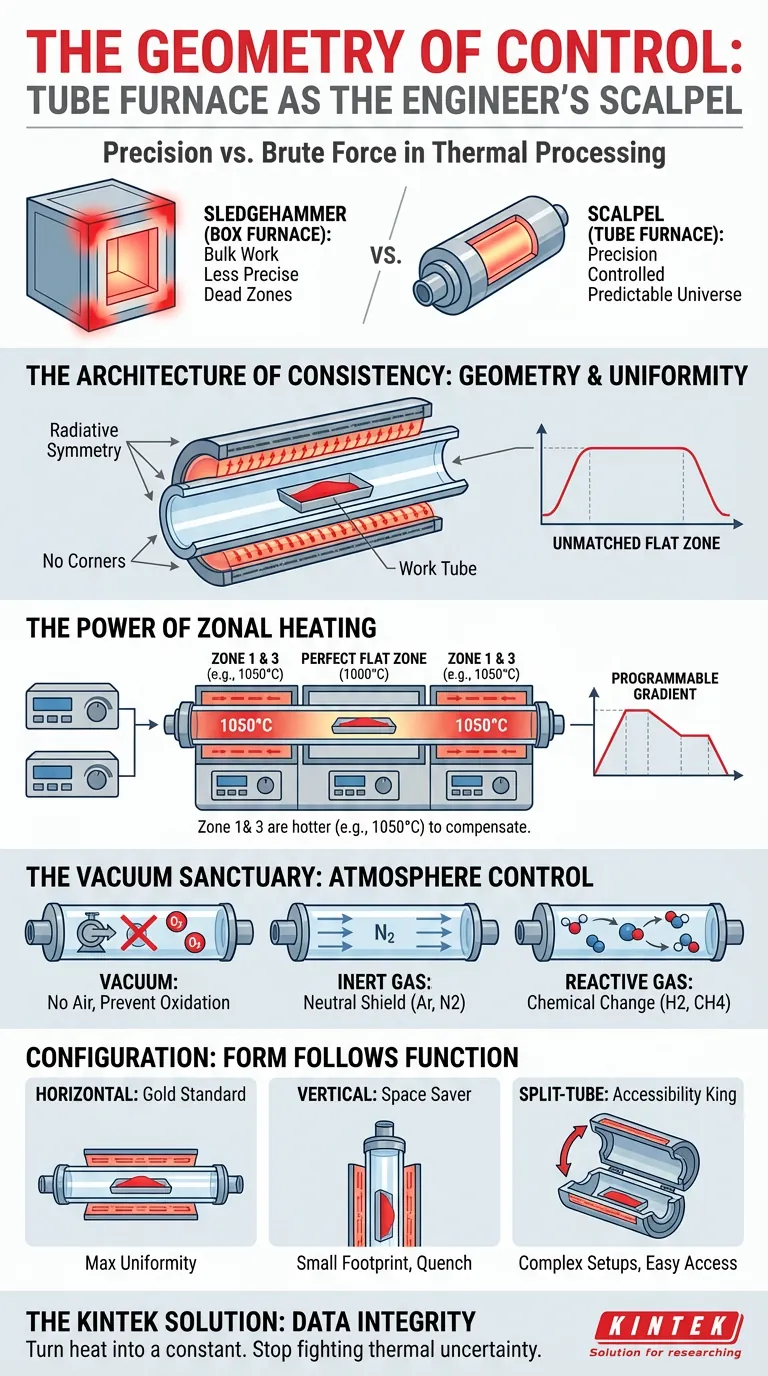
The standard box furnace is the sledgehammer of the thermal world. It is powerful, spacious, and effective for bulk work. But when precision is non-negotiable, you need a scalpel.

Enter the tube furnace. Its value isn't just that it gets hot; it is that it creates a predictable, isolated universe for your sample.

The Architecture of Consistency

The primary struggle in thermal processing is uniformity.

In a square box, corners trap heat or create cold spots (dead zones). Air currents behave chaotically.

The tube furnace solves this through geometry. By arranging heating elements around a cylindrical work tube, it creates a symmetrical thermal environment. There are no corners. Radiative heat transfer is equal from all sides.

This creates an unmatched flat zone—a specific length within the tube where the temperature is constant.

The Power of Zonal Heating

Modern engineering takes this a step further with multi-zone heating.

Imagine dividing the tube into three or five distinct sections, each with its own controller. You can program the ends to run hotter to compensate for heat loss, extending the length of your perfect flat zone.

Or, you can do something more romantic: you can create a deliberate gradient. You can force a material to melt at one end and recrystallize at the other. This level of control allows you to "paint" with temperature.

The Vacuum Sanctuary

The second struggle in the lab is contamination.

Oxygen is chemically aggressive. At high temperatures, it ruins samples, oxidizes metals, and skews results.

A box furnace is difficult to seal perfectly. A tube furnace, by design, is a pressure vessel.

Because the work tube is physically distinct from the heating elements, you can hermetically seal the ends. This turns the tube into a sanctuary.

  • Vacuum: Remove the air entirely to prevent oxidation.
  • Inert Gas: Flood the tube with Argon or Nitrogen to create a neutral shield.
  • Reactive Gas: Introduce Hydrogen or Methane to induce specific chemical changes.

You are not just controlling the temperature; you are controlling the atmosphere.

Configuration: Form Follows Function

The "tube furnace" is a category, not a single device. The orientation you choose dictates what you can achieve.

1. Horizontal: The Gold Standard

This is the default for a reason. Gravity works with you to keep the sample centered in the hot zone.

  • Best for: Maximum thermal uniformity.
  • Use case: Thermally sensitive parts and long-duration synthesis.

2. Vertical: The Space Saver

Floorspace in a lab is expensive real estate. A vertical furnace minimizes the footprint.

  • Best for: Compact labs and batch processing.
  • Use case: Top-loading samples or quench testing (dropping a sample directly from the hot zone into a cooling medium).

3. Split-Tube: The Accessibility King

Standard tubes require you to slide the sample in from the end. But what if your reaction vessel has complex plumbing, large flanges, or wires attached? You can't thread it through.

  • Best for: Complex setups.
  • Use case: The furnace body is hinged. It opens like a clam shell, allowing you to place the reactor directly inside.

The Operational Reality

There is no free lunch in engineering. The precision of a tube furnace comes with trade-offs that must be managed.

Throughput is lower. You are usually placing samples in small "boats" and pushing them into the center with a rod. It is a manual, deliberate process. It is perfect for R&D, but harder to scale for mass production.

Tubes are consumables. Whether quartz, alumina, or silicon carbide, the tube faces the harshest conditions. It undergoes thermal shock and chemical attack. It will eventually fail, and it must be replaced.

Maintenance is mandatory. To maintain that perfect uniformity, insulation must be checked, and elements must be calibrated.

Summary: The Right Tool for the Job

If you are just burning off binder from a ceramic block, use a box furnace. But if you are growing crystals, sintering advanced ceramics, or testing thermocouples, the physics of the tube furnace are superior.

Feature The Engineering Benefit Ideal Application
Cylindrical Design Eliminates corner "dead zones" for radiative symmetry. High-precision material synthesis.
Sealed Work Tube Isolates sample from heating elements and outside air. Vacuum or inert gas processing.
Multi-Zone Control Extends the "flat zone" or creates programmable gradients. Thermal CVD or gradient testing.
Split Configuration Allows access to the heated length without threading. Complex reactors with fixed plumbing.

The KINTEK Solution

At KINTEK, we understand that you aren't just buying a heater; you are buying data integrity.

Whether you need the absolute precision of a horizontal multi-zone unit, the footprint efficiency of a vertical model, or the flexibility of a split-tube design, our equipment is built to turn the variable of heat into a constant.

We also supply the critical consumables—the boats, the tubes, and the fittings—that keep your process running.

Stop fighting with thermal uncertainty.

Contact Our Experts to discuss your specific temperature profiles and atmospheric requirements. Let’s build a reproducible environment for your best work.

Visual Guide
The Geometry of Control: Why the Tube Furnace is the Engineer’s Scalpel Visual Guide

Related Products

Related Articles

Related Products

Laboratory Rapid Thermal Processing (RTP) Quartz Tube Furnace

Laboratory Rapid Thermal Processing (RTP) Quartz Tube Furnace

Get lightning-fast heating with our RTP Rapid Heating Tube Furnace. Designed for precise, high-speed heating and cooling with convenient sliding rail and TFT touch screen controller. Order now for ideal thermal processing!

High Pressure Laboratory Vacuum Tube Furnace Quartz Tubular Furnace

High Pressure Laboratory Vacuum Tube Furnace Quartz Tubular Furnace

KT-PTF High Pressure Tube Furnace: Compact split tube furnace with strong positive pressure resistance. Working temp up to 1100°C and pressure up to 15Mpa. Also works under controller atmosphere or high vacuum.

1700℃ Laboratory High Temperature Tube Furnace with Alumina Tube

1700℃ Laboratory High Temperature Tube Furnace with Alumina Tube

Looking for a high-temperature tube furnace? Check out our 1700℃ Tube Furnace with Alumina Tube. Perfect for research and industrial applications up to 1700C.

1200℃ Split Tube Furnace with Quartz Tube Laboratory Tubular Furnace

1200℃ Split Tube Furnace with Quartz Tube Laboratory Tubular Furnace

KT-TF12 split tube furnace: high-purity insulation, embedded heating wire coils, and max. 1200C. Widely used for new materials and chemical vapour deposition.

1400℃ Laboratory High Temperature Tube Furnace with Alumina Tube

1400℃ Laboratory High Temperature Tube Furnace with Alumina Tube

Looking for a tube furnace for high-temperature applications? Our 1400℃ Tube Furnace with Alumina Tube is perfect for research and industrial use.

1800℃ Muffle Oven Furnace for Laboratory

1800℃ Muffle Oven Furnace for Laboratory

KT-18 muffle furnace with Japan Al2O3 polycrystalline fibe and Silicon Molybdenum heating element, up to 1900℃, PID temperature control and 7" smart touch screen. Compact design, low heat loss, and high energy efficiency. Safety interlock system and versatile functions.

Multi Heating Zones CVD Tube Furnace Machine Chemical Vapor Deposition Chamber System Equipment

Multi Heating Zones CVD Tube Furnace Machine Chemical Vapor Deposition Chamber System Equipment

KT-CTF14 Multi Heating Zones CVD Furnace - Precise Temperature Control and Gas Flow for Advanced Applications. Max temp up to 1200℃, 4 channels MFC mass flow meter, and 7" TFT touch screen controller.

1700℃ Muffle Oven Furnace for Laboratory

1700℃ Muffle Oven Furnace for Laboratory

Get superior heat control with our 1700℃ Muffle Furnace. Equipped with intelligent temperature microprocessor, TFT touch screen controller & advanced insulation materials for precise heating up to 1700C. Order now!

Multi-zone Laboratory Tube Furnace

Multi-zone Laboratory Tube Furnace

Experience precise, efficient thermal testing with our Multi Zone Tube Furnace. Independent heating zones and temperature sensors allow for controlled high-temperature gradient heating fields. Order now for advanced thermal analysis!

Laboratory Vacuum Tilt Rotary Tube Furnace Rotating Tube Furnace

Laboratory Vacuum Tilt Rotary Tube Furnace Rotating Tube Furnace

Discover the versatility of Laboratory Rotary Furnace: Ideal for calcination, drying, sintering, and high-temperature reactions. Adjustable rotating and tilting functions for optimal heating. Suitable for vacuum and controlled atmosphere environments. Learn more now!

1700℃ Controlled Atmosphere Furnace Nitrogen Inert Atmosphere Furnace

1700℃ Controlled Atmosphere Furnace Nitrogen Inert Atmosphere Furnace

KT-17A Controlled atmosphere furnace: 1700℃ heating, vacuum sealing technology, PID temperature control, and versatile TFT smart touch screen controller for laboratory and industrial use.

Electric Rotary Kiln Continuous Working Small Rotary Furnace Heating Pyrolysis Plant

Electric Rotary Kiln Continuous Working Small Rotary Furnace Heating Pyrolysis Plant

Efficiently calcine and dry bulk powder and lump fluid materials with an electric heating rotary furnace. Ideal for processing lithium ion battery materials and more.

1400℃ Muffle Oven Furnace for Laboratory

1400℃ Muffle Oven Furnace for Laboratory

Get precise high-temperature control up to 1500℃ with KT-14M Muffle furnace. Equipped with a smart touch screen controller and advanced insulation materials.

1400℃ Controlled Atmosphere Furnace with Nitrogen and Inert Atmosphere

1400℃ Controlled Atmosphere Furnace with Nitrogen and Inert Atmosphere

Achieve precise heat treatment with KT-14A controlled atmosphere furnace. Vacuum sealed with a smart controller, it's ideal for lab and industrial use up to 1400℃.

Laboratory Muffle Oven Furnace Bottom Lifting Muffle Furnace

Laboratory Muffle Oven Furnace Bottom Lifting Muffle Furnace

Efficiently produce batches with excellent temperature uniformity using our Bottom Lifting Furnace. Features two electric lifting stages and advanced temperature control up to 1600℃.

1200℃ Controlled Atmosphere Furnace Nitrogen Inert Atmosphere Furnace

1200℃ Controlled Atmosphere Furnace Nitrogen Inert Atmosphere Furnace

Discover our KT-12A Pro Controlled atmosphere furnace - high precision, heavy duty vacuum chamber, versatile smart touch screen controller, and excellent temperature uniformity up to 1200C. Ideal for both laboratory and industrial application.

Horizontal High Temperature Graphite Vacuum Graphitization Furnace

Horizontal High Temperature Graphite Vacuum Graphitization Furnace

Horizontal Graphitization Furnace: This type of furnace is designed with the heating elements placed horizontally, allowing for uniform heating of the sample. It's well-suited for graphitizing large or bulky samples that require precise temperature control and uniformity.

Ultra-High Temperature Graphite Vacuum Graphitization Furnace

Ultra-High Temperature Graphite Vacuum Graphitization Furnace

The ultra-high temperature graphitization furnace utilizes medium frequency induction heating in a vacuum or inert gas environment. The induction coil generates an alternating magnetic field, inducing eddy currents in the graphite crucible, which heats up and radiates heat to the workpiece, bringing it to the desired temperature. This furnace is primarily used for graphitization and sintering of carbon materials, carbon fiber materials, and other composite materials.

Vacuum Heat Treat and Molybdenum Wire Sintering Furnace for Vacuum Sintering

Vacuum Heat Treat and Molybdenum Wire Sintering Furnace for Vacuum Sintering

A vacuum molybdenum wire sintering furnace is a vertical or bedroom structure, which is suitable for withdrawal, brazing, sintering and degassing of metal materials under high vacuum and high temperature conditions. It is also suitable for dehydroxylation treatment of quartz materials.

Vertical High Temperature Graphite Vacuum Graphitization Furnace

Vertical High Temperature Graphite Vacuum Graphitization Furnace

Vertical high temperature graphitization furnace for carbonization and graphitization of carbon materials up to 3100℃.Suitable for shaped graphitization of carbon fiber filaments and other materials sintered in a carbon environment.Applications in metallurgy, electronics, and aerospace for producing high-quality graphite products like electrodes and crucibles.


Leave Your Message



















