Blog The Glass Ceiling: Navigating the True Thermal Limits of Quartz Tube Furnaces
The Glass Ceiling: Navigating the True Thermal Limits of Quartz Tube Furnaces

The Glass Ceiling: Navigating the True Thermal Limits of Quartz Tube Furnaces

2 weeks ago

There is a seduction in the specification sheet.

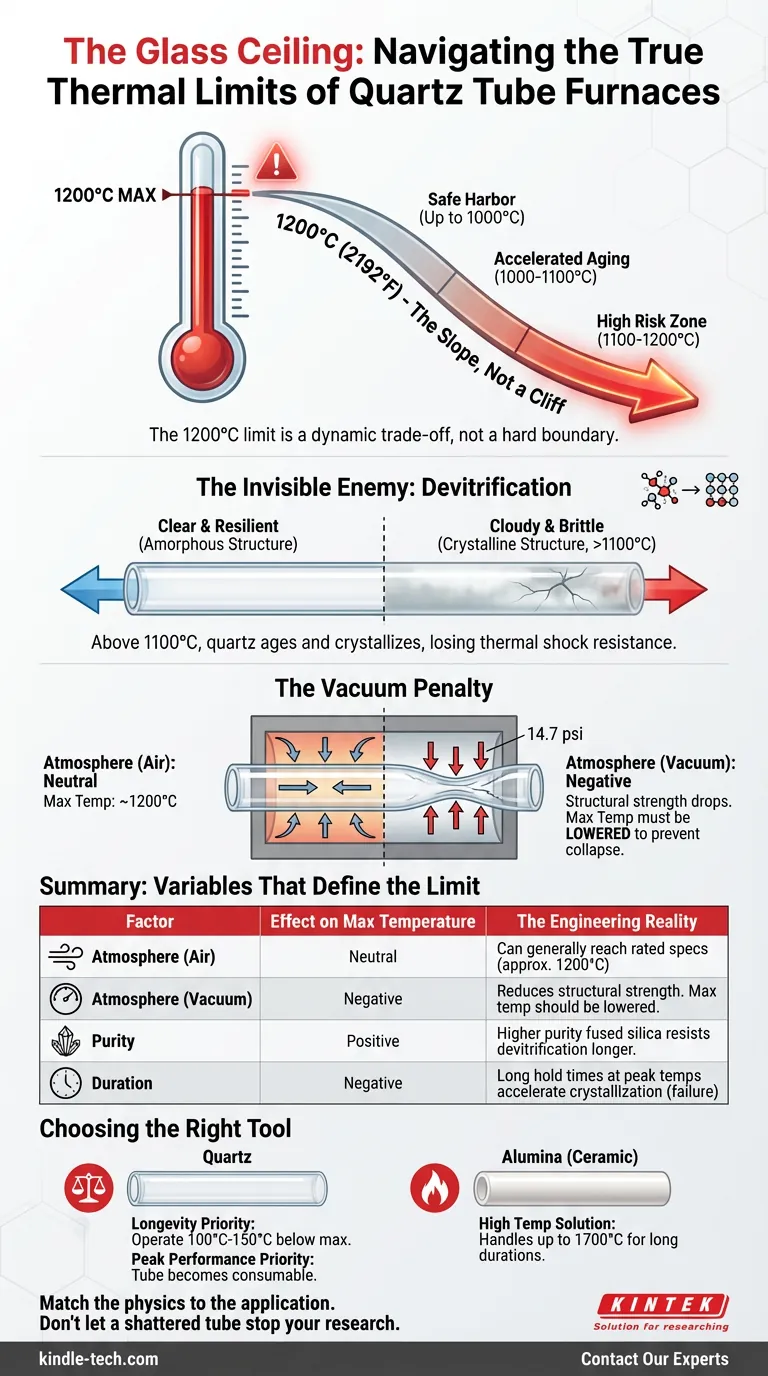
When you look at the manual for a quartz tube furnace, you will likely see a bold number: 1200°C (2192°F).

Engineers and lab managers often treat this number as a hard boundary—a safe harbor up to the very last degree. They assume that if the dial reads 1190°C, safety is guaranteed.

But materials science is rarely that binary.

The reality of high-temperature processing is that the 1200°C limit is not a cliff; it is a slope. It is a dynamic trade-off between your processing goals, the atmospheric pressure inside the tube, and how often you are willing to replace your equipment.

Here is the engineering reality behind the "Glass Ceiling" of quartz.

The Romance of Fused Silica

To understand the limit, you must understand the material.

The "quartz" used in high-end laboratory equipment is actually fused silica. It is a material of paradoxes. It is glass, yet it withstands thermal shock that would shatter a Pyrex dish instantly.

You can heat a quartz tube to 1000°C and plunge it into ice water. It will survive.

This resilience comes from an incredibly low coefficient of thermal expansion. Because the material barely changes size when heated, it does not tear itself apart with internal stress.

However, this thermal invincibility has a ceiling. While the material’s theoretical softening point is around 1600°C, its structural integrity is compromised long before that temperature is reached.

The Invisible Enemy: Devitrification

The primary failure mode of a quartz tube is almost biological in nature. It ages.

Fused silica is amorphous. Its molecular structure is chaotic and random. This is what makes it "glass." Nature, however, prefers order.

When you hold quartz at temperatures above 1100°C for extended periods, the material attempts to return to a crystalline state. This process is called devitrification.

  • The Symptom: The clear tube becomes cloudy or milky white.
  • The Mechanism: The silica molecules realign into cristobalite crystals.
  • The Result: The tube loses its thermal shock resistance. Upon cooling, the crystalline areas contract at different rates than the amorphous glass, leading to catastrophic cracking.

Devitrification is the silent killer of quartz tubes. It turns a flexible, resilient component into a brittle, fragile one.

The Vacuum Penalty

The environment inside the tube matters as much as the temperature.

In a vacuum furnace, the tube is fighting a war on two fronts. It is battling the thermal energy trying to melt it, and it is battling the atmospheric pressure trying to crush it.

At sea level, the atmosphere pushes against the outside of the tube with 14.7 psi of force. At room temperature, quartz ignores this. But as you approach 1100°C or 1200°C, the silica lattice softens slightly.

Under vacuum, the maximum safe temperature drops.

A tube that is perfectly stable at 1200°C in an air atmosphere may collapse or deform under its own weight at the same temperature under vacuum. The heat weakens the walls; the pressure finishes the job.

The Psychology of Limits

Operating a furnace is an exercise in risk management.

Think of the 1200°C rating like the redline on a car's tachometer. You can visit the redline, but you cannot live there.

If you run your furnace at its maximum rating continuously:

  1. Devitrification accelerates.
  2. Structural sag occurs.
  3. Lifespan plummets.

If your process requires holding 1200°C for hours at a time, quartz is likely the wrong material. You have moved past the "safe slope" and are dangling off the cliff. In these scenarios, the solution is not a better quartz tube, but a switch to Alumina (ceramic), which can handle temperatures up to 1700°C.

Summary: Variables That define the Limit

The following table outlines how different factors shift the "true" maximum temperature of your system.

Factor Effect on Max Temperature The Engineering Reality
Atmosphere (Air) Neutral Can generally reach rated specs (approx. 1200°C).
Atmosphere (Vacuum) Negative Reduces structural strength. Max temp should be lowered to prevent collapse.
Purity Positive Higher purity fused silica resists devitrification longer.
Duration Negative Long hold times at peak temps accelerate crystallization (failure).

Choosing the Right Tool

There is a distinct difference between what a machine can do and what it should do.

If your priority is equipment longevity, operate your quartz tube 100°C to 150°C below its stated maximum. If your priority is peak temperature performance, accept that the tube becomes a consumable item that requires frequent inspection for cloudiness.

At KINTEK, we understand that a furnace is only as good as the tube inside it. We specialize in navigating these material trade-offs. Whether you need high-purity quartz for sensitive semiconductor work or a robust alumina solution for extreme heat, we help you match the physics to the application.

Don't let a shattered tube stop your research. Let us help you calculate the real limits of your process.

Contact Our Experts

Visual Guide

The Glass Ceiling: Navigating the True Thermal Limits of Quartz Tube Furnaces Visual Guide

Related Products

Related Articles

Related Products

1400℃ Laboratory High Temperature Tube Furnace with Alumina Tube

1400℃ Laboratory High Temperature Tube Furnace with Alumina Tube

Looking for a tube furnace for high-temperature applications? Our 1400℃ Tube Furnace with Alumina Tube is perfect for research and industrial use.

Laboratory Rapid Thermal Processing (RTP) Quartz Tube Furnace

Laboratory Rapid Thermal Processing (RTP) Quartz Tube Furnace

Get lightning-fast heating with our RTP Rapid Heating Tube Furnace. Designed for precise, high-speed heating and cooling with convenient sliding rail and TFT touch screen controller. Order now for ideal thermal processing!

Laboratory High Pressure Vacuum Tube Furnace

Laboratory High Pressure Vacuum Tube Furnace

KT-PTF High Pressure Tube Furnace: Compact split tube furnace with strong positive pressure resistance. Working temp up to 1100°C and pressure up to 15Mpa. Also works under controller atmosphere or high vacuum.

1700℃ Laboratory High Temperature Tube Furnace with Alumina Tube

1700℃ Laboratory High Temperature Tube Furnace with Alumina Tube

Looking for a high-temperature tube furnace? Check out our 1700℃ Tube Furnace with Alumina Tube. Perfect for research and industrial applications up to 1700C.

1200℃ Split Tube Furnace with Quartz Tube Laboratory Tubular Furnace

1200℃ Split Tube Furnace with Quartz Tube Laboratory Tubular Furnace

KT-TF12 split tube furnace: high-purity insulation, embedded heating wire coils, and max. 1200C. Widely used for new materials and chemical vapour deposition.

Multi-zone Laboratory Tube Furnace

Multi-zone Laboratory Tube Furnace

Experience precise, efficient thermal testing with our Multi Zone Tube Furnace. Independent heating zones and temperature sensors allow for controlled high-temperature gradient heating fields. Order now for advanced thermal analysis!

Multi Heating Zones CVD Tube Furnace Machine Chemical Vapor Deposition Chamber System Equipment

Multi Heating Zones CVD Tube Furnace Machine Chemical Vapor Deposition Chamber System Equipment

KT-CTF14 Multi Heating Zones CVD Furnace - Precise Temperature Control and Gas Flow for Advanced Applications. Max temp up to 1200℃, 4 channels MFC mass flow meter, and 7" TFT touch screen controller.

1700℃ Controlled Atmosphere Furnace Nitrogen Inert Atmosphere Furnace

1700℃ Controlled Atmosphere Furnace Nitrogen Inert Atmosphere Furnace

KT-17A Controlled atmosphere furnace: 1700℃ heating, vacuum sealing technology, PID temperature control, and versatile TFT smart touch screen controller for laboratory and industrial use.

1700℃ Muffle Oven Furnace for Laboratory

1700℃ Muffle Oven Furnace for Laboratory

Get superior heat control with our 1700℃ Muffle Furnace. Equipped with intelligent temperature microprocessor, TFT touch screen controller & advanced insulation materials for precise heating up to 1700C. Order now!

1800℃ Muffle Oven Furnace for Laboratory

1800℃ Muffle Oven Furnace for Laboratory

KT-18 muffle furnace with Japan Al2O3 polycrystalline fibe and Silicon Molybdenum heating element, up to 1900℃, PID temperature control and 7" smart touch screen. Compact design, low heat loss, and high energy efficiency. Safety interlock system and versatile functions.

Horizontal High Temperature Graphite Vacuum Graphitization Furnace

Horizontal High Temperature Graphite Vacuum Graphitization Furnace

Horizontal Graphitization Furnace: This type of furnace is designed with the heating elements placed horizontally, allowing for uniform heating of the sample. It's well-suited for graphitizing large or bulky samples that require precise temperature control and uniformity.

Vacuum Heat Treat and Molybdenum Wire Sintering Furnace for Vacuum Sintering

Vacuum Heat Treat and Molybdenum Wire Sintering Furnace for Vacuum Sintering

A vacuum molybdenum wire sintering furnace is a vertical or bedroom structure, which is suitable for withdrawal, brazing, sintering and degassing of metal materials under high vacuum and high temperature conditions. It is also suitable for dehydroxylation treatment of quartz materials.

Laboratory Muffle Oven Furnace Bottom Lifting Muffle Furnace

Laboratory Muffle Oven Furnace Bottom Lifting Muffle Furnace

Efficiently produce batches with excellent temperature uniformity using our Bottom Lifting Furnace. Features two electric lifting stages and advanced temperature control up to 1600℃.

1200℃ Controlled Atmosphere Furnace Nitrogen Inert Atmosphere Furnace

1200℃ Controlled Atmosphere Furnace Nitrogen Inert Atmosphere Furnace

Discover our KT-12A Pro Controlled atmosphere furnace - high precision, heavy duty vacuum chamber, versatile smart touch screen controller, and excellent temperature uniformity up to 1200C. Ideal for both laboratory and industrial application.

Molybdenum Vacuum Heat Treat Furnace

Molybdenum Vacuum Heat Treat Furnace

Discover the benefits of a high-configuration molybdenum vacuum furnace with heat shield insulation. Ideal for high-purity, vacuum environments like sapphire crystal growth and heat treatment.

1400℃ Muffle Oven Furnace for Laboratory

1400℃ Muffle Oven Furnace for Laboratory

Get precise high-temperature control up to 1500℃ with KT-14M Muffle furnace. Equipped with a smart touch screen controller and advanced insulation materials.

Ultra-High Temperature Graphite Vacuum Graphitization Furnace

Ultra-High Temperature Graphite Vacuum Graphitization Furnace

The ultra-high temperature graphitization furnace utilizes medium frequency induction heating in a vacuum or inert gas environment. The induction coil generates an alternating magnetic field, inducing eddy currents in the graphite crucible, which heats up and radiates heat to the workpiece, bringing it to the desired temperature. This furnace is primarily used for graphitization and sintering of carbon materials, carbon fiber materials, and other composite materials.

Laboratory Vacuum Tilt Rotary Tube Furnace Rotating Tube Furnace

Laboratory Vacuum Tilt Rotary Tube Furnace Rotating Tube Furnace

Discover the versatility of Laboratory Rotary Furnace: Ideal for calcination, drying, sintering, and high-temperature reactions. Adjustable rotating and tilting functions for optimal heating. Suitable for vacuum and controlled atmosphere environments. Learn more now!

2200 ℃ Tungsten Vacuum Heat Treat and Sintering Furnace

2200 ℃ Tungsten Vacuum Heat Treat and Sintering Furnace

Experience the ultimate refractory metal furnace with our Tungsten vacuum furnace. Capable of reaching 2200℃, perfect for sintering advanced ceramics and refractory metals. Order now for high-quality results.

Vertical High Temperature Graphite Vacuum Graphitization Furnace

Vertical High Temperature Graphite Vacuum Graphitization Furnace

Vertical high temperature graphitization furnace for carbonization and graphitization of carbon materials up to 3100℃.Suitable for shaped graphitization of carbon fiber filaments and other materials sintered in a carbon environment.Applications in metallurgy, electronics, and aerospace for producing high-quality graphite products like electrodes and crucibles.


Leave Your Message