Blog Cracked Tubes, Contaminated Samples? Your Furnace Tube Is The Hidden Culprit
Cracked Tubes, Contaminated Samples? Your Furnace Tube Is The Hidden Culprit

Cracked Tubes, Contaminated Samples? Your Furnace Tube Is The Hidden Culprit

2 weeks ago

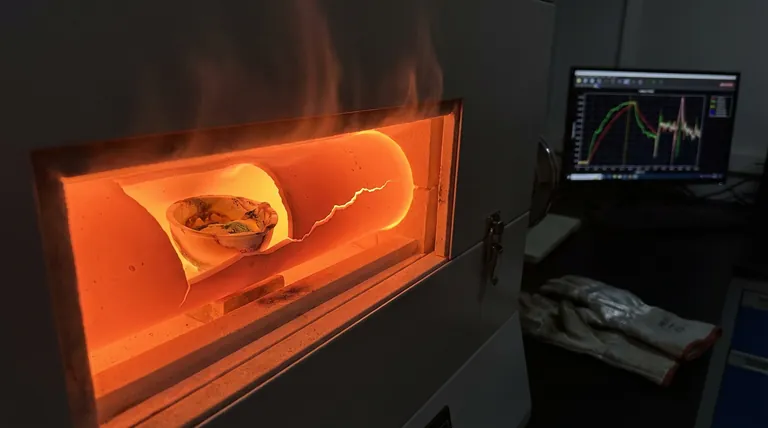
Imagine this: after hours of a meticulously planned high-temperature run, you open the furnace. Instead of a perfect sample, you find a cracked tube, a visibly contaminated product, or worse, results so inconsistent they call the entire experiment into question. It’s a moment of pure frustration that costs time, money, and confidence.

If this scenario feels familiar, you are not alone.

The Frustrating Cycle of "Fixing" the Wrong Problem

When a high-temperature process fails, the troubleshooting checklist is predictable. We immediately suspect the most complex parts of the system:

  • "Was the temperature ramp rate too aggressive?"
  • "Did the gas flow controller malfunction?"
  • "Was the source material impure to begin with?"

Engineers and researchers can spend weeks recalibrating controllers, verifying gas purities, and re-running tests, all while treating the furnace tube as a simple, passive container. This cycle of trial-and-error is more than just an academic annoyance. It has direct business consequences: critical projects are delayed, expensive materials and energy are wasted, and the path from R&D to production becomes unreliable. You're stuck treating the symptoms, while the real disease goes undiagnosed.

The Root Cause: A Furnace Tube is an Active Component, Not a Box

Here is the fundamental truth that changes everything: at high temperatures, your furnace tube is not a passive container. It is an active chemical and physical participant in your process.

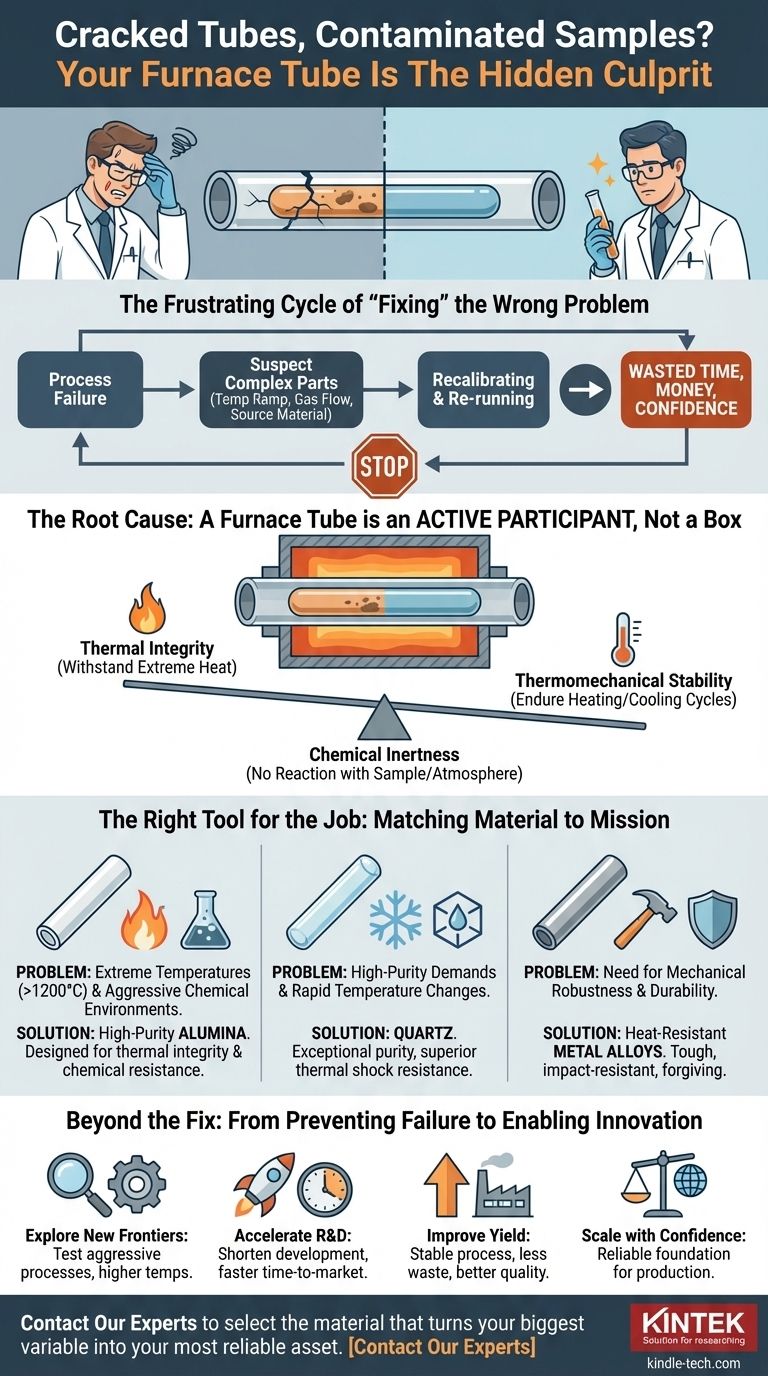
The common "fixes" fail because they ignore this reality. The problem isn't a faulty setting; it's a fundamental mismatch between the tube's material properties and the demands of the process. Every furnace tube must constantly perform a high-stakes balancing act between three critical factors:

  1. Thermal Integrity: It must withstand extreme heat without softening, deforming, or melting.
  2. Chemical Inertness: It must not react with your sample, the process gases, or the atmosphere. At 1400°C, materials that are stable at room temperature can become surprisingly reactive.
  3. Thermomechanical Stability: It must endure the stress of heating and cooling cycles (thermal shock) without cracking.

Recalibrating your furnace won't stop a metal alloy tube from oxidizing in an air atmosphere. Re-running your experiment won’t prevent an alumina tube from cracking if it’s cooled too quickly. You've been trying to solve a material science problem by adjusting equipment settings.

The Right Tool for the Job: Matching Material to Mission

To permanently solve this issue, you don't need a more complicated furnace; you need a furnace tube material that is explicitly chosen to master the specific challenges of your application. This is where a simple component becomes a precision-engineered tool.

This is not a matter of guesswork. It's an engineering decision based on the underlying principles we've discussed. The solution is to select a material whose properties directly counter the root cause of your failures.

  • Problem: Extreme Temperatures (>1200°C) and Aggressive Chemical Environments.

    • Solution: High-purity Alumina tubes are the standard. They are designed for thermal integrity and chemical resistance at temperatures where metals would fail and quartz would soften.
  • Problem: High-Purity Demands and Rapid Temperature Changes.

    • Solution: Quartz tubes offer exceptional purity, preventing sample contamination, and boast superior resistance to thermal shock, making them ideal for semiconductor processing and applications requiring fast cycling.
  • Problem: Need for Mechanical Robustness and Durability.

    • Solution: Heat-resistant metal alloys are tough. They resist physical impact and are more forgiving than ceramics, making them a reliable choice for applications where mechanical durability is the top priority (within their temperature and atmospheric limits).

At KINTEK, we see the furnace tube not as a simple consumable, but as a critical piece of process equipment. Our role is to help you make this crucial engineering choice correctly the first time, ensuring your setup is built on a foundation of material stability.

Beyond the Fix: From Preventing Failure to Enabling Innovation

Once your furnace tube is no longer the weakest link, the focus shifts from damage control to genuine progress. A reliable thermal process doesn't just mean fewer headaches; it unlocks new potential.

  • Explore New Frontiers: You can confidently test more aggressive chemical processes or push your operating temperatures higher, knowing your equipment is stable.
  • Accelerate R&D: With repeatable and trustworthy results, you can shorten development cycles and get new materials or products to market faster.
  • Improve Yield: In a production environment, process stability translates directly to higher yields, less waste, and better product quality.
  • Scale with Confidence: You can move from lab-scale experiments to pilot production knowing that your process is fundamentally sound and repeatable.

Solving the furnace tube problem is the first step toward achieving more ambitious goals. It’s about building a reliable foundation that allows your research and production to thrive. If you're ready to move past the cycle of troubleshooting and start achieving more consistent, predictable results, our team is here to help you analyze your process and select the material that will turn your biggest variable into your most reliable asset. Contact Our Experts to discuss your specific application.

Visual Guide
Cracked Tubes, Contaminated Samples? Your Furnace Tube Is The Hidden Culprit Visual Guide

Related Products

Related Articles

Related Products

1700℃ Laboratory Quartz Tube Furnace with Alumina Tube Tubular Furnace

1700℃ Laboratory Quartz Tube Furnace with Alumina Tube Tubular Furnace

Looking for a high-temperature tube furnace? Check out our 1700℃ Tube Furnace with Alumina Tube. Perfect for research and industrial applications up to 1700C.

1400℃ Laboratory Quartz Tube Furnace with Alumina Tube Tubular Furnace

1400℃ Laboratory Quartz Tube Furnace with Alumina Tube Tubular Furnace

Looking for a tube furnace for high-temperature applications? Our 1400℃ Tube Furnace with Alumina Tube is perfect for research and industrial use.

High Pressure Laboratory Vacuum Tube Furnace Quartz Tubular Furnace

High Pressure Laboratory Vacuum Tube Furnace Quartz Tubular Furnace

KT-PTF High Pressure Tube Furnace: Compact split tube furnace with strong positive pressure resistance. Working temp up to 1100°C and pressure up to 15Mpa. Also works under controller atmosphere or high vacuum.

1200℃ Split Tube Furnace with Quartz Tube Laboratory Tubular Furnace

1200℃ Split Tube Furnace with Quartz Tube Laboratory Tubular Furnace

KT-TF12 split tube furnace: high-purity insulation, embedded heating wire coils, and max. 1200C. Widely used for new materials and chemical vapour deposition.

High Temperature Alumina (Al2O3) Furnace Tube for Engineering Advanced Fine Ceramics

High Temperature Alumina (Al2O3) Furnace Tube for Engineering Advanced Fine Ceramics

High temperature alumina furnace tube combines the advantages of high hardness of alumina, good chemical inertness and steel, and has excellent wear resistance, thermal shock resistance and mechanical shock resistance.

Multi Zone Laboratory Quartz Tube Furnace Tubular Furnace

Multi Zone Laboratory Quartz Tube Furnace Tubular Furnace

Experience precise, efficient thermal testing with our Multi Zone Tube Furnace. Independent heating zones and temperature sensors allow for controlled high-temperature gradient heating fields. Order now for advanced thermal analysis!

Molybdenum Disilicide (MoSi2) Thermal Elements Electric Furnace Heating Element

Molybdenum Disilicide (MoSi2) Thermal Elements Electric Furnace Heating Element

Discover the power of Molybdenum Disilicide (MoSi2) Heating Element for high-temperature resistance. Unique oxidation resistance with stable resistance value. Learn more about its benefits now!

High Temperature Aluminum Oxide (Al2O3) Protective Tube for Engineering Advanced Fine Ceramics

High Temperature Aluminum Oxide (Al2O3) Protective Tube for Engineering Advanced Fine Ceramics

Alumina oxide protective tube, also known as high temperature resistant corundum tube or thermocouple protection tube, is a ceramic tube mainly made of alumina (aluminum oxide).

Rotary Tube Furnace Split Multi Heating Zone Rotating Tube Furnace

Rotary Tube Furnace Split Multi Heating Zone Rotating Tube Furnace

Multi zone rotary furnace for high-precision temperature control with 2-8 independent heating zones. Ideal for lithium ion battery electrode materials and high-temperature reactions. Can work under vacuum and controlled atmosphere.

1800℃ Muffle Oven Furnace for Laboratory

1800℃ Muffle Oven Furnace for Laboratory

KT-18 muffle furnace with Japan Al2O3 polycrystalline fibe and Silicon Molybdenum heating element, up to 1900℃, PID temperature control and 7" smart touch screen. Compact design, low heat loss, and high energy efficiency. Safety interlock system and versatile functions.

Vacuum Sealed Continuous Working Rotary Tube Furnace Rotating Tube Furnace

Vacuum Sealed Continuous Working Rotary Tube Furnace Rotating Tube Furnace

Experience efficient material processing with our vacuum-sealed rotary tube furnace. Perfect for experiments or industrial production, equipped with optional features for controlled feeding and optimized results. Order now.

Laboratory Muffle Oven Furnace Bottom Lifting Muffle Furnace

Laboratory Muffle Oven Furnace Bottom Lifting Muffle Furnace

Efficiently produce batches with excellent temperature uniformity using our Bottom Lifting Furnace. Features two electric lifting stages and advanced temperature control up to 1600℃.

Silicon Carbide SiC Thermal Heating Elements for Electric Furnace

Silicon Carbide SiC Thermal Heating Elements for Electric Furnace

Experience the advantages of Silicon Carbide (SiC) Heating Element: Long service life, high corrosion and oxidation resistance, fast heating speed, and easy maintenance. Learn more now!

High Temperature Muffle Oven Furnace for Laboratory Debinding and Pre Sintering

High Temperature Muffle Oven Furnace for Laboratory Debinding and Pre Sintering

KT-MD High temperature debinding and pre-sintering furnace for ceramic materials with various molding processes. Ideal for electronic components such as MLCC and NFC.

1700℃ Controlled Atmosphere Furnace Nitrogen Inert Atmosphere Furnace

1700℃ Controlled Atmosphere Furnace Nitrogen Inert Atmosphere Furnace

KT-17A Controlled atmosphere furnace: 1700℃ heating, vacuum sealing technology, PID temperature control, and versatile TFT smart touch screen controller for laboratory and industrial use.

Custom PTFE Teflon Parts Manufacturer for Centrifuge Tubes

Custom PTFE Teflon Parts Manufacturer for Centrifuge Tubes

PTFE centrifugal tubes are highly valued for their exceptional chemical resistance, thermal stability, and non-stick properties, making them indispensable in various high-demand sectors. These tubes are particularly useful in environments where exposure to corrosive substances, high temperatures, or stringent cleanliness requirements are prevalent.

Engineering Advanced Fine Alumina Al2O3 Ceramic Crucible for Laboratory Muffle Furnace

Engineering Advanced Fine Alumina Al2O3 Ceramic Crucible for Laboratory Muffle Furnace

Alumina ceramic crucibles are used in some materials and metal melting tools, and flat-bottomed crucibles are suitable for melting and processing larger batches of materials with better stability and uniformity.

Boron Nitride (BN) Ceramic Tube

Boron Nitride (BN) Ceramic Tube

Boron nitride (BN) is known for its high thermal stability, excellent electrical insulating properties and lubricating properties.

Hexagonal Boron Nitride HBN Thermocouple Protection Tube

Hexagonal Boron Nitride HBN Thermocouple Protection Tube

Hexagonal boron nitride ceramics is an emerging industrial material. Because of its similar structure to graphite and many similarities in performance, it is also called "white graphite".

Engineering Advanced Fine Ceramics Alumina Crucibles (Al2O3) for Thermal Analysis TGA DTA

Engineering Advanced Fine Ceramics Alumina Crucibles (Al2O3) for Thermal Analysis TGA DTA

TGA/DTA thermal analysis vessels are made of aluminum oxide (corundum or aluminum oxide). It can withstand high temperature and is suitable for analyzing materials that require high temperature testing.


Leave Your Message