Blog Beyond the Spec Sheet: The Hidden Physics of a Tube Furnace's True Limit
Beyond the Spec Sheet: The Hidden Physics of a Tube Furnace's True Limit

Beyond the Spec Sheet: The Hidden Physics of a Tube Furnace's True Limit

3 days ago

The Allure of the Maximum Number

When evaluating a high-temperature tube furnace, the first question is almost always the same: "How hot can it get?"

It’s a natural human impulse. We are drawn to extremes, to the highest number on the spec sheet. We see 1800°C and assume it’s inherently better than 1200°C. But this simple question hides a complex reality and often leads to poor decisions, premature equipment failure, and compromised research.

A tube furnace isn't a simple appliance; it's a balanced system of interacting components under extreme stress. The "maximum temperature" is not a target to be aimed for, but a boundary defined by the single weakest link in that system.

The right question is not "how hot can it get?" but rather, "what limits its temperature, and how do those limits align with my work?"

A System Defined by Its Weakest Link

To understand a furnace’s true capabilities, you have to look past the single number and see the components that produce and contain the heat. The maximum temperature is a promise made by the entire system, but it can be broken by any single part.

The Engine of Heat: The Heating Element

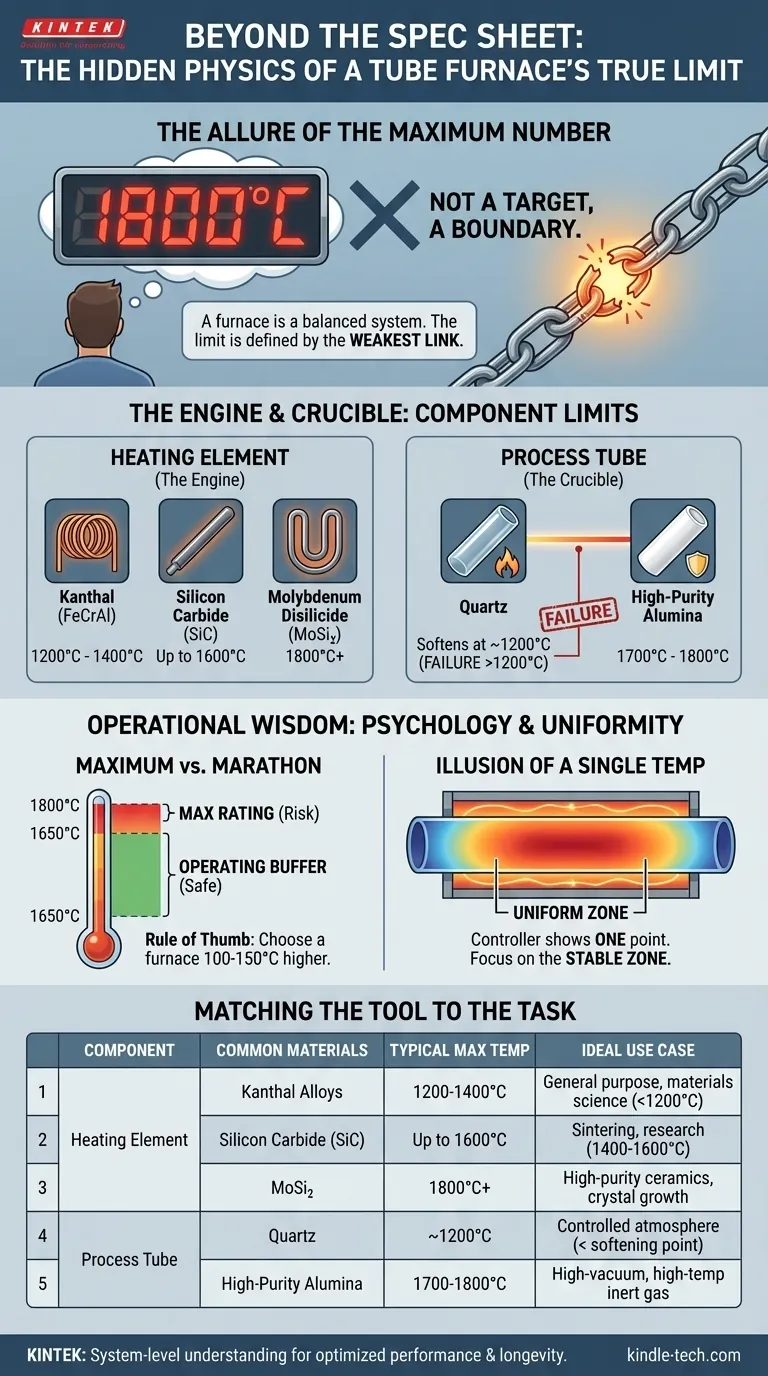
The heart of the furnace is its heating element. The material used here is the primary determinant of the furnace's thermal potential. Each has a hard physical limit beyond which it will rapidly degrade and fail.

  • Kanthal (FeCrAl) Alloys: The workhorse for general applications, reliably operating up to 1200°C - 1400°C. Cost-effective and durable within their range.
  • Silicon Carbide (SiC): The next step up, essential for processes requiring sustained heat up to 1600°C.
  • Molybdenum Disilicide (MoSi₂): The choice for extreme temperatures, engineered to perform consistently at 1800°C and even higher in specialized designs.

The Crucible of Containment: The Process Tube

While the element creates the heat, the process tube contains the experiment. It must endure the same extreme temperatures while maintaining its structural integrity and protecting the sample. Often, the tube itself becomes the limiting factor.

  • Quartz Tubes: An excellent and common material, but it has a non-negotiable ceiling. Above approximately 1200°C, quartz begins to soften and deform.
  • High-Purity Alumina Tubes: For any work above 1200°C, these ceramic tubes are mandatory. They can withstand temperatures from 1700°C to 1800°C, making them the partner for SiC and MoSi₂ elements.

Pushing a quartz tube into a 1400°C furnace is not a matter of risk; it is a guarantee of failure.

The Psychology of Operational Limits

Understanding the physics is only half the battle. The other half is fighting the psychological urge to push the equipment to its absolute limit—a behavior that is both costly and counterproductive.

Maximum vs. Marathon Temperature

A furnace rated for 1800°C is not designed to be run at 1800°C every day. This "maximum temperature" is a capability, not a recommended cruising speed.

Operating any furnace at its absolute peak drastically shortens the lifespan of its heating elements and places immense thermal stress on its insulation and structure. A wise rule of thumb is to choose a furnace with a maximum rating at least 100-150°C higher than your typical operating temperature. This buffer is the difference between an instrument that lasts for years and one that fails in months.

The Illusion of a Single Temperature

The number on the digital controller represents the temperature at a single point—the tip of the thermocouple, typically in the center of the heating zone. It does not represent the temperature throughout the entire tube.

Temperature naturally drops off toward the ends of the tube. For processes like crystal growth or annealing semiconductor wafers, the length of the stable and consistent "uniform zone" is far more critical than a peak number. Chasing the maximum temperature can blind you to the more important metric of thermal uniformity.

Matching the Tool to the Task

Selecting the right furnace is not about buying the most powerful one. It's about precisely matching the equipment's systemic capabilities to your scientific goals. The choice becomes clear when you define your needs first.

Component Common Materials Typical Max Temperature Ideal Use Case
Heating Element Kanthal Alloys 1200°C - 1400°C General purpose, materials science, annealing below 1200°C
Silicon Carbide (SiC) Up to 1600°C Sintering, research requiring 1400°C - 1600°C
Molybdenum Disilicide (MoSi₂) 1800°C+ High-purity ceramics, crystal growth, extreme temp R&D
Process Tube Quartz ~1200°C Controlled atmosphere work below the softening point
High-Purity Alumina 1700°C - 1800°C High-vacuum and high-temperature inert gas processes

Choosing the right system requires more than just reading a spec sheet; it requires expertise in how these components interact under the stress of your specific application. At KINTEK, we provide not just the equipment, but the system-level understanding to ensure you get the right tool for your research, optimized for performance and longevity.

If you need to navigate these critical trade-offs, Contact Our Experts.

Visual Guide
Beyond the Spec Sheet: The Hidden Physics of a Tube Furnace's True Limit Visual Guide

Related Products

Related Articles

Related Products

1700℃ Laboratory High Temperature Tube Furnace with Alumina Tube

1700℃ Laboratory High Temperature Tube Furnace with Alumina Tube

Looking for a high-temperature tube furnace? Check out our 1700℃ Tube Furnace with Alumina Tube. Perfect for research and industrial applications up to 1700C.

1400℃ Laboratory High Temperature Tube Furnace with Alumina Tube

1400℃ Laboratory High Temperature Tube Furnace with Alumina Tube

Looking for a tube furnace for high-temperature applications? Our 1400℃ Tube Furnace with Alumina Tube is perfect for research and industrial use.

1200℃ Split Tube Furnace with Quartz Tube Laboratory Tubular Furnace

1200℃ Split Tube Furnace with Quartz Tube Laboratory Tubular Furnace

KT-TF12 split tube furnace: high-purity insulation, embedded heating wire coils, and max. 1200C. Widely used for new materials and chemical vapour deposition.

Laboratory High Pressure Vacuum Tube Furnace

Laboratory High Pressure Vacuum Tube Furnace

KT-PTF High Pressure Tube Furnace: Compact split tube furnace with strong positive pressure resistance. Working temp up to 1100°C and pressure up to 15Mpa. Also works under controller atmosphere or high vacuum.

Vertical Laboratory Tube Furnace

Vertical Laboratory Tube Furnace

Elevate your experiments with our Vertical Tube Furnace. Versatile design allows for operation under various environments and heat treatment applications. Order now for precise results!

1800℃ Muffle Oven Furnace for Laboratory

1800℃ Muffle Oven Furnace for Laboratory

KT-18 muffle furnace with Japan Al2O3 polycrystalline fibe and Silicon Molybdenum heating element, up to 1900℃, PID temperature control and 7" smart touch screen. Compact design, low heat loss, and high energy efficiency. Safety interlock system and versatile functions.

Rotary Tube Furnace Split Multi Heating Zone Rotating Tube Furnace

Rotary Tube Furnace Split Multi Heating Zone Rotating Tube Furnace

Multi zone rotary furnace for high-precision temperature control with 2-8 independent heating zones. Ideal for lithium ion battery electrode materials and high-temperature reactions. Can work under vacuum and controlled atmosphere.

Laboratory Rapid Thermal Processing (RTP) Quartz Tube Furnace

Laboratory Rapid Thermal Processing (RTP) Quartz Tube Furnace

Get lightning-fast heating with our RTP Rapid Heating Tube Furnace. Designed for precise, high-speed heating and cooling with convenient sliding rail and TFT touch screen controller. Order now for ideal thermal processing!

1200℃ Controlled Atmosphere Furnace Nitrogen Inert Atmosphere Furnace

1200℃ Controlled Atmosphere Furnace Nitrogen Inert Atmosphere Furnace

Discover our KT-12A Pro Controlled atmosphere furnace - high precision, heavy duty vacuum chamber, versatile smart touch screen controller, and excellent temperature uniformity up to 1200C. Ideal for both laboratory and industrial application.

Multi-zone Laboratory Tube Furnace

Multi-zone Laboratory Tube Furnace

Experience precise, efficient thermal testing with our Multi Zone Tube Furnace. Independent heating zones and temperature sensors allow for controlled high-temperature gradient heating fields. Order now for advanced thermal analysis!

Vacuum Sealed Continuous Working Rotary Tube Furnace Rotating Tube Furnace

Vacuum Sealed Continuous Working Rotary Tube Furnace Rotating Tube Furnace

Experience efficient material processing with our vacuum-sealed rotary tube furnace. Perfect for experiments or industrial production, equipped with optional features for controlled feeding and optimized results. Order now.

Laboratory Muffle Oven Furnace Bottom Lifting Muffle Furnace

Laboratory Muffle Oven Furnace Bottom Lifting Muffle Furnace

Efficiently produce batches with excellent temperature uniformity using our Bottom Lifting Furnace. Features two electric lifting stages and advanced temperature control up to 1600℃.

Laboratory Vacuum Tilt Rotary Tube Furnace Rotating Tube Furnace

Laboratory Vacuum Tilt Rotary Tube Furnace Rotating Tube Furnace

Discover the versatility of Laboratory Rotary Furnace: Ideal for calcination, drying, sintering, and high-temperature reactions. Adjustable rotating and tilting functions for optimal heating. Suitable for vacuum and controlled atmosphere environments. Learn more now!

High Temperature Muffle Oven Furnace for Laboratory Debinding and Pre Sintering

High Temperature Muffle Oven Furnace for Laboratory Debinding and Pre Sintering

KT-MD High temperature debinding and pre-sintering furnace for ceramic materials with various molding processes. Ideal for electronic components such as MLCC and NFC.

1700℃ Muffle Oven Furnace for Laboratory

1700℃ Muffle Oven Furnace for Laboratory

Get superior heat control with our 1700℃ Muffle Furnace. Equipped with intelligent temperature microprocessor, TFT touch screen controller & advanced insulation materials for precise heating up to 1700C. Order now!

1700℃ Controlled Atmosphere Furnace Nitrogen Inert Atmosphere Furnace

1700℃ Controlled Atmosphere Furnace Nitrogen Inert Atmosphere Furnace

KT-17A Controlled atmosphere furnace: 1700℃ heating, vacuum sealing technology, PID temperature control, and versatile TFT smart touch screen controller for laboratory and industrial use.

2200 ℃ Tungsten Vacuum Heat Treat and Sintering Furnace

2200 ℃ Tungsten Vacuum Heat Treat and Sintering Furnace

Experience the ultimate refractory metal furnace with our Tungsten vacuum furnace. Capable of reaching 2200℃, perfect for sintering advanced ceramics and refractory metals. Order now for high-quality results.

1400℃ Muffle Oven Furnace for Laboratory

1400℃ Muffle Oven Furnace for Laboratory

Get precise high-temperature control up to 1500℃ with KT-14M Muffle furnace. Equipped with a smart touch screen controller and advanced insulation materials.

Molybdenum Vacuum Heat Treat Furnace

Molybdenum Vacuum Heat Treat Furnace

Discover the benefits of a high-configuration molybdenum vacuum furnace with heat shield insulation. Ideal for high-purity, vacuum environments like sapphire crystal growth and heat treatment.

1400℃ Controlled Atmosphere Furnace with Nitrogen and Inert Atmosphere

1400℃ Controlled Atmosphere Furnace with Nitrogen and Inert Atmosphere

Achieve precise heat treatment with KT-14A controlled atmosphere furnace. Vacuum sealed with a smart controller, it's ideal for lab and industrial use up to 1400℃.


Leave Your Message



















