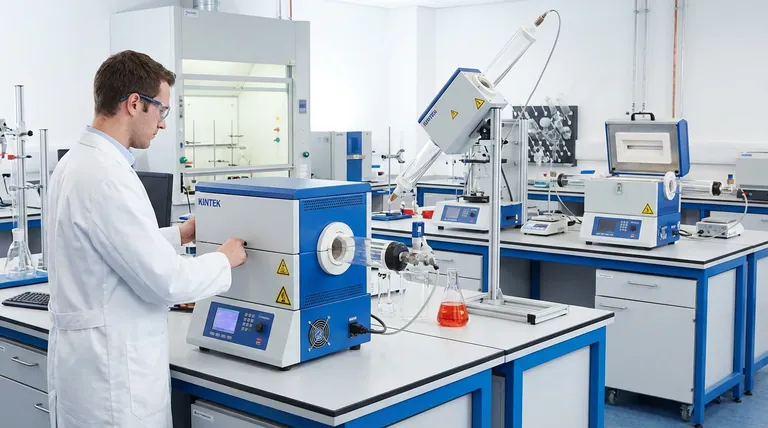
In the laboratory, gravity is often treated as a constant—a background noise that we rarely question. But when you introduce extreme heat, gravity becomes a variable that defines the success or failure of a material process.
The orientation of a tube furnace is not merely a matter of where it fits on a bench. It is a fundamental engineering decision that dictates how convection currents move, how samples settle, and how heat interacts with matter.
Choosing between horizontal, vertical, or rotary configurations is arguably the most critical step in designing a thermal experiment. It is a choice between fighting gravity and weaponizing it.
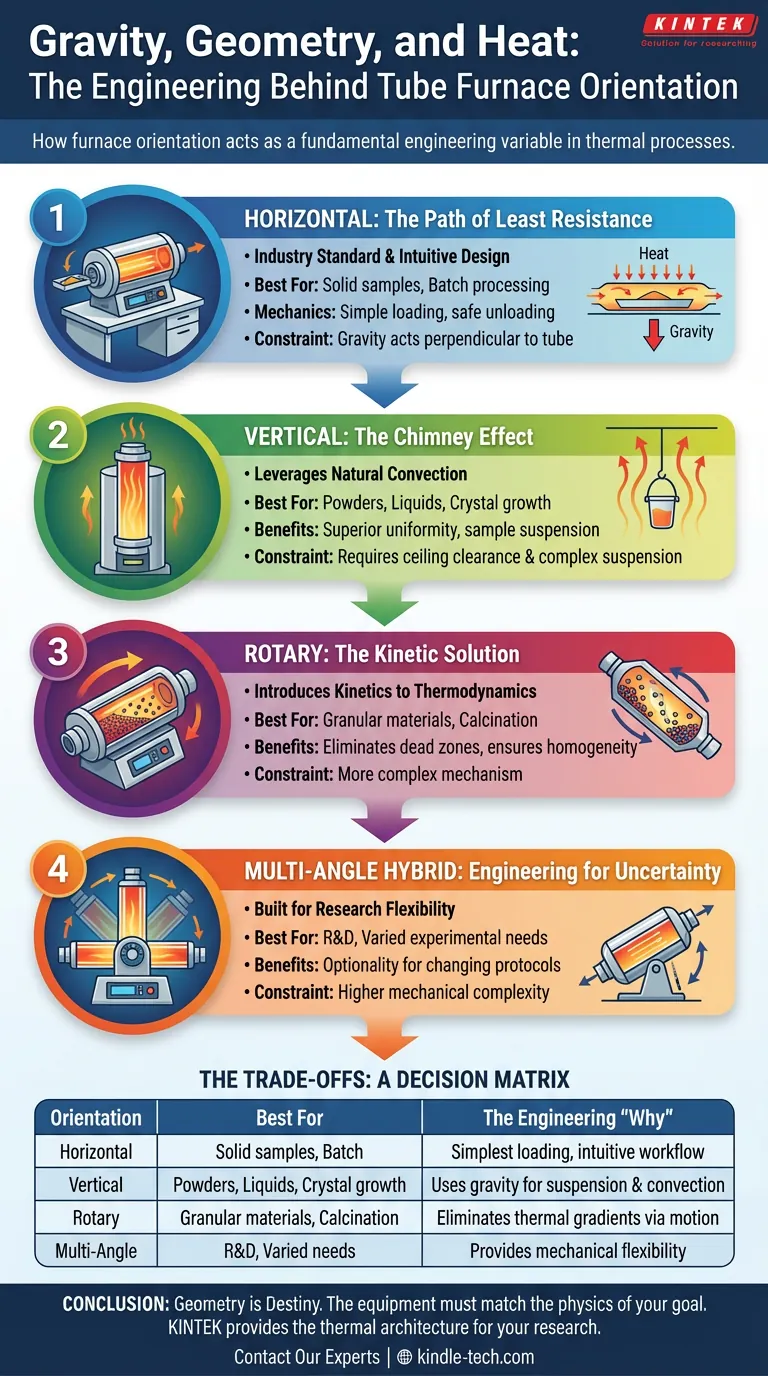
Horizontal: The Path of Least Resistance
The horizontal tube furnace is the industry standard for a reason. It mirrors the intuitive design of nearly every heating tool we have used since the discovery of fire.
In this configuration, the tube lies flat. The primary psychological and practical benefit here is accessibility.
- The Mechanics: You place solid samples in a "boat" and slide them into the hot zone.
- The Benefit: It is straightforward. Loading is simple. Unloading is safe.
- The Constraint: Gravity acts perpendicular to the tube.
For standard annealing, curing, or synthesis where the sample is solid and static, this is the most cost-effective and logical solution. It works because the process doesn't require the sample to move, nor does it require the airflow to behave in complex ways.
Vertical: The Chimney Effect
When you tilt the tube 90 degrees upright, you are no longer just heating a sample; you are creating a chimney.
Vertical tube furnaces leverage natural convection. As heat rises, it creates a draft that moves vertically through the tube. This simple geometric shift solves two complex problems that horizontal furnaces struggle with:
- Uniformity: The vertical airflow minimizes temperature gradients, often creating a more consistent "hot zone" than horizontal counterparts.
- Suspension: Samples can be hung from the top or placed in crucibles that do not touch the tube walls.
This is the engineer’s choice for delicate precision. If you are growing crystals, working with drop-testing, or heating powders that react with containment vessels, verticality is not a preference—it is a requirement.
Rotary: The Kinetic Solution
Static heating has a flaw: "Dead zones."
If a pile of powder sits in a boat in a horizontal furnace, the particles on the outside heat up faster than those in the center. The heat transfer is uneven.
The rotary tube furnace introduces kinetics to thermodynamics. By spinning the tube, the furnace tumbles the material continuously.
- Homogeneity: Every particle gets equal time against the heated wall.
- Gas Interaction: The tumbling action exposes more surface area to the atmosphere within the tube (essential for oxidation or reduction processes).
This is the solution for granular materials, calcination, and roasting. It is the industrialization of the laboratory process—moving from static observation to dynamic production.
The Multi-Angle Hybrid: Engineering for Uncertainty
Science is rarely linear. A project that requires annealing today might require fluid dynamics tomorrow.
Multi-angle (tilting) furnaces are built for the researcher who values optionality. They can operate horizontally, vertically, or at any angle in between.
This is useful for hybrid processes—for example, heating a sample horizontally and then tilting the unit to pour the molten material into a quench tank. It buys you the freedom to change your mind without changing your equipment.
The Trade-offs: A Decision Matrix
Every engineering choice has a cost. The perfect furnace for one application is a disaster for another.
Space vs. Height
- Horizontal furnaces eat up bench width.
- Vertical furnaces require ceiling clearance and tall stands.
Simplicity vs. Uniformity
- Horizontal is easier to load but battles minor thermal gradients.
- Vertical offers superior thermal physics but requires complex sample suspension systems.
Summary of Configurations
| Orientation | Best For | The Engineering "Why" |
|---|---|---|
| Horizontal | Solid samples, Batch processing | Simplest loading mechanics; intuitive workflow. |
| Vertical | Powders, Liquids, Crystal growth | Uses gravity for suspension and convection for uniformity. |
| Rotary | Granular materials, Calcination | Eliminates thermal gradients via continuous motion. |
| Multi-Angle | R&D, Varied experimental needs | Provides mechanical flexibility for changing protocols. |
Conclusion
The orientation of your furnace is the stage upon which your thermal reaction performs. If the stage is tilted wrong, the performance fails.
Whether you need the simple utility of a horizontal unit, the convective precision of a vertical setup, or the kinetic energy of a rotary system, the equipment must match the physics of your goal.
At KINTEK, we don't just sell tubes and heaters; we provide the thermal architecture that supports your research. We understand that in your lab, geometry is destiny.
Contact Our Experts to analyze your specific heating requirements and find the configuration that aligns with your science.
Visual Guide
Related Products
- Rotary Tube Furnace Split Multi Heating Zone Rotating Tube Furnace
- Laboratory Vacuum Tilt Rotary Tube Furnace Rotating Tube Furnace
- 1200℃ Split Tube Furnace with Quartz Tube Laboratory Tubular Furnace
- 1400℃ Laboratory High Temperature Tube Furnace with Alumina Tube
- 1700℃ Laboratory High Temperature Tube Furnace with Alumina Tube
Related Articles
- The Geometry of Heat: Why Motion Matters in Material Synthesis
- Exploring the Advantages of Rotary Tube Furnaces in Industrial and Laboratory Applications
- The Geometry of Heat: Engineering the Perfect Thermal Environment
- Exploring the Functions and Advantages of Rotary Tube Furnaces
- Exploring Rotary Tube Furnaces: A Comprehensive Guide



















