Blog The Geometry of Heat: Why the Split Tube Furnace is an Engineer’s Best Ally
The Geometry of Heat: Why the Split Tube Furnace is an Engineer’s Best Ally

The Geometry of Heat: Why the Split Tube Furnace is an Engineer’s Best Ally

2 weeks ago

The Square Peg Problem

There is a specific, quiet frustration known only to materials scientists and chemical engineers.

It happens when you have built the perfect reactor. You have sealed the quartz tube. You have attached the vacuum flanges, the delicate sensors, and the gas feedthroughs. It is a masterpiece of plumbing and physics.

Then, you turn to your standard tube furnace.

You realize, with a sinking feeling, that the flanges are wider than the furnace bore. To heat the sample, you must disassemble the very ecosystem you just perfected.

This is not a thermal problem. It is a geometry problem.

The standard tube furnace is a tunnel. It requires the payload to be streamlined, simple, and narrower than the opening. But modern research is rarely simple.

This is where the split tube furnace changes the paradigm.

The Architecture of Openness

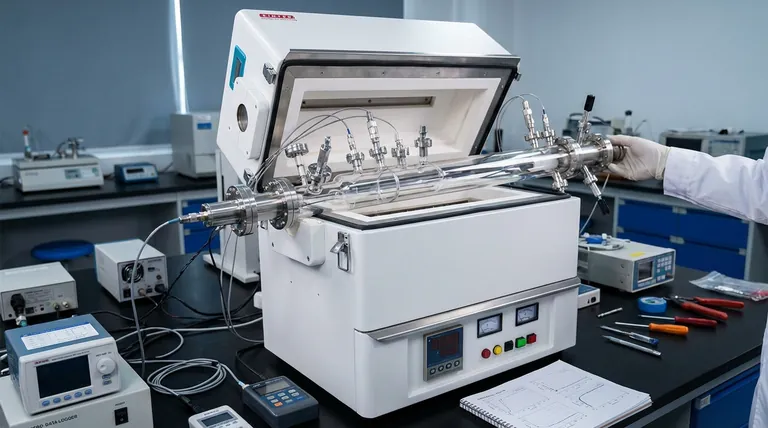
The split tube furnace is defined by a simple, mechanical act of liberation: it opens.

Instead of a solid cylinder, the heating chamber is bisected lengthwise. Heavy-duty hinges and pneumatic struts allow the top half to lift like a clamshell.

This seems like a trivial design choice until you use one.

By removing the "tunnel" constraint, the furnace stops being a bottleneck. You don't slide your work in; you place it.

The Death of Disassembly

The true value of this design isn't just convenience; it is data integrity.

In high-stakes R&D, every connection you unfasten to fit a tube into a furnace is a potential leak point. Every sensor you remove is a calibration risk.

The split design allows you to:

  • Preserve the Assembly: Lower a tube with pre-attached, bulky flanges directly onto the heating element.
  • Accommodate Complexity: Use reaction vessels with odd geometries or integrated side-ports that would never survive a slide-in loading process.
  • Accelerate Cooling: Open the chamber to flash-cool a sample, freezing the microstructure in place—a maneuver impossible with solid-body furnaces.

The Brain Within the Brawn

A hinge provides access, but control provides results.

A furnace that opens easily must also close securely and heat evenly. This requires a specific kind of engineering romance—balancing mechanical movement with thermal stability.

Modern split furnaces, like those engineered by KINTEK, rely on sophisticated nervous systems to manage this balance.

PID: The Art of Prediction

We have moved past simple "on/off" thermostats. These units utilize PID (Proportional-Integral-Derivative) controllers.

The controller doesn't just react to temperature; it anticipates it. It learns the thermal mass of your unique, complex vessel. Through Auto-Tune features, the system calculates exactly how much energy is needed to hold a steady 1000°C, ensuring that the "split" in the insulation does not translate to a split in thermal uniformity.

The Safety Net

When you are running unattended experiments for 48 hours, "trust" is not a safety strategy.

The system requires redundancies:

  • Over-temperature Protection: A hard limit that cuts power if the PID logic fails.
  • Broken Thermocouple Protection: A sensor that detects if the "eyes" of the furnace have gone blind, preventing a thermal runaway event.

The Psychology of Choice: When to Switch?

Not every lab needs a split tube furnace.

If you are processing hundreds of identical, simple ceramic rods, a standard solid-body furnace is a marvel of efficiency. It is the "commuter train" of thermal processing—reliable, streamlined, and cost-effective.

The split tube furnace is the off-road vehicle.

You choose it when the path isn't clear. You choose it for Research & Development, where the setup changes every Tuesday.

Here is a simple heuristic for making the decision:

The Decision Matrix

If your workflow involves... Then your solution is...
High-throughput, uniform samples Standard Tube Furnace
Complex reactors with wide flanges Split Tube Furnace
Frequent changes in experimental setup Split Tube Furnace
Need for rapid cooling (quenching) Split Tube Furnace
Strict budget constraints Standard Tube Furnace

Conclusion

In the laboratory, friction is the enemy.

Friction is the time spent dismantling a flange. Friction is the fear of breaking a quartz tube while trying to slide it into a tight bore.

The split tube furnace is an investment in removing friction. It acknowledges that the science happens inside the tube, and the furnace should simply get out of the way.

Ready to stop fighting with your equipment?

At KINTEK, we specialize in solving the geometry problems of the modern lab. Our split tube furnaces are designed for researchers who refuse to compromise on their experimental setups.

Don't disassemble your masterpiece to fit your tools. Get tools that fit your masterpiece.

Contact Our Experts

Visual Guide

The Geometry of Heat: Why the Split Tube Furnace is an Engineer’s Best Ally Visual Guide

Related Products

Related Articles

Related Products

1200℃ Split Tube Furnace with Quartz Tube Laboratory Tubular Furnace

1200℃ Split Tube Furnace with Quartz Tube Laboratory Tubular Furnace

KT-TF12 split tube furnace: high-purity insulation, embedded heating wire coils, and max. 1200C. Widely used for new materials and chemical vapour deposition.

1400℃ Laboratory High Temperature Tube Furnace with Alumina Tube

1400℃ Laboratory High Temperature Tube Furnace with Alumina Tube

Looking for a tube furnace for high-temperature applications? Our 1400℃ Tube Furnace with Alumina Tube is perfect for research and industrial use.

Laboratory Rapid Thermal Processing (RTP) Quartz Tube Furnace

Laboratory Rapid Thermal Processing (RTP) Quartz Tube Furnace

Get lightning-fast heating with our RTP Rapid Heating Tube Furnace. Designed for precise, high-speed heating and cooling with convenient sliding rail and TFT touch screen controller. Order now for ideal thermal processing!

High Pressure Laboratory Vacuum Tube Furnace Quartz Tubular Furnace

High Pressure Laboratory Vacuum Tube Furnace Quartz Tubular Furnace

KT-PTF High Pressure Tube Furnace: Compact split tube furnace with strong positive pressure resistance. Working temp up to 1100°C and pressure up to 15Mpa. Also works under controller atmosphere or high vacuum.

Multi-zone Laboratory Tube Furnace

Multi-zone Laboratory Tube Furnace

Experience precise, efficient thermal testing with our Multi Zone Tube Furnace. Independent heating zones and temperature sensors allow for controlled high-temperature gradient heating fields. Order now for advanced thermal analysis!

1700℃ Laboratory High Temperature Tube Furnace with Alumina Tube

1700℃ Laboratory High Temperature Tube Furnace with Alumina Tube

Looking for a high-temperature tube furnace? Check out our 1700℃ Tube Furnace with Alumina Tube. Perfect for research and industrial applications up to 1700C.

Multi Heating Zones CVD Tube Furnace Machine Chemical Vapor Deposition Chamber System Equipment

Multi Heating Zones CVD Tube Furnace Machine Chemical Vapor Deposition Chamber System Equipment

KT-CTF14 Multi Heating Zones CVD Furnace - Precise Temperature Control and Gas Flow for Advanced Applications. Max temp up to 1200℃, 4 channels MFC mass flow meter, and 7" TFT touch screen controller.

Laboratory Vacuum Tilt Rotary Tube Furnace Rotating Tube Furnace

Laboratory Vacuum Tilt Rotary Tube Furnace Rotating Tube Furnace

Discover the versatility of Laboratory Rotary Furnace: Ideal for calcination, drying, sintering, and high-temperature reactions. Adjustable rotating and tilting functions for optimal heating. Suitable for vacuum and controlled atmosphere environments. Learn more now!

1200℃ Controlled Atmosphere Furnace Nitrogen Inert Atmosphere Furnace

1200℃ Controlled Atmosphere Furnace Nitrogen Inert Atmosphere Furnace

Discover our KT-12A Pro Controlled atmosphere furnace - high precision, heavy duty vacuum chamber, versatile smart touch screen controller, and excellent temperature uniformity up to 1200C. Ideal for both laboratory and industrial application.

1800℃ Muffle Oven Furnace for Laboratory

1800℃ Muffle Oven Furnace for Laboratory

KT-18 muffle furnace with Japan Al2O3 polycrystalline fibe and Silicon Molybdenum heating element, up to 1900℃, PID temperature control and 7" smart touch screen. Compact design, low heat loss, and high energy efficiency. Safety interlock system and versatile functions.

1700℃ Muffle Oven Furnace for Laboratory

1700℃ Muffle Oven Furnace for Laboratory

Get superior heat control with our 1700℃ Muffle Furnace. Equipped with intelligent temperature microprocessor, TFT touch screen controller & advanced insulation materials for precise heating up to 1700C. Order now!

Vacuum Sealed Continuous Working Rotary Tube Furnace Rotating Tube Furnace

Vacuum Sealed Continuous Working Rotary Tube Furnace Rotating Tube Furnace

Experience efficient material processing with our vacuum-sealed rotary tube furnace. Perfect for experiments or industrial production, equipped with optional features for controlled feeding and optimized results. Order now.

Ultra-High Temperature Graphite Vacuum Graphitization Furnace

Ultra-High Temperature Graphite Vacuum Graphitization Furnace

The ultra-high temperature graphitization furnace utilizes medium frequency induction heating in a vacuum or inert gas environment. The induction coil generates an alternating magnetic field, inducing eddy currents in the graphite crucible, which heats up and radiates heat to the workpiece, bringing it to the desired temperature. This furnace is primarily used for graphitization and sintering of carbon materials, carbon fiber materials, and other composite materials.

1400℃ Muffle Oven Furnace for Laboratory

1400℃ Muffle Oven Furnace for Laboratory

Get precise high-temperature control up to 1500℃ with KT-14M Muffle furnace. Equipped with a smart touch screen controller and advanced insulation materials.

Horizontal High Temperature Graphite Vacuum Graphitization Furnace

Horizontal High Temperature Graphite Vacuum Graphitization Furnace

Horizontal Graphitization Furnace: This type of furnace is designed with the heating elements placed horizontally, allowing for uniform heating of the sample. It's well-suited for graphitizing large or bulky samples that require precise temperature control and uniformity.

Mesh belt controlled atmosphere furnace

Mesh belt controlled atmosphere furnace

Discover our KT-MB mesh belt sintering furnace - perfect for high-temperature sintering of electronic components & glass insulators. Available for open air or controlled atmosphere environments.

1700℃ Controlled Atmosphere Furnace Nitrogen Inert Atmosphere Furnace

1700℃ Controlled Atmosphere Furnace Nitrogen Inert Atmosphere Furnace

KT-17A Controlled atmosphere furnace: 1700℃ heating, vacuum sealing technology, PID temperature control, and versatile TFT smart touch screen controller for laboratory and industrial use.

Graphite Vacuum Furnace IGBT Experimental Graphitization Furnace

Graphite Vacuum Furnace IGBT Experimental Graphitization Furnace

IGBT experimental graphitization furnace, a tailored solution for universities and research institutions, with high heating efficiency, user-friendliness, and precise temperature control.

Small Vacuum Heat Treat and Tungsten Wire Sintering Furnace

Small Vacuum Heat Treat and Tungsten Wire Sintering Furnace

The small vacuum tungsten wire sintering furnace is a compact experimental vacuum furnace specially designed for universities and scientific research institutes. The furnace features a CNC welded shell and vacuum piping to ensure leak-free operation. Quick-connect electrical connections facilitate relocation and debugging, and the standard electrical control cabinet is safe and convenient to operate.

Laboratory Muffle Oven Furnace Bottom Lifting Muffle Furnace

Laboratory Muffle Oven Furnace Bottom Lifting Muffle Furnace

Efficiently produce batches with excellent temperature uniformity using our Bottom Lifting Furnace. Features two electric lifting stages and advanced temperature control up to 1600℃.


Leave Your Message



















