Heat is easy to generate. It is incredibly difficult to tame.
In material science, the enemy is rarely a lack of temperature. The enemy is the gradient. A difference of a few degrees across a sample of semiconductor material or a ceramic composite can mean the difference between a breakthrough and a wasted week of synthesis.
This is a systemic issue. We often blame the chemistry when the failure was actually architectural.
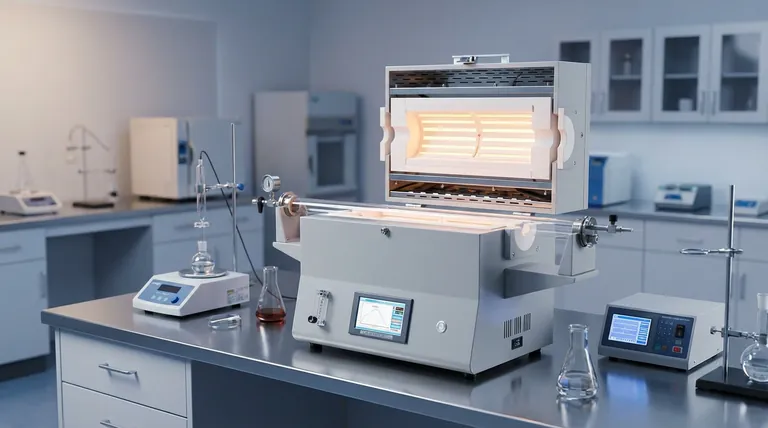
The tube furnace remains a staple in modern laboratories not because it is new, but because it solves this fundamental problem of chaos through simple, elegant geometry. It offers a "cylindrical defense" against thermal inconsistency.
The Cylindrical Defense Against Chaos
The primary advantage of a tube furnace is uniformity.
In a standard box furnace, corners and edges create natural pockets where heat behaves unpredictably. The tube furnace removes the corners. By encasing the sample within a cylindrical heating chamber and arranging elements symmetrically, it enforces a stable thermal environment.
This matters for a few specific reasons:
- Symmetry: The heat source is equidistant from the sample at all points radially.
- Gradient Reduction: It minimizes the "cold spots" that plague square geometries.
- Repeatability: When the environment is geometrically simple, the results become predictable.
For crystal growth or high-purity annealing, this isn't a luxury. It is a prerequisite.
The Romance of Mature Technology
There is a psychological tendency to equate "complex" with "better." In engineering, the opposite is often true.
The tube furnace benefits from being a mature technology. It is a system that has been refined to its absolute essentials. Because the design is simplified, the variables are reduced.
Efficiency through Focus The enclosed design concentrates energy directly onto the process tube. There is very little wasted volume to heat. This leads to high thermal efficiency and lower power consumption. In industrial settings, this tightness allows for heat recovery from flue gases—a nod to the engineer’s desire to waste nothing.
The Space Advantage Complexity takes up room. The streamlined nature of tube furnaces often results in a smaller footprint compared to box furnaces of similar capacity. In a crowded lab, vertical models turn floor space problems into vertical solutions.
Adaptation to the Task
While the core physics remain constant, the application of the tool shifts based on human needs. The variations of the tube furnace are essentially answers to specific logistical frustrations.
1. The Standard Horizontal
The workhorse. This is for general-purpose heat treatment where the sample can be placed in a boat and pushed into the center of the thermal stage. It is the baseline for consistency.
2. The Vertical Furnace
Gravity is a tool. By tilting the geometry 90 degrees, these furnaces simplify the loading of batch processes and utilize gravity to assist in specific material synthesis applications.
3. The Split-Tube
The problem-solver. Standard tubes are restrictive; you cannot fit a large reactor flange through a small opening. The split-tube design opens like a clamshell. It acknowledges that real-world experiments often involve complex reactors, wires, and odd shapes that need to be encased, not inserted.
Selecting the Right Architecture
Choosing a furnace is not about buying heat; it is about buying control.
| If your priority is... | You need... | The Logic |
|---|---|---|
| High-Purity Synthesis | Standard Horizontal | Maximum temperature uniformity is the only metric that matters. |
| Limited Lab Space | Vertical Tube | Uses verticality to reduce the physical footprint. |
| Complex Reactors | Split-Tube | Accommodates large end-fittings that cannot pass through a standard bore. |
| Scalability | Continuous System | The ability to automate and link furnaces for industrial throughput. |
The Vessel for Your Science
At KINTEK, we understand that a furnace is not just a box that gets hot. It is a controlled environment designed to eliminate variables so you can focus on the science.
Whether you require the accessibility of a split-tube design or the rigorous uniformity of a standard horizontal unit, our equipment is built to ensure that when you run an experiment, the only surprises you find are the ones you were looking for.
Stop fighting the gradients and start controlling them. Contact Our Experts
Visual Guide

Related Products
- Rotary Tube Furnace Split Multi Heating Zone Rotating Tube Furnace
- Laboratory Vacuum Tilt Rotary Tube Furnace Rotating Tube Furnace
- 1200℃ Split Tube Furnace with Quartz Tube Laboratory Tubular Furnace
- 1400℃ Laboratory High Temperature Tube Furnace with Alumina Tube
- 1700℃ Laboratory High Temperature Tube Furnace with Alumina Tube
Related Articles
- The Geometry of Heat: Why Motion Matters in Material Synthesis
- Exploring the Advantages of Rotary Tube Furnaces in Industrial and Laboratory Applications
- The Geometry of Heat: Engineering the Perfect Thermal Environment
- Exploring the Functions and Advantages of Rotary Tube Furnaces
- Exploring Rotary Tube Furnaces: A Comprehensive Guide



















