Blog The Thermodynamics of Trust: Navigating the Silent Hazards of Tube Furnaces
The Thermodynamics of Trust: Navigating the Silent Hazards of Tube Furnaces

The Thermodynamics of Trust: Navigating the Silent Hazards of Tube Furnaces

1 hour ago

It is easy to respect fire. The feedback loop is immediate: you touch a hot surface, you feel pain, you pull away.

It is much harder to respect dust.

In the laboratory, the tube furnace is the workhorse of high-temperature processing. It is an engineering marvel designed to contain immense energy within a precise geometry. However, most safety protocols suffer from a psychological blind spot. They focus entirely on the energy you can feel—the heat—while overlooking the structural and chemical byproducts that you breathe.

Safety isn’t just about avoiding burns. It is about understanding the lifespan of materials and the behavior of invisible particles.

The Optical Illusion of Safety

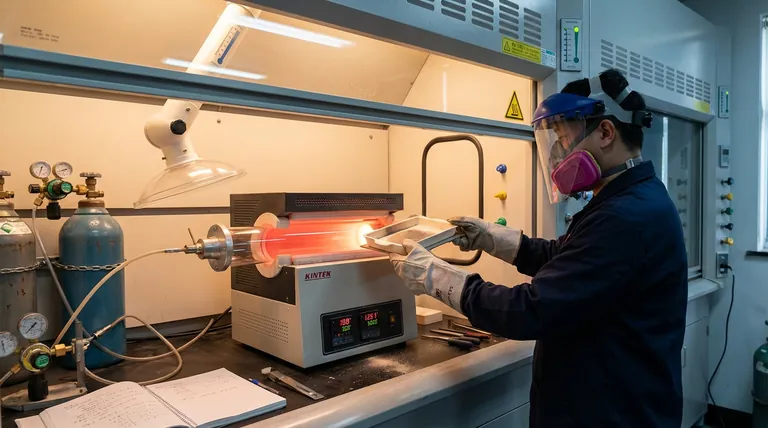
The most obvious hazard of a tube furnace is the thermal load. But the danger is rarely the glowing red element; humans are evolved to avoid glowing red things.

The danger is thermal inertia.

High-quality furnaces are designed with exceptional insulation. This means the casing, the process tube (quartz or alumina), and the sample boats retain dangerous temperatures long after the power is cut. A furnace that looks "off" can still be chemically active and physically destructive.

Beyond direct contact, we must consider the unseen spectrum:

  • Radiant Exposure: Prolonged exposure to infrared radiation without skin contact can cause burns similar to sunburn.
  • Retinal Damage: The glare from a white-hot aperture is not just bright; it is damaging.
  • The Ignition Zone: The heat creates a perimeter where common lab solvents or improper wiring can auto-ignite without ever touching the furnace walls.

The Ghost in the Insulation

Here is where the engineering reality becomes darker. The materials used to protect us from the heat can, over time, become the hazard.

For decades, Refractory Ceramic Fiber (RCF) has been the gold standard for insulation. It is lightweight and handles thermal shock beautifully. But it has a lifespan. As the furnace cycles through extreme temperatures, these liners degrade. They release microscopic fibers and dust containing crystalline silica.

This creates a respiratory hazard that mimics the tragic history of asbestos:

  1. Inhalation: The fibers are often invisible to the naked eye.
  2. Accumulation: Once inhaled, they can lodge in lung tissue.
  3. Latency: The damage, such as silicosis, appears years after the exposure.

If you are operating a legacy unit, the risk is higher. Older models may still contain actual asbestos. The act of "fixing" an old furnace—disturbing the insulation—is often the most dangerous moment in its lifecycle.

The Alchemy of the Unknown

A tube furnace is merely a vessel. The variable that defines the risk is the sample.

When materials are heated to 1000°C or higher, their chemistry changes fundamentally. A stable powder can become a volatile gas. A benign solid can react aggressively with the process tube.

  • Off-Gassing: Many samples release toxic vapors that colorless and odorless. Without a robust exhaust system, the lab atmosphere becomes a trap.
  • Tube Failure: If a sample reacts with the quartz or alumina tube, it can cause a catastrophic breach, releasing superheated gases.
  • Gas Supply Leaks: Processes often require inert or reactive atmospheres (hydrogen, nitrogen). A leak here isn't just a plumbing issue; it is an asphyxiation or explosion risk.

Systematizing Survival

Great engineering is about redundancy. Great safety is about checklist discipline.

To manage these risks, we must move from a "don't touch" mindset to a systemic protection strategy. The protocol changes based on your interaction with the machine.

Operational Phase The Primary Risk The Required Defense
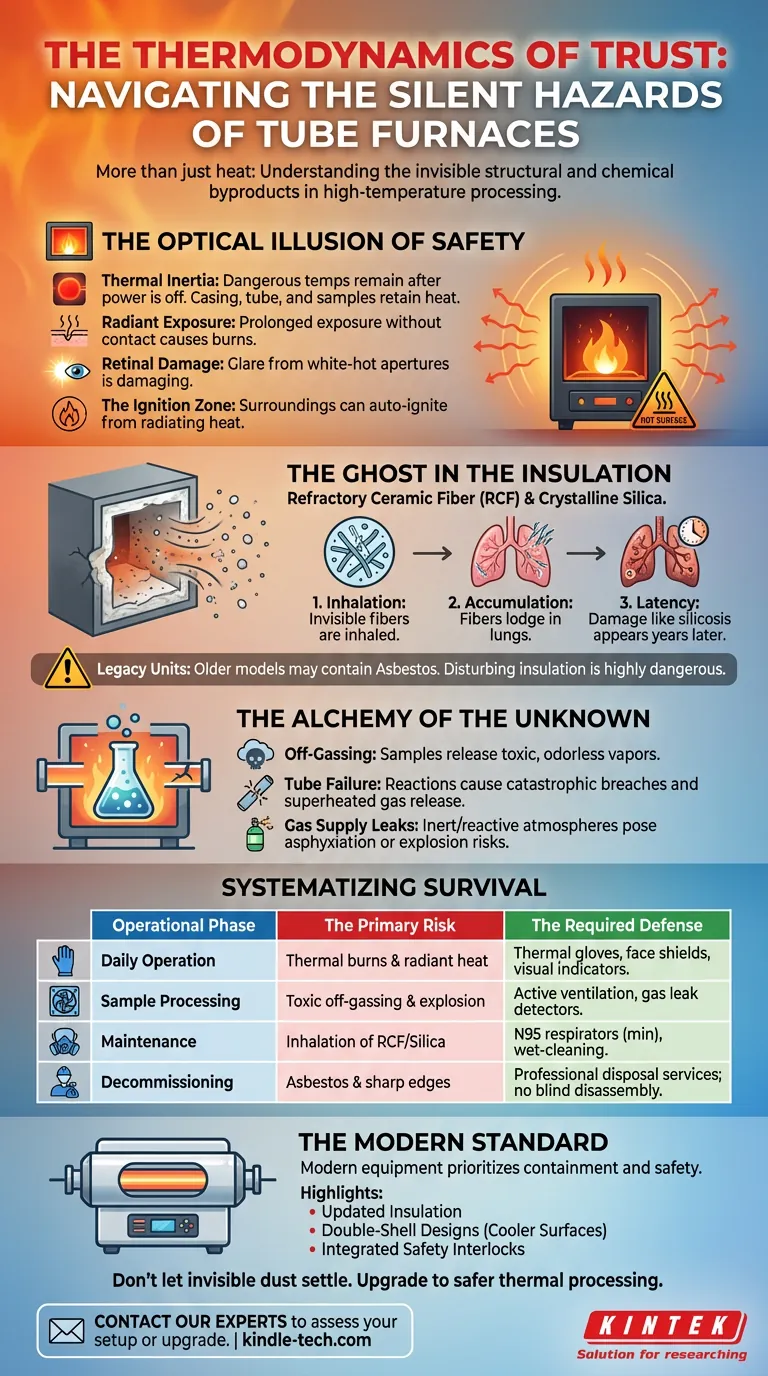
Daily Operation Thermal burns & radiant heat Thermal gloves, face shields, and visual temperature indicators.
Sample Processing Toxic off-gassing & explosion Active ventilation systems and gas leak detectors.
Maintenance Inhalation of RCF/Silica N95 respirators (minimum) and wet-cleaning methods to suppress dust.
Decommissioning Asbestos & sharp edges Professional disposal services; never disassemble blindly.

The Modern Standard

We often keep laboratory equipment far past its prime because "it still gets hot." This is a fallacy.

A furnace with degrading insulation or a compromised chassis is a liability, regardless of its heating capability. Modern laboratory equipment is designed not just for performance, but for containment. Updated insulation materials, double-shell designs for cooler outer surfaces, and integrated safety interlocks are not luxuries—they are the baseline for a safe environment.

At KINTEK, we understand that you are not just buying heat; you are buying precision and safety. We specialize in lab equipment that respects both the thermodynamics of the process and the biology of the operator. From advanced tube furnaces to the correct consumables that prevent sample cross-contamination, our solutions are engineered to mitigate the invisible risks.

Don't let the invisible dust settle in your lungs.

Contact Our Experts to assess your current setup or upgrade to safer, modern thermal processing standards.

Visual Guide
The Thermodynamics of Trust: Navigating the Silent Hazards of Tube Furnaces Visual Guide

Related Products

Related Articles

Related Products

1700℃ Muffle Oven Furnace for Laboratory

1700℃ Muffle Oven Furnace for Laboratory

Get superior heat control with our 1700℃ Muffle Furnace. Equipped with intelligent temperature microprocessor, TFT touch screen controller & advanced insulation materials for precise heating up to 1700C. Order now!

1700℃ Laboratory High Temperature Tube Furnace with Alumina Tube

1700℃ Laboratory High Temperature Tube Furnace with Alumina Tube

Looking for a high-temperature tube furnace? Check out our 1700℃ Tube Furnace with Alumina Tube. Perfect for research and industrial applications up to 1700C.

1400℃ Laboratory High Temperature Tube Furnace with Alumina Tube

1400℃ Laboratory High Temperature Tube Furnace with Alumina Tube

Looking for a tube furnace for high-temperature applications? Our 1400℃ Tube Furnace with Alumina Tube is perfect for research and industrial use.

1200℃ Split Tube Furnace with Quartz Tube Laboratory Tubular Furnace

1200℃ Split Tube Furnace with Quartz Tube Laboratory Tubular Furnace

KT-TF12 split tube furnace: high-purity insulation, embedded heating wire coils, and max. 1200C. Widely used for new materials and chemical vapour deposition.

1400℃ Muffle Oven Furnace for Laboratory

1400℃ Muffle Oven Furnace for Laboratory

Get precise high-temperature control up to 1500℃ with KT-14M Muffle furnace. Equipped with a smart touch screen controller and advanced insulation materials.

1800℃ Muffle Oven Furnace for Laboratory

1800℃ Muffle Oven Furnace for Laboratory

KT-18 muffle furnace with Japan Al2O3 polycrystalline fibe and Silicon Molybdenum heating element, up to 1900℃, PID temperature control and 7" smart touch screen. Compact design, low heat loss, and high energy efficiency. Safety interlock system and versatile functions.

Molybdenum Vacuum Heat Treat Furnace

Molybdenum Vacuum Heat Treat Furnace

Discover the benefits of a high-configuration molybdenum vacuum furnace with heat shield insulation. Ideal for high-purity, vacuum environments like sapphire crystal growth and heat treatment.

Vacuum Heat Treat and Molybdenum Wire Sintering Furnace for Vacuum Sintering

Vacuum Heat Treat and Molybdenum Wire Sintering Furnace for Vacuum Sintering

A vacuum molybdenum wire sintering furnace is a vertical or bedroom structure, which is suitable for withdrawal, brazing, sintering and degassing of metal materials under high vacuum and high temperature conditions. It is also suitable for dehydroxylation treatment of quartz materials.

Laboratory Rapid Thermal Processing (RTP) Quartz Tube Furnace

Laboratory Rapid Thermal Processing (RTP) Quartz Tube Furnace

Get lightning-fast heating with our RTP Rapid Heating Tube Furnace. Designed for precise, high-speed heating and cooling with convenient sliding rail and TFT touch screen controller. Order now for ideal thermal processing!

Graphite Vacuum Furnace Bottom Discharge Graphitization Furnace for Carbon Materials

Graphite Vacuum Furnace Bottom Discharge Graphitization Furnace for Carbon Materials

Bottom-out graphitization furnace for carbon materials, ultra-high temperature furnace up to 3100°C, suitable for graphitization and sintering of carbon rods and carbon blocks. Vertical design, bottom discharging, convenient feeding and discharging, high temperature uniformity, low energy consumption, good stability, hydraulic lifting system, convenient loading and unloading.

2200 ℃ Graphite Vacuum Heat Treat Furnace

2200 ℃ Graphite Vacuum Heat Treat Furnace

Discover the power of the KT-VG Graphite Vacuum Furnace - with a maximum working temperature of 2200℃, it's perfect for vacuum sintering of various materials. Learn more now.

Vertical High Temperature Graphite Vacuum Graphitization Furnace

Vertical High Temperature Graphite Vacuum Graphitization Furnace

Vertical high temperature graphitization furnace for carbonization and graphitization of carbon materials up to 3100℃.Suitable for shaped graphitization of carbon fiber filaments and other materials sintered in a carbon environment.Applications in metallurgy, electronics, and aerospace for producing high-quality graphite products like electrodes and crucibles.

Horizontal High Temperature Graphite Vacuum Graphitization Furnace

Horizontal High Temperature Graphite Vacuum Graphitization Furnace

Horizontal Graphitization Furnace: This type of furnace is designed with the heating elements placed horizontally, allowing for uniform heating of the sample. It's well-suited for graphitizing large or bulky samples that require precise temperature control and uniformity.

Vacuum Heat Treat and Sintering Furnace with 9MPa Air Pressure

Vacuum Heat Treat and Sintering Furnace with 9MPa Air Pressure

The air pressure sintering furnace is a high-tech equipment commonly used for the sintering of advanced ceramic materials. It combines vacuum sintering and pressure sintering techniques to achieve high-density and high-strength ceramics.

Laboratory Muffle Oven Furnace Bottom Lifting Muffle Furnace

Laboratory Muffle Oven Furnace Bottom Lifting Muffle Furnace

Efficiently produce batches with excellent temperature uniformity using our Bottom Lifting Furnace. Features two electric lifting stages and advanced temperature control up to 1600℃.

Ultra-High Temperature Graphite Vacuum Graphitization Furnace

Ultra-High Temperature Graphite Vacuum Graphitization Furnace

The ultra-high temperature graphitization furnace utilizes medium frequency induction heating in a vacuum or inert gas environment. The induction coil generates an alternating magnetic field, inducing eddy currents in the graphite crucible, which heats up and radiates heat to the workpiece, bringing it to the desired temperature. This furnace is primarily used for graphitization and sintering of carbon materials, carbon fiber materials, and other composite materials.

Vacuum Heat Treat Sintering Brazing Furnace

Vacuum Heat Treat Sintering Brazing Furnace

A vacuum brazing furnace is a type of industrial furnace used for brazing, a metalworking process that joins two pieces of metal using a filler metal that melts at a lower temperature than the base metals. Vacuum brazing furnaces are typically used for high-quality applications where a strong, clean joint is required.

Graphite Vacuum Continuous Graphitization Furnace

Graphite Vacuum Continuous Graphitization Furnace

High-temperature graphitization furnace is a professional equipment for graphitization treatment of carbon materials. It is a key equipment for the production of high-quality graphite products. It has high temperature, high efficiency and uniform heating. It is suitable for various high-temperature treatments and graphitization treatments. It is widely used in metallurgy, electronics, aerospace, etc. industry.

2200 ℃ Tungsten Vacuum Heat Treat and Sintering Furnace

2200 ℃ Tungsten Vacuum Heat Treat and Sintering Furnace

Experience the ultimate refractory metal furnace with our Tungsten vacuum furnace. Capable of reaching 2200℃, perfect for sintering advanced ceramics and refractory metals. Order now for high-quality results.

Laboratory Vacuum Tilt Rotary Tube Furnace Rotating Tube Furnace

Laboratory Vacuum Tilt Rotary Tube Furnace Rotating Tube Furnace

Discover the versatility of Laboratory Rotary Furnace: Ideal for calcination, drying, sintering, and high-temperature reactions. Adjustable rotating and tilting functions for optimal heating. Suitable for vacuum and controlled atmosphere environments. Learn more now!


Leave Your Message



















