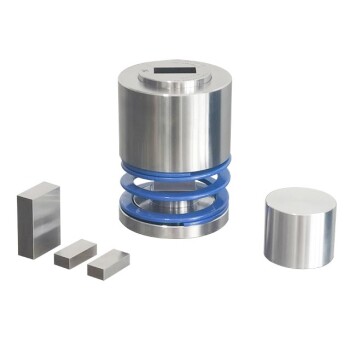
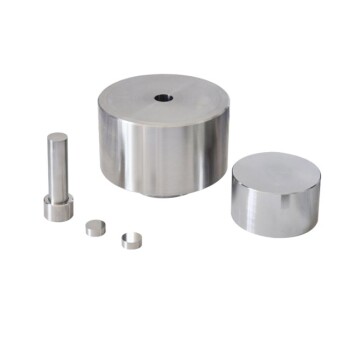
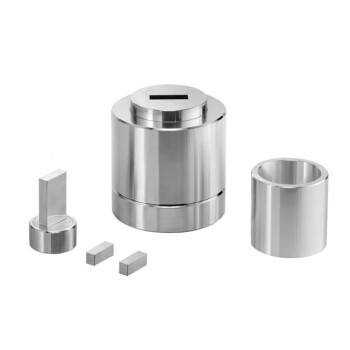
Specialized pressure dies act as critical stabilizers for battery integrity. Beyond simply shaping the pellet, their primary technical function is to prevent structural failures caused by uneven force distribution. By resisting elastic deformation under massive axial loads, they eliminate common defects such as delamination, variable density, and edge fractures.
The core value of a specialized die lies in its rigidity; it ensures pressure is transmitted evenly throughout the powder to prevent density gradients and physical separation within the green body.
The Mechanics of Pressure Transmission
The fundamental challenge in pressing all-solid-state batteries is managing the massive force required to densify powder without distorting the tooling.
Resisting Elastic Deformation
Standard tooling often flexes or warps under high loads, a phenomenon known as elastic deformation. This flexing absorbs energy that should be directed into the powder. High-strength specialized dies resolve this by maintaining absolute rigidity, ensuring the applied force is used entirely for compaction.
Ensuring Uniform Density
When a die deforms, it alters the internal geometry of the pressing chamber. This leads to uneven density distributions, where some areas of the pellet are highly compacted while others remain porous. Specialized dies act as an immovable constraint, forcing the powder to densify uniformly across the entire volume.
Preventing Defects in the "Green Body"
The "green body" refers to the compacted powder before any final sintering or processing. Preserving the integrity of this fragile state is the die's most critical role.
Eliminating Delamination
One of the most severe issues in powder pressing is delamination, where the compacted layers separate horizontally. This occurs when pressure is not transmitted equally through the depth of the material. Specialized dies ensure consistent axial pressure, bonding the particles cohesively to prevent layer separation.
Mitigating Edge Damage
The perimeter of a compressed pellet is typically its weakest point. Low-quality tooling can allow the powder to shift or expand unevenly at the boundaries, leading to chipping or edge damage. High-precision dies maintain strict containment to protect these vulnerable edges during the compression cycle.
Common Pitfalls to Avoid
While the focus is often on the press machine itself, the die determines the success of the force transfer.
The Consequence of Die Flexing
If a die lacks sufficient strength, it creates a "cushioning" effect. The machine may register high pressure, but the powder inside is not experiencing that full force due to the die expanding outward. This leads to pellets that meet geometric specs but fail in performance testing.
Inconsistent Internal Structure
Using dies that cannot withstand massive axial pressure results in invisible defects. While the exterior may look perfect, the internal structure may suffer from density gradients that impede ion flow in the final battery.
Making the Right Choice for Your Goal
Selecting the correct pressure die is about matching the tooling capability to the specific mechanical requirements of your powder material.
- If your primary focus is Structural Integrity: Prioritize dies with maximum rigidity to prevent delamination and ensure cohesive particle bonding.
- If your primary focus is Electrochemical Consistency: Select high-strength dies to guarantee uniform density, which ensures consistent ion transport pathways.
High-strength pressure dies are not just molds; they are the primary safeguard against the physical failure of the battery pellet.
Summary Table:
| Technical Issue | Resolution Provided by Specialized Dies | Impact on Battery Integrity |
|---|---|---|
| Elastic Deformation | High-strength rigidity prevents die flexing under load | Full force transfer to powder |
| Delamination | Uniform axial pressure ensures cohesive bonding | Prevents horizontal layer separation |
| Variable Density | Absolute geometric constraint during compression | Eliminates porous zones/ion flow barriers |
| Edge Damage | Precision containment at the perimeter | Protects fragile boundaries of the green body |
Elevate Your Battery Research with KINTEK's Precision Tooling
Don't let structural defects like delamination or uneven density compromise your solid-state battery performance. KINTEK provides high-strength pressure dies and a comprehensive range of laboratory hydraulic presses (pellet, hot, isostatic) designed to withstand massive axial loads without deformation.
From high-temperature furnaces and crushing systems to specialized battery research tools and consumables, our equipment ensures your materials meet the most rigorous electrochemical standards. Our experts are ready to help you select the perfect pressing solutions tailored to your specific powders.
Ready to achieve superior pellet integrity? Contact us today to discuss your project requirements!
Related Products
- Ring Press Mold for Lab Applications
- Special Heat Press Mold for Lab Use
- Cylindrical Press Mold for Lab Applications
- Special Shape Press Mold for Lab
- Ball Press Mold for Lab
People Also Ask
- How to use a press mold? Master the Art of Creating Consistent Ceramic Forms
- Why are pressure molds with non-conductive resin inner walls required for battery testing? Ensure Data Accuracy
- What is the press mould method? A Guide to Consistent, Detailed Ceramic Forms
- What is the function of press molds during the preparation of SiCf/Ti-43Al-9V composites? Achieve Structural Precision
- What is a press mold used for? Achieve Repeatable Precision and Efficiency