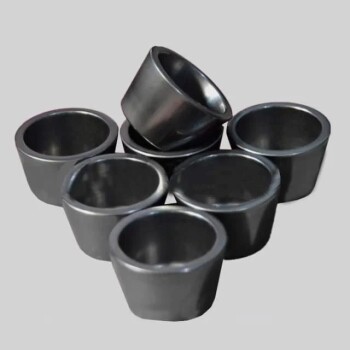
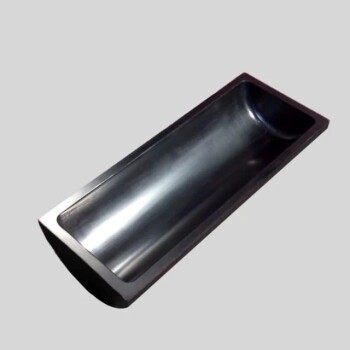
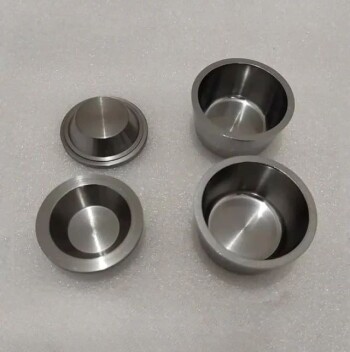
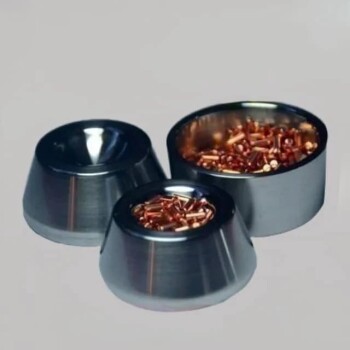
Graphite crucibles serve as a critical thermal regulator during the annealing phase of glass production, specifically operating effectively at temperatures around 550 °C. By functioning as a medium for slow, controlled cooling, these crucibles ensure the glass transitions from a melt to a solid state without locking in destructive tensions.
Core Insight: Graphite’s uniform thermal conductivity allows it to act as a precision heat sink, regulating the cooling rate of glass to eliminate residual internal stresses. This step is mandatory to prevent the glass from shattering during subsequent mechanical fabrication.
The Mechanics of Thermal Regulation
Uniform Thermal Conductivity
The primary mechanism by which graphite assists annealing is its uniform thermal conductivity.
When glass melts are poured into the crucible, the graphite distributes heat evenly across the surface. This creates an ideal environment for slow cooling, preventing the rapid temperature gradients that cause structural instability.
Thermal Stability at 550 °C
Annealing typically occurs at temperatures around 550 °C.
Graphite possesses excellent thermal stability at this specific heat range. It maintains its structural integrity and thermal properties, ensuring consistent performance throughout the critical cooling window.
Preventing Structural Failure
Eliminating Residual Stresses
The central goal of using graphite in this stage is the elimination of residual internal stresses.
If glass cools too quickly or unevenly, tension remains trapped inside the material. Graphite’s ability to slow the cooling process allows the glass molecules to settle into a stable configuration, relieving this internal pressure.
Avoiding Micro-Cracks
Internal stress often manifests as micro-cracks.
These microscopic defects compromise the integrity of the glass. By using a graphite crucible to control the thermal descent, the formation of these invisible weaknesses is significantly reduced.
The Impact on Fabrication and Machinability
Critical for Mechanical Processing
The value of the annealing process is most apparent during mechanical processing.
Steps such as cutting and grinding exert external force on the glass. If the glass has not been properly annealed in a graphite crucible, these forces will interact with internal stresses, causing the workpiece to fail.
Preventing Shattering
The ultimate consequence of bypassing this controlled cooling is shattering.
Graphite crucibles act as an insurance policy for the fabrication stage. They prepare the material to withstand the physical demands of machining without sudden, catastrophic breakage.
Making the Right Choice for Your Goal
To ensure your glass components are viable for production, consider the following based on your processing needs:
- If your primary focus is mechanical fabrication: Prioritize the use of graphite crucibles to eliminate the internal tensions that cause breakage during cutting and grinding.
- If your primary focus is material quality: Ensure the annealing process is held strictly around 550 °C to leverage graphite's thermal stability for uniform stress relief.
Controlled cooling is not merely a step in the process; it is the prerequisite for a workable, durable glass product.
Summary Table:
| Feature | Benefit in Glass Annealing |
|---|---|
| Uniform Thermal Conductivity | Ensures even heat distribution for controlled cooling. |
| Thermal Stability at 550°C | Maintains structural integrity during critical cooling phases. |
| Stress Elimination | Removes residual internal tensions to prevent micro-cracks. |
| Enhanced Machinability | Prepares glass for safe cutting, grinding, and mechanical processing. |
Elevate Your Material Quality with KINTEK Precision Solutions
Don't let internal stresses compromise your production. KINTEK specializes in high-performance laboratory equipment, providing the thermal precision your glass and material research requires. From high-quality graphite crucibles and ceramics to advanced high-temperature muffle and vacuum furnaces, we deliver the tools needed for flawless annealing and fabrication.
Whether you are performing mechanical processing or complex thermal treatments, our comprehensive range—including high-pressure reactors, crushing systems, and hydraulic presses—is designed to meet the rigorous demands of modern laboratories.
Ready to optimize your results? Contact KINTEK today to discover how our expertise in laboratory consumables and thermal equipment can enhance your lab's efficiency and product durability.
References
- Loryelle Sessegolo, Anne Chabas. Alteration rate of medieval potash-lime silicate glass as a function of pH and temperature: A low pH-dependent dissolution. DOI: 10.1016/j.chemgeo.2020.119704
This article is also based on technical information from Kintek Solution Knowledge Base .
Related Products
- High Purity Pure Graphite Crucible for Evaporation
- High Purity Pure Graphite Crucible for Electron Beam Evaporation
- Carbon Graphite Boat -Laboratory Tube Furnace with Cover
- Arc-Shaped Alumina Ceramic Crucible High Temperature Resistant for Engineering Advanced Fine Ceramics
- Engineering Advanced Fine Ceramics Alumina Al2O3 Crucible With Lid Cylindrical Laboratory Crucible
People Also Ask
- Why are high-purity graphite crucibles preferred for sulfide solid electrolytes? Achieve Superior Material Purity
- Why is a high-purity graphite crucible required for Chromel-TaC composites? Ensure Peak Purity at 1400°C
- What role do high-purity graphite crucibles play in molten salt corrosion research? Ensure Reactor-Grade Precision
- Why are high-purity graphite crucibles used for magnesium distillation? Ensure 3N8 Purity & Thermal Stability
- Why is a high-purity graphite crucible ideal for nitrogen-doped graphene at 1500 °C? Maximize Purity and Stability