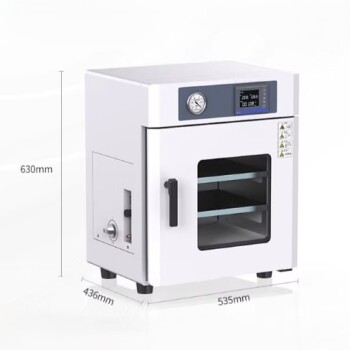
Industrial-grade constant temperature drying ovens serve as a critical instrument in the manufacturing of high-performance Graphene Oxide (GO) anti-corrosion coatings. By delivering a precise and uniform thermal environment, these ovens facilitate the essential chemical cross-linking of resins while simultaneously orchestrating the physical alignment of GO nanosheets. This dual action ensures the coating develops the necessary molecular structure and physical barrier properties to effectively resist corrosion.
Precision thermal control is not merely about drying; it is the architect of the coating’s microstructure. By stabilizing the curing rate, these ovens ensure GO nanosheets align parallel to the substrate, creating an impenetrable barrier while preventing solvent-induced defects.
The Role of Thermal Precision in Chemical Curing
Ensuring Complete Cross-Linking
To achieve a durable finish, organic resins such as epoxy or polyurethane require a specific thermal environment to fully react. Industrial ovens provide the consistent heat necessary to drive these cross-linking reactions to completion.
Stabilizing the Reaction Rate
Without a uniform thermal environment, curing can occur unevenly across the workpiece. Controlled heating ensures that the chemical bonds form consistently throughout the coating, preventing weak points in the polymer matrix.
Optimizing the Physical Shielding Structure
Achieving Parallel Nanosheet Alignment
The performance of a GO coating relies heavily on the orientation of its internal components. A controlled curing process facilitates the ideal parallel alignment of Graphene Oxide nanosheets relative to the substrate surface.
Maximizing the Barrier Effect
When these nanosheets align horizontally, they create a "tortuous path" that blocks the penetration of corrosive elements. This structural organization maximizes the physical shielding effectiveness, making it significantly harder for moisture and salts to reach the base metal.
Preventing Structural Defects
Controlling Solvent Evaporation
Coatings contain water or solvents that must be removed during the curing phase. A stable heating curve ensures these volatile components evaporate steadily rather than boiling off rapidly.
Eliminating Surface Imperfections
Rapid or uneven evaporation often compromises the coating's integrity. By regulating this process, the oven prevents the formation of physical defects such as bubbles, micro-cracks, or pinholes, which would otherwise act as entry points for corrosion.
Understanding the Trade-offs
Equipment Complexity vs. Quality
While industrial-grade ovens ensure superior coating performance, they introduce complexity to the production line. Operators must precisely manage heating profiles; a mismatch between the oven settings and the specific resin chemistry can negate the benefits of the equipment.
The Necessity of Process Control
The oven is only as effective as the heating curve programmed into it. Relying on this technology requires a commitment to strict process control, as even minor deviations in the temperature ramp-up can impact the settling of the GO nanosheets.
Making the Right Choice for Your Goal
To ensure your Graphene Oxide coatings perform as intended, you must prioritize the curing environment as much as the chemical formulation.
- If your primary focus is Maximum Corrosion Resistance: Prioritize ovens with highly stable heating curves to ensure the perfect parallel alignment of GO nanosheets for optimal shielding.
- If your primary focus is Surface Aesthetics and Integrity: Focus on thermal uniformity to control solvent evaporation and eliminate visible defects like bubbles or micro-cracks.
The drying oven is not simply a heater; it is a manufacturing tool that defines the final molecular and physical architecture of your protective system.
Summary Table:
| Feature | Impact on GO Coating Performance | Benefit |
|---|---|---|
| Thermal Uniformity | Ensures consistent chemical cross-linking | High durability & bond strength |
| Controlled Heating Curve | Regulates solvent evaporation rates | Prevents bubbles and micro-cracks |
| Precise Curing Temp | Facilitates parallel nanosheet alignment | Maximizes physical barrier shielding |
| Stable Environment | Minimizes molecular structure defects | Enhances long-term corrosion resistance |
Elevate Your Material Research with KINTEK Precision Solutions
Don't let inconsistent curing compromise your advanced coatings. KINTEK specializes in high-performance laboratory equipment designed to meet the rigorous demands of material science. Whether you are perfecting Graphene Oxide anti-corrosion layers or conducting complex battery research, our industrial-grade drying ovens, high-temperature furnaces, and vacuum systems provide the thermal precision you need for success.
From pellet presses and crushing systems to high-pressure reactors and cooling solutions, KINTEK offers a comprehensive portfolio to streamline your workflow and ensure repeatable results. Our experts are ready to help you select the ideal tools for your specific laboratory or production requirements.
Ready to optimize your curing process? Contact us today to find the perfect equipment solution!
References
- Shuo Tang, Guozhe Meng. Progress in the Graphene Oxide-Based Composite Coatings for Anticorrosion of Metal Materials. DOI: 10.3390/coatings13061120
This article is also based on technical information from Kintek Solution Knowledge Base .
Related Products
- 23L Laboratory Vacuum Drying Oven
- Laboratory Scientific Electric Heating Blast Drying Oven
- 2200 ℃ Graphite Vacuum Heat Treat Furnace
- Graphite Vacuum Continuous Graphitization Furnace
- Ultra-High Temperature Graphite Vacuum Graphitization Furnace
People Also Ask
- Why is a laboratory vacuum drying oven recommended for rice straw residues? Protect Your Biomass Integrity
- What role does a laboratory vacuum drying oven play in the preparation of modified multi-walled carbon nanotubes?
- What is the importance of using a laboratory vacuum drying oven? Preserving Slow-Release Microcapsule Integrity
- Why is a Laboratory Vacuum Drying Oven recommended for PBAT microspheres? Protect Sensitive Polymer Integrity
- What role does a laboratory vacuum drying oven play in processing nanoparticle powder samples? Protect Sample Integrity