Industrial hydraulic presses and Buchner funnels act as a two-stage separation system that transforms a liquid-heavy slurry into a dryable solid. The Buchner funnel performs the initial vacuum filtration to isolate primary solids, while the hydraulic press applies intense mechanical pressure to expel remaining water. This sequence is vital because it leverages the natural hydrophobicity of hydrochar to minimize moisture levels before energy-intensive thermal drying begins.
Core Takeaway: The integration of vacuum filtration and mechanical pressing optimizes the hydrochar production cycle by significantly lowering the equilibrium moisture content, thereby reducing the total energy required for final processing.
The Filtration Sequence: From Slurry to Primary Solid
Initial Bulk Separation via Buchner Funnels
The first step in hydrochar preparation involves passing the hydrothermal mixture through a Buchner funnel. This device utilizes vacuum filtration to pull the liquid phase away from the solid particles.
This stage is critical for capturing the primary solids from the liquid-liquid-solid mixture produced during carbonization. It serves as a necessary "rough cut" that prepares the material for more intensive mechanical processing.
Preparing for High-Pressure Dewatering
By removing the bulk of the process water, the Buchner funnel creates a wet hydrochar cake. While this cake appears solid, it still retains significant internal moisture that cannot be removed by vacuum alone.
The funnel effectively concentrates the material, ensuring that the subsequent hydraulic pressing phase is efficient and not overwhelmed by excessive liquid volume.
Mechanical Dewatering: The Role of the Hydraulic Press
Expelling Deep Moisture with High Pressure
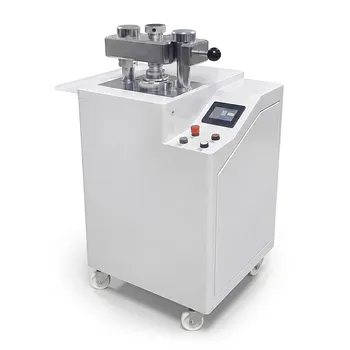
Once the primary solids are isolated, an industrial hydraulic press is employed for mechanical pressure-filtration. This equipment applies sustained force to the wet hydrochar, physically squeezing water out of the material's pores.
This mechanical approach is far more energy-efficient than evaporative drying. It targets the "free water" and a portion of the "bound water" that survives the initial vacuum filtration.
Leveraging Material Hydrophobicity
Hydrothermal carbonization (HTC) naturally enhances the hydrophobicity of the biomass. This chemical change means the resulting hydrochar has a lower affinity for water than the original feedstock.
The hydraulic press takes advantage of this property, as the hydrophobic nature of the particles makes it easier for mechanical pressure to displace water molecules. This synergy results in a significantly lower equilibrium moisture content.
Understanding the Trade-offs
Equipment Wear and Maintenance
While industrial hydraulic presses are highly effective for dewatering, the abrasive nature of carbonized particles can lead to equipment wear. The high pressures required for effective dewatering necessitate robust maintenance schedules for seals and contact surfaces.
Over-pressurizing the material can also lead to the formation of overly dense "green bodies" that might trap internal moisture if the pressure is not applied and released in controlled stages.
Energy vs. Throughput Balance
There is a fundamental trade-off between the duration of the pressing cycle and the final moisture content. While longer pressing times result in drier hydrochar, they also reduce the overall throughput of the production line.
Finding the "sweet spot" involves balancing the energy saved in the thermal dryer against the operational costs of running the hydraulic press for extended cycles.
How to Apply This to Your Process
When designing a hydrochar preparation workflow, your equipment selection should be guided by your specific production goals and energy constraints.
- If your primary focus is minimizing energy costs: Invest in a high-capacity industrial hydraulic press to maximize mechanical dewatering, as this is significantly cheaper than thermal evaporation.
- If your primary focus is high-speed production: Prioritize a high-surface-area Buchner or vacuum belt filtration system to move bulk liquids quickly, even if it leaves more work for the final drying stage.
- If your primary focus is product density: Use the hydraulic press not just for dewatering, but to apply precise axial pressure (typically 8-10 kilonewtons) to mold the hydrochar into uniform pellets or "green bodies."
By systematically combining vacuum separation and mechanical pressure, you can create a high-quality hydrochar product while maintaining a lean energy profile.
Summary Table:
| Stage | Equipment | Core Action | Primary Outcome |
|---|---|---|---|
| 1. Bulk Separation | Buchner Funnel | Vacuum Filtration | Captures primary solids from slurry |
| 2. Deep Dewatering | Hydraulic Press | Mechanical Pressure | Expels pore water from the cake |
| 3. Final Drying | Thermal Dryer | Evaporative Heating | Reaches equilibrium moisture content |
| 4. Pelleting (Optional) | Hydraulic Press | Axial Compaction | Forms dense, uniform green bodies |
Optimize Your Hydrochar Workflow with KINTEK
Ready to enhance your material processing efficiency? KINTEK specializes in high-precision laboratory equipment designed to streamline your research and production. From robust industrial hydraulic presses (pellet, hot, and isostatic) for superior dewatering to a comprehensive range of high-temperature furnaces (muffle, vacuum, CVD) and high-pressure reactors, we provide the tools you need for advanced hydrothermal carbonization.
Why choose KINTEK?
- Comprehensive Range: We offer everything from crushing systems and sieving equipment to cooling solutions and essential consumables like crucibles.
- Precision & Reliability: Our equipment is engineered to withstand abrasive materials and high-pressure cycles.
- Expert Support: We help you balance throughput and energy savings for a leaner production profile.
Maximize your lab's performance today—Contact our specialists now!
References
- Łukasz Niedźwiecki, Artur Krzysztof Pozarlik. Influence of Hydrothermal Carbonization on Catalytic Fast Pyrolysis of Agricultural Biomass. DOI: 10.3390/app13074190
This article is also based on technical information from Kintek Solution Knowledge Base .
Related Products
- Automatic Hydraulic Hot Press with 500x500mm Heating Plates and Multi Stage PLC Control for Material Sintering
- Automatic High Temperature Heated Hydraulic Press Machine with Heated Plates for Lab
- Heated Hydraulic Press Machine with Heated Plates for Vacuum Box Laboratory Hot Press
- 24T 30T 60T Heated Hydraulic Press Machine with Heated Plates for Laboratory Hot Press
- Fully Automatic Heated Hydraulic Lab Press for Materials Sintering and Sample Preparation
People Also Ask
- How do hydraulic presses facilitate material solidification in Low-Temperature LPS? Optimize Your Material Densification
- Why is 800 MPa required for TiNiPdCu alloy green bodies? Master High-Density Compaction for Superior Material Strength
- How does KBr pellet preparation facilitate FTIR of high-ash mud? Precision Sample Prep for Structural Analysis
- Why is an industrial hydraulic press with precision stainless steel molds used? For Uniform Mo-Fe Precursor Compacts.
- Purpose of Coaxial Ring Molds & Presses in EM Testing? Achieve Precise VNA Data & Fit