The precision of sample preparation determines the validity of microwave absorption data.
Using high-precision metal molds and hydraulic presses ensures Carbon/Nickel/Epoxy Resin (C/Ni/EP) specimens achieve strict geometric tolerances and uniform density. This process eliminates reflection errors and air gap inaccuracies, which are critical for calculating precise electromagnetic parameters and reflection loss (RL).
Core Takeaway: Standardized molding with a hydraulic press removes mechanical variables by ensuring perfect fitment and material homogeneity, allowing researchers to isolate the actual electromagnetic performance of the C/Ni/EP composite.
Eliminating Geometric and Reflection Errors
Achieving Precise Coaxial and Waveguide Dimensions
Microwave testing fixtures, such as coaxial transmission lines, require specimens with specific dimensions (e.g., 7.00 mm outer and 3.04 mm inner diameters). High-precision metal molds ensure these tolerances are met consistently, preventing physical defects from skewing results.
Minimizing Surface Irregularities
The use of a hydraulic press ensures that specimen surfaces are perfectly flat and parallel. Any deviation in surface planarity can cause unwanted reflections that do not represent the material's inherent properties, leading to incorrect reflection loss calculations.
Reducing Air Gap Errors
A tight fit between the specimen and the test fixture is mandatory to prevent air gap errors. Even a microscopic gap can lead to significant measurement inaccuracies regarding impedance matching and microwave loss characteristics.
Enhancing Material Integrity and Density
Removing Internal Voids and Air Bubbles
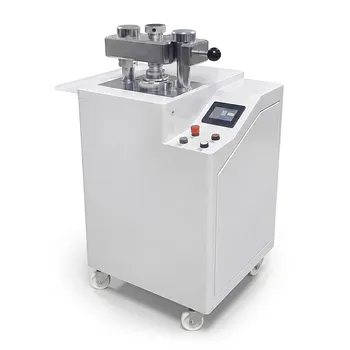
The high-pressure environment of a hydraulic press (often reaching several tons) forces out internal pores and air bubbles trapped within the C/Ni/EP mixture. Eliminating these voids is an essential prerequisite for obtaining accurate dielectric performance and breakdown strength data.
Ensuring Uniform Density Gradients
Precise pressure control ensures that the Carbon and Nickel fillers are distributed with uniform density throughout the epoxy matrix. This prevents density gradients that could cause interference or inconsistent wave propagation during 3D reflection loss mapping.
Repeatability in Composite Testing
Using standardized molds allows for repeatable results across different batches of C/Ni/EP specimens. This consistency is vital for scientifically comparing how varying concentrations of Nickel or Carbon impact the overall absorption rate.
Understanding the Trade-offs
The Risk of Over-Compression
Applying excessive pressure can lead to the crushing of delicate carbon nanostructures or the deformation of the nickel filler. This may artificially alter the percolation threshold of the composite, leading to results that do not reflect the material's performance under normal conditions.
Mold Wear and Maintenance
High-precision metal molds are subject to wear over time, especially when dealing with abrasive fillers like nickel. Regular calibration and maintenance are required to ensure that dimensional consistency does not drift, which could introduce systematic errors into long-term research.
Material Selection for Molds
While steel molds offer high durability, they must be perfectly cleaned to prevent cross-contamination. Residual epoxy or metal particles from previous batches can alter the electromagnetic signature of the new C/Ni/EP specimen.
How to Apply This to Your Project
Recommendations for Specimen Preparation
- If your primary focus is Research Accuracy: Prioritize high-precision steel molds with a manual hydraulic press to ensure every sample maintains an identical thickness and density for peer-reviewed data.
- If your primary focus is Material Screening: Use standardized ring-shaped molds (3.04 mm/7.00 mm) to ensure compatibility with standard coaxial fixtures and minimize the need for data correction.
- If your primary focus is Manufacturing Consistency: Implement a hydraulic press with digital pressure control to guarantee that the compression force remains constant across every batch produced.
By mastering the mechanical aspects of specimen fabrication, you ensure that your electromagnetic findings are a true reflection of your material's potential.
Summary Table:
| Key Feature | Benefit for C/Ni/EP Specimens | Impact on Microwave Testing |
|---|---|---|
| Geometric Precision | Perfect fit in coaxial/waveguide fixtures | Eliminates air gap errors and measurement lag |
| High-Pressure Molding | Removes internal voids and air bubbles | Ensures accurate dielectric and impedance data |
| Surface Planarity | Creates perfectly flat and parallel faces | Prevents unwanted reflections and RL inaccuracies |
| Density Control | Uniform distribution of Ni/Carbon fillers | Guarantees consistent 3D wave propagation mapping |
| Repeatability | Standardized mechanical preparation | Enables valid comparisons between different batches |
Achieve Scientific Excellence with KINTEK Precision Solutions
In microwave absorption research, the quality of your data is only as good as the precision of your specimens. KINTEK specializes in high-performance laboratory equipment designed to eliminate variables and ensure repeatability. Our robust portfolio features high-precision hydraulic presses (manual, electric, and isostatic) and custom-engineered molds tailored for C/Ni/EP and other advanced composite materials.
Beyond sample preparation, KINTEK supports your entire research lifecycle with:
- High-Temperature Furnaces: Muffle, tube, vacuum, and CVD systems for advanced material synthesis.
- Material Processing: Advanced crushing, milling, and sieving equipment for uniform filler preparation.
- Specialized Reactors: High-temperature high-pressure reactors and autoclaves for complex resin chemistry.
- Lab Essentials: Precision ceramics, crucibles, and PTFE products to maintain material purity.
Don't let mechanical inconsistencies skew your results. Partner with KINTEK to secure the accuracy your research deserves.
Contact our technical team today to find the perfect equipment for your microwave testing needs!
References
- Zifan Zhang, Ye Yuan. Recycling Polyethylene into High‐Value Porous Carbon Composites for Microwave Absorption. DOI: 10.1002/adem.202300366
This article is also based on technical information from Kintek Solution Knowledge Base .
Related Products
- Automatic Hydraulic Hot Press with 500x500mm Heating Plates and Multi Stage PLC Control for Material Sintering
- Heated Hydraulic Press Machine with Heated Plates for Vacuum Box Laboratory Hot Press
- Automatic High Temperature Heated Hydraulic Press Machine with Heated Plates for Lab
- Manual High Temperature Heated Hydraulic Press Machine with Heated Plates for Lab
- 24T 30T 60T Heated Hydraulic Press Machine with Heated Plates for Laboratory Hot Press
People Also Ask
- How do hydraulic presses facilitate material solidification in Low-Temperature LPS? Optimize Your Material Densification
- Why is 800 MPa required for TiNiPdCu alloy green bodies? Master High-Density Compaction for Superior Material Strength
- How does KBr pellet preparation facilitate FTIR of high-ash mud? Precision Sample Prep for Structural Analysis
- Why is an industrial hydraulic press with precision stainless steel molds used? For Uniform Mo-Fe Precursor Compacts.
- Purpose of Coaxial Ring Molds & Presses in EM Testing? Achieve Precise VNA Data & Fit