Knowledge How do inert gases prevent oxidation? A Simple Guide to Creating Protective Atmospheres
Author avatar

Tech Team · Kintek Solution

Updated 6 days ago

How do inert gases prevent oxidation? A Simple Guide to Creating Protective Atmospheres


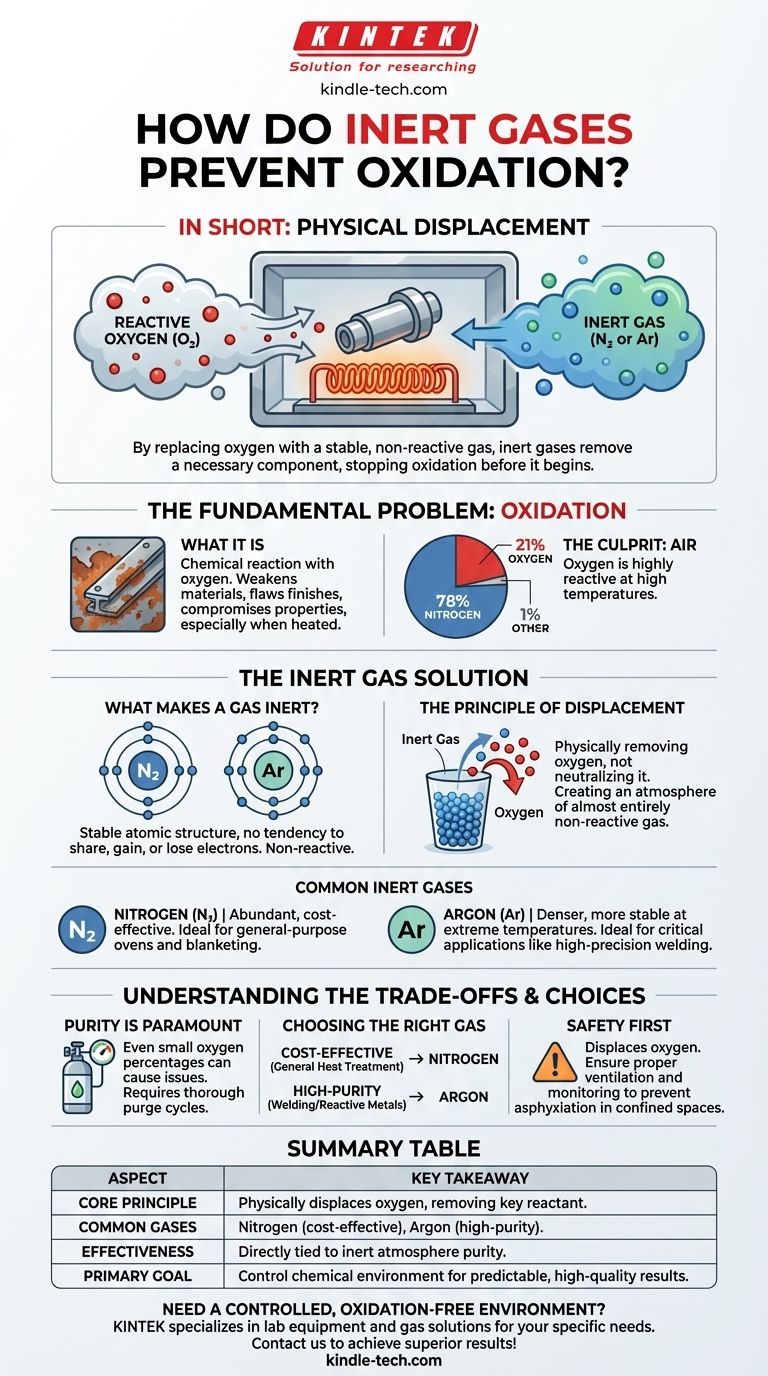
In short, inert gases prevent oxidation by physically displacing oxygen. They are pumped into a sealed environment, pushing out the reactive oxygen-rich air and replacing it with a stable, non-reactive gas that forms a protective barrier around the material.

The core principle is simple: oxidation is a chemical reaction that requires oxygen as a key ingredient. By replacing the oxygen with a gas that is chemically stable and refuses to participate in reactions, you effectively remove a necessary component, stopping oxidation before it can begin.
How do inert gases prevent oxidation? A Simple Guide to Creating Protective Atmospheres

The Fundamental Problem: Oxidation

What is Oxidation?

Oxidation is a chemical process that occurs when a substance reacts with oxygen. This is the same reaction that causes iron to rust, a cut apple to turn brown, or a fire to burn.

In industrial settings, especially when materials are heated, this process accelerates dramatically. Unwanted oxidation can weaken materials, compromise their electrical properties, or create a flawed surface finish.

Why Air is the Culprit

The air around us is approximately 78% nitrogen and 21% oxygen. While nitrogen is fairly stable, the oxygen is highly reactive and readily combines with other elements, especially at high temperatures.

Therefore, the goal in many sensitive manufacturing or scientific processes is to create an environment completely free of this reactive oxygen.

The Inert Gas Solution

What Makes a Gas "Inert"?

A gas is considered "inert" or "noble" because of its atomic structure. Gases like argon and nitrogen have a full outer shell of electrons.

This stable configuration means they have no tendency to share, gain, or lose electrons. As a result, they do not participate in chemical reactions under most conditions.

The Principle of Displacement

Using an inert gas isn't about neutralizing oxygen; it's about physically removing it. Imagine filling a cup full of water with sand—the sand displaces the water, pushing it out until the cup contains only sand.

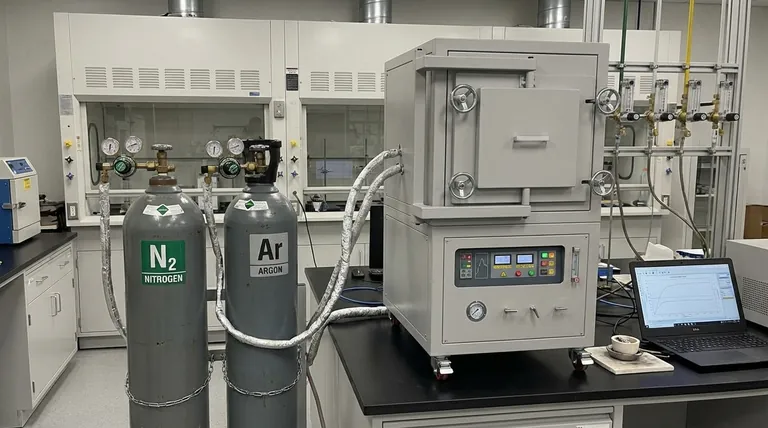
Similarly, an inert gas like nitrogen or argon is fed into a chamber (such as an oven or a welding area), purging the oxygen and creating a new atmosphere composed almost entirely of the non-reactive gas.

Common Inert Gases

The most common inert gases used for this purpose are Nitrogen (N₂) and Argon (Ar).

Nitrogen is abundant and inexpensive, making it the go-to choice for many applications. Argon is denser than air and even more inert than nitrogen, making it ideal for critical applications like high-precision TIG welding where absolute protection is required.

Understanding the Trade-offs

Purity is Paramount

The effectiveness of an inert atmosphere is directly tied to its purity. Even a small percentage of remaining oxygen can be enough to cause unwanted oxidation, especially at high temperatures.

This is why processes often involve a "purge cycle" to flush the chamber thoroughly before the primary operation (like heating) begins.

Choosing the Right Gas

While both nitrogen and argon are inert, they are not interchangeable for all tasks. Nitrogen is a cost-effective workhorse for general-purpose ovens and blanketing.

Argon, being denser and more stable at extreme temperatures, provides a more robust shield. It's preferred for welding exotic metals or in advanced manufacturing where even the slightest reaction with nitrogen could be a problem.

Safety and Handling

It is critical to remember that while inert gases are non-toxic, they displace oxygen. In a confined space, a leak can create an oxygen-deficient atmosphere that poses a serious asphyxiation hazard. Proper ventilation and monitoring are essential.

Making the Right Choice for Your Goal

Selecting the correct approach depends entirely on the sensitivity and goal of your process.

  • If your primary focus is cost-effective oxidation prevention for general heat treatment: Nitrogen is almost always the superior choice due to its low cost and high availability.
  • If your primary focus is high-purity welding or processing reactive metals at extreme temperatures: Argon provides a more reliable and completely non-reactive shield, justifying its higher cost.

Ultimately, using an inert gas is about taking deliberate control of the chemical environment to guarantee a predictable and high-quality result.

Summary Table:

Aspect Key Takeaway
Core Principle Physically displaces oxygen, removing a key reactant needed for oxidation.
Common Gases Nitrogen (cost-effective), Argon (high-purity for critical applications).
Effectiveness Directly tied to the purity of the inert atmosphere; even small oxygen levels can cause issues.
Primary Goal Control the chemical environment to prevent unwanted reactions and ensure predictable results.

Need to create a controlled, oxidation-free environment for your lab processes? KINTEK specializes in providing the right lab equipment and gas solutions to meet your specific needs. Whether you require cost-effective nitrogen blanketing or high-purity argon systems for sensitive applications, our expertise ensures your materials are protected. Contact us today to discuss how we can help you achieve superior results!

Visual Guide
How do inert gases prevent oxidation? A Simple Guide to Creating Protective Atmospheres Visual Guide

Related Products

People Also Ask

Related Products

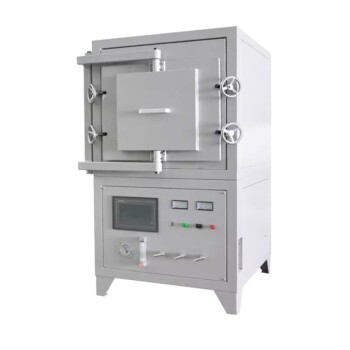
1200℃ Controlled Atmosphere Furnace Nitrogen Inert Atmosphere Furnace

1200℃ Controlled Atmosphere Furnace Nitrogen Inert Atmosphere Furnace

Discover our KT-12A Pro Controlled atmosphere furnace - high precision, heavy duty vacuum chamber, versatile smart touch screen controller, and excellent temperature uniformity up to 1200C. Ideal for both laboratory and industrial application.

1700℃ Controlled Atmosphere Furnace Nitrogen Inert Atmosphere Furnace

1700℃ Controlled Atmosphere Furnace Nitrogen Inert Atmosphere Furnace

KT-17A Controlled atmosphere furnace: 1700℃ heating, vacuum sealing technology, PID temperature control, and versatile TFT smart touch screen controller for laboratory and industrial use.

1400℃ Controlled Atmosphere Furnace with Nitrogen and Inert Atmosphere

1400℃ Controlled Atmosphere Furnace with Nitrogen and Inert Atmosphere

Achieve precise heat treatment with KT-14A controlled atmosphere furnace. Vacuum sealed with a smart controller, it's ideal for lab and industrial use up to 1400℃.

Controlled Nitrogen Inert Hydrogen Atmosphere Furnace

Controlled Nitrogen Inert Hydrogen Atmosphere Furnace

KT-AH Hydrogen atmosphere furnace - induction gas furnace for sintering/annealing with built-in safety features, dual housing design, and energy-saving efficiency. Ideal for lab and industrial use.

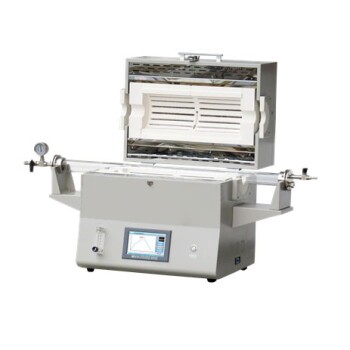
1400℃ Laboratory Quartz Tube Furnace with Alumina Tube Tubular Furnace

1400℃ Laboratory Quartz Tube Furnace with Alumina Tube Tubular Furnace

Looking for a tube furnace for high-temperature applications? Our 1400℃ Tube Furnace with Alumina Tube is perfect for research and industrial use.

1700℃ Laboratory Quartz Tube Furnace with Alumina Tube Tubular Furnace

1700℃ Laboratory Quartz Tube Furnace with Alumina Tube Tubular Furnace

Looking for a high-temperature tube furnace? Check out our 1700℃ Tube Furnace with Alumina Tube. Perfect for research and industrial applications up to 1700C.

1800℃ Muffle Oven Furnace for Laboratory

1800℃ Muffle Oven Furnace for Laboratory

KT-18 muffle furnace with Japan Al2O3 polycrystalline fibe and Silicon Molybdenum heating element, up to 1900℃, PID temperature control and 7" smart touch screen. Compact design, low heat loss, and high energy efficiency. Safety interlock system and versatile functions.

Laboratory Muffle Oven Furnace Bottom Lifting Muffle Furnace

Laboratory Muffle Oven Furnace Bottom Lifting Muffle Furnace

Efficiently produce batches with excellent temperature uniformity using our Bottom Lifting Furnace. Features two electric lifting stages and advanced temperature control up to 1600℃.

High Temperature Muffle Oven Furnace for Laboratory Debinding and Pre Sintering

High Temperature Muffle Oven Furnace for Laboratory Debinding and Pre Sintering

KT-MD High temperature debinding and pre-sintering furnace for ceramic materials with various molding processes. Ideal for electronic components such as MLCC and NFC.

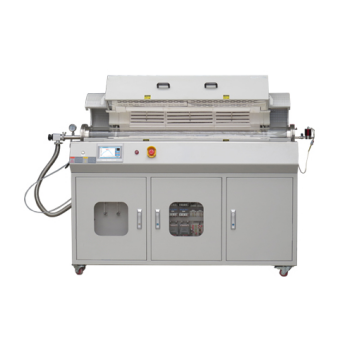
Rotary Tube Furnace Split Multi Heating Zone Rotating Tube Furnace

Rotary Tube Furnace Split Multi Heating Zone Rotating Tube Furnace

Multi zone rotary furnace for high-precision temperature control with 2-8 independent heating zones. Ideal for lithium ion battery electrode materials and high-temperature reactions. Can work under vacuum and controlled atmosphere.

Vertical Laboratory Quartz Tube Furnace Tubular Furnace

Vertical Laboratory Quartz Tube Furnace Tubular Furnace

Elevate your experiments with our Vertical Tube Furnace. Versatile design allows for operation under various environments and heat treatment applications. Order now for precise results!

1700℃ Muffle Oven Furnace for Laboratory

1700℃ Muffle Oven Furnace for Laboratory

Get superior heat control with our 1700℃ Muffle Furnace. Equipped with intelligent temperature microprocessor, TFT touch screen controller & advanced insulation materials for precise heating up to 1700C. Order now!

Graphite Vacuum Continuous Graphitization Furnace

Graphite Vacuum Continuous Graphitization Furnace

High-temperature graphitization furnace is a professional equipment for graphitization treatment of carbon materials. It is a key equipment for the production of high-quality graphite products. It has high temperature, high efficiency and uniform heating. It is suitable for various high-temperature treatments and graphitization treatments. It is widely used in metallurgy, electronics, aerospace, etc. industry.

1200℃ Split Tube Furnace with Quartz Tube Laboratory Tubular Furnace

1200℃ Split Tube Furnace with Quartz Tube Laboratory Tubular Furnace

KT-TF12 split tube furnace: high-purity insulation, embedded heating wire coils, and max. 1200C. Widely used for new materials and chemical vapour deposition.

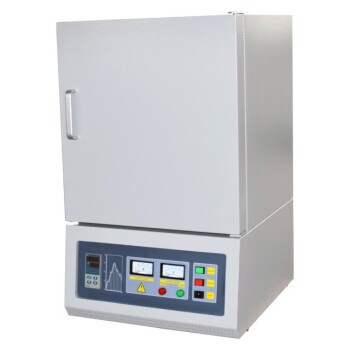
1400℃ Muffle Oven Furnace for Laboratory

1400℃ Muffle Oven Furnace for Laboratory

Get precise high-temperature control up to 1500℃ with KT-14M Muffle furnace. Equipped with a smart touch screen controller and advanced insulation materials.

High Pressure Laboratory Vacuum Tube Furnace Quartz Tubular Furnace

High Pressure Laboratory Vacuum Tube Furnace Quartz Tubular Furnace

KT-PTF High Pressure Tube Furnace: Compact split tube furnace with strong positive pressure resistance. Working temp up to 1100°C and pressure up to 15Mpa. Also works under controller atmosphere or high vacuum.

Vacuum Heat Treat and Sintering Furnace with 9MPa Air Pressure

Vacuum Heat Treat and Sintering Furnace with 9MPa Air Pressure

The air pressure sintering furnace is a high-tech equipment commonly used for the sintering of advanced ceramic materials. It combines vacuum sintering and pressure sintering techniques to achieve high-density and high-strength ceramics.

Laboratory Quartz Tube Furnace Tubular RTP Heating Furnace

Laboratory Quartz Tube Furnace Tubular RTP Heating Furnace

Get lightning-fast heating with our RTP Rapid Heating Tube Furnace. Designed for precise, high-speed heating and cooling with convenient sliding rail and TFT touch screen controller. Order now for ideal thermal processing!

Vacuum Sealed Continuous Working Rotary Tube Furnace Rotating Tube Furnace

Vacuum Sealed Continuous Working Rotary Tube Furnace Rotating Tube Furnace

Experience efficient material processing with our vacuum-sealed rotary tube furnace. Perfect for experiments or industrial production, equipped with optional features for controlled feeding and optimized results. Order now.

Laboratory Vacuum Tilt Rotary Tube Furnace Rotating Tube Furnace

Laboratory Vacuum Tilt Rotary Tube Furnace Rotating Tube Furnace

Discover the versatility of Laboratory Rotary Furnace: Ideal for calcination, drying, sintering, and high-temperature reactions. Adjustable rotating and tilting functions for optimal heating. Suitable for vacuum and controlled atmosphere environments. Learn more now!


Leave Your Message