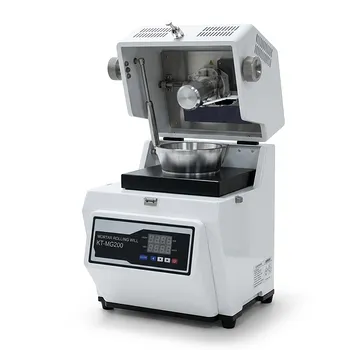
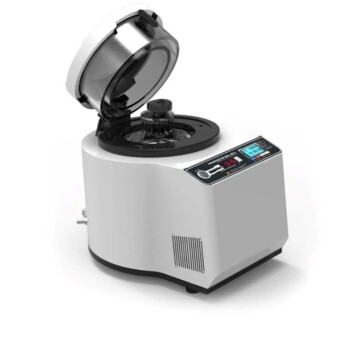
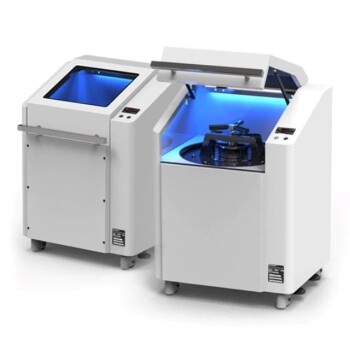
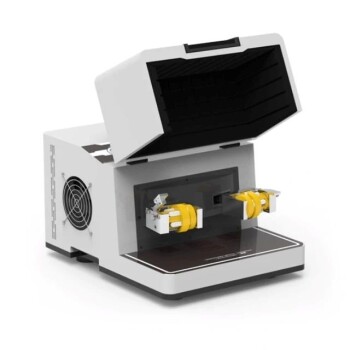
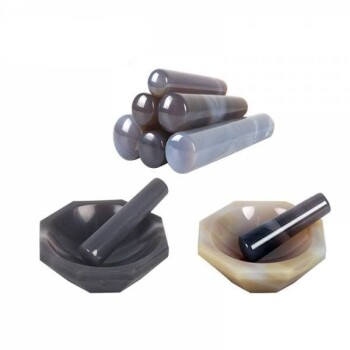
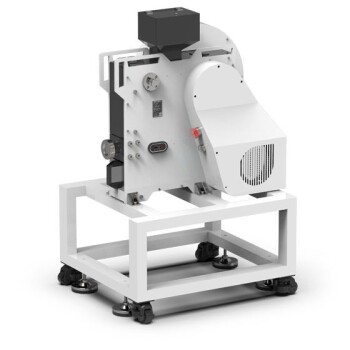
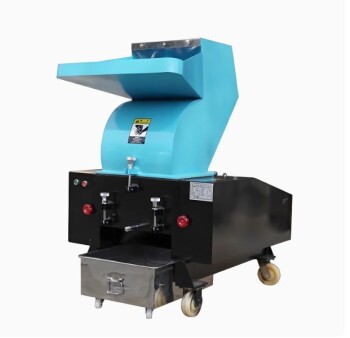
Laboratory pulverizers utilize mechanical force to fundamentally alter the physical structure of finished Ag/Ce-Mn catalysts. These devices are responsible for breaking down large, solid agglomerates that naturally form during the calcination (heating) process, converting them into extremely fine powders. This physical transformation is a prerequisite for the catalyst to function effectively in a reaction environment.
Core Takeaway The primary role of grinding equipment is to maximize the specific surface area ($S_{BET}$) of the material. By reducing particle size, you exponentially increase the frequency of contact between reactant molecules and catalytic active sites, directly driving higher macroscopic efficiency.
The Mechanism of Enhancement
Breaking Down Post-Calcination Agglomerates
During the calcination phase of catalyst preparation, materials often fuse into large clumps or "agglomerates."
Laboratory pulverizers apply mechanical force to shatter these structures. This step effectively undoes the physical consolidation caused by heat treatment without altering the chemical composition.
Creating Extremely Fine Powders
The goal of this equipment is not just to crush the material, but to reduce it to a fine powder state.
This reduction is critical because large particles hide the majority of the catalytic material inside their core, making it inaccessible to reactants. Fine powders expose the maximum amount of material to the environment.
Impact on Catalytic Performance
Maximizing Specific Surface Area ($S_{BET}$)
The most direct metric improved by pulverization is the specific surface area, often denoted as $S_{BET}$.
A higher $S_{BET}$ value means there is more physical "real estate" available for chemical reactions to occur. This is the defining factor in distinguishing a high-performance catalyst from an inefficient one.
Increasing Reactant Contact Frequency
Catalysis is a contact sport; the reactants must physically touch the active sites for a reaction to happen.
By increasing the surface area, pulverizers significantly enhance the frequency of contact between reactant molecules—such as hydrogen peroxide—and the catalyst's active sites.
Improving Macroscopic Efficiency
The cumulative effect of breaking down agglomerates and increasing surface area is a boost in overall efficiency.
While the chemical formula of the Ag/Ce-Mn catalyst provides the potential for reaction, the grinding process ensures that potential is realized on a macroscopic scale.
The Critical Role of Physical Availability
The Limitations of Calcination
It is important to recognize that a chemically perfect catalyst can fail if it is physically inaccessible.
Calcination sets the chemical structure, but it inadvertently reduces the physical availability of active sites by forming agglomerates. Relying solely on the heating process leaves the catalyst in a suboptimal state.
Mechanical Force as an Activator
Think of the pulverizer not just as a crusher, but as an activator.
Without the mechanical force to reduce particle size, the active sites remain trapped. The grinding equipment bridges the gap between a theoretical catalyst and a functional one.
Making the Right Choice for Your Goal
To optimize the performance of your Ag/Ce-Mn catalysts, ensure your preparation protocol prioritizes particle size reduction.
- If your primary focus is Maximizing Reaction Rate: Ensure the pulverization process is thorough enough to eliminate all large agglomerates, maximizing the collision frequency for reactants like hydrogen peroxide.
- If your primary focus is Material Efficiency: Prioritize achieving the highest possible specific surface area ($S_{BET}$), ensuring that no catalytic material is wasted inside uncrushed clumps.
Ultimately, the mechanical reduction of particle size is the key to unlocking the full chemical potential of your catalyst.
Summary Table:
| Feature | Impact of Grinding on Ag/Ce-Mn Catalysts |
|---|---|
| Physical State | Converts large post-calcination agglomerates into fine powders |
| Surface Area | Significantly increases $S_{BET}$ (Specific Surface Area) |
| Active Sites | Exposes internal catalytic sites for maximum reactant accessibility |
| Reaction Rate | Increases collision frequency between reactants and active sites |
| Overall Result | Bridges the gap between chemical potential and macroscopic efficiency |
Unlock the Full Potential of Your Catalyst Materials with KINTEK
At KINTEK, we understand that the performance of your Ag/Ce-Mn catalysts depends on more than just chemistry—it requires precise physical activation. Our professional-grade crushing and milling systems are engineered to deliver the uniform particle size and high specific surface area ($S_{BET}$) necessary for peak catalytic efficiency.
Whether you are refining battery research, optimizing high-pressure reactors, or developing advanced chemical sensors, KINTEK provides the comprehensive laboratory equipment your research demands. Our portfolio includes:
- Advanced Milling & Sieving: Precision pulverizers for consistent catalyst preparation.
- Thermal Processing: High-temperature muffle and tube furnaces for perfect calcination.
- Synthesis Tools: High-pressure reactors, autoclaves, and electrolytic cells.
- Laboratory Essentials: Hydraulic presses, PTFE consumables, and specialized ceramics.
Ready to elevate your material efficiency? Contact KINTEK today to discover how our high-performance grinding solutions can transform your laboratory's macroscopic results.
References
- David Alami, V.I. Bulavin. Synthesis and Characterization of Ag/Ce1-xMnxO2-δ Oxidation Catalysts. DOI: 10.9767/bcrec.8.1.4718.83-88
This article is also based on technical information from Kintek Solution Knowledge Base .
Related Products
- Three-dimensional electromagnetic sieving instrument
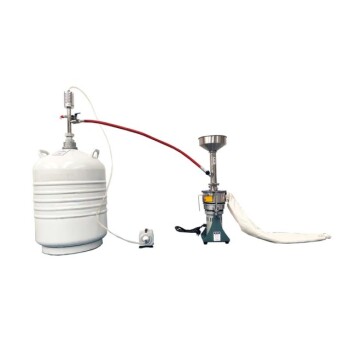
- Liquid Nitrogen Cryogenic Grinder Mill Cryomill Airflow Ultrafine Pulverizer
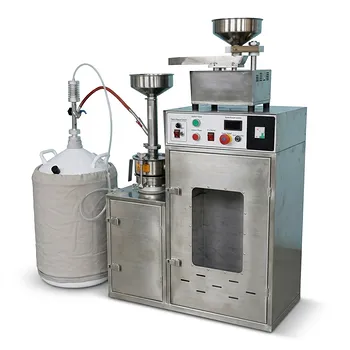
- Liquid Nitrogen Cryogenic Grinder Mill Cryomill with Screw Feeder
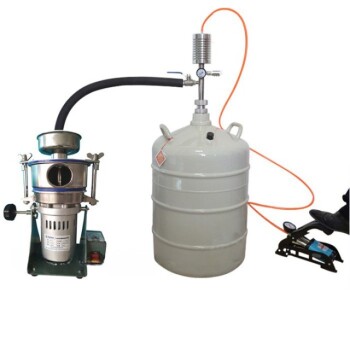
- Small Cryogenic Grinder Cryomill Cryogrinder with Liquid Nitrogen for Laboratory Use
- High Energy Planetary Ball Mill Milling Machine for Laboratory
People Also Ask
- Why is sieving equipment essential for the classification of processed bio-activated carbon? Optimize Performance
- What are the limitations of sieving? Understanding the Constraints of Particle Size Analysis
- What are advantages and disadvantages of sieving method? A Guide to Reliable & Cost-Effective Particle Sizing
- How is sieving important? The Critical Role of Particle Size Analysis in Quality Control
- What is sieving and how does it work? A Guide to Accurate Particle Size Analysis