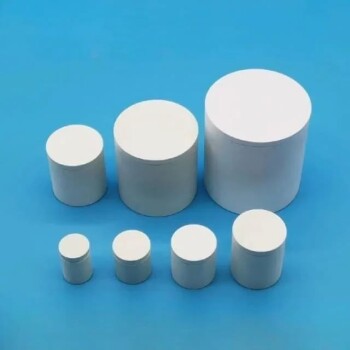
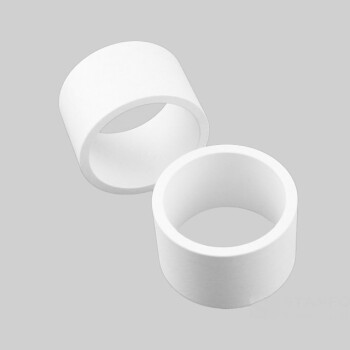
Porcelain boats and quartz tubes serve as the foundational hardware for managing reactants and gas dynamics during the Chemical Vapor Deposition (CVD) of Boron Nitride. The porcelain boat acts as a thermally stable, inert reservoir for the volatile precursor powder, while the quartz tube functions as the reaction chamber that physically constrains and directs the flow of decomposed gases over the substrate.
The synergy between these consumables is critical: the porcelain boat safely releases the precursor, while the quartz tube's geometry creates a high-concentration gas corridor. This forced flow path is essential for achieving efficient, high-quality coatings on samples like Lithium Aluminum Titanium Phosphate (LATP).
The Role of the Porcelain Boat
The porcelain boat addresses the challenge of safely containing solid reactants within a high-heat environment.
Thermal and Chemical Stability
CVD processes require extreme temperatures to vaporize precursors. Porcelain boats are selected for their high-temperature resistance, ensuring they maintain structural integrity without melting or deforming.
Inert Containment
Beyond heat resistance, the vessel must not chemically interact with the process. Porcelain provides a chemically inert surface, holding the volatile precursor powders without contaminating the vapor stream or the final coating.
The Function of the Quartz Tube
The quartz tube acts as the engine of the deposition process, dictating how the vapor moves and reacts.
Defining the Reaction Zone
The quartz tube serves as the primary reaction chamber. It creates a sealed, controlled environment where the substrate (such as LATP) is exposed to the volatile precursors in the vapor phase.
Restricting Gas Flow Paths
The physical dimensions of the tube are not arbitrary. The tube's diameter is specifically sized to restrict the gas flow path, preventing the vapor from dissipating into a large volume.
Maximizing Vapor Concentration
By confining the flow path, the quartz tube forces the decomposed precursor gases to travel in a specific direction. This creates a high concentration of reactants directly over the LATP samples, which is the primary driver for enhanced deposition efficiency and superior coating quality.
Understanding the Trade-offs
While these consumables are standard, their physical properties introduce specific limitations that must be managed.
Thermal Limits of Quartz
While quartz is excellent for flow control, it has a lower thermal threshold than the porcelain boat. Operating at excessive temperatures for prolonged periods can lead to devitrification or sagging of the tube, potentially altering the flow geometry.
Geometric Sensitivity
The advantage of the quartz tube—flow restriction—is also a potential pitfall. If the tube diameter is too narrow relative to the sample size, it may cause uneven flow turbulence; if too wide, the gas concentration drops, reducing deposition rates.
Optimizing Your CVD Setup
To maximize the effectiveness of your Boron Nitride deposition, select your consumables based on your specific experimental constraints.
- If your primary focus is Coating Uniformity: Prioritize the dimensions of the quartz tube to ensure it creates a tight, laminar flow path directly over your LATP sample.
- If your primary focus is Precursor Purity: Ensure your porcelain boats are high-grade and free of surface defects to prevent any unwanted chemical side-reactions at high heat.
Success in CVD relies not just on the chemistry, but on using the physical hardware to force the reactants exactly where they are needed.
Summary Table:
| Component | Primary Function | Key Advantage |
|---|---|---|
| Porcelain Boat | Precursor Reservoir | Thermally stable and chemically inert at extreme temperatures |
| Quartz Tube | Reaction Chamber | Restricts flow path to maximize vapor concentration over substrates |
| LATP Sample | Substrate | Receives high-quality BN coating via controlled gas dynamics |
| Process Synergy | Flow Regulation | Forces decomposed gases into a high-concentration corridor |
Elevate Your Material Research with KINTEK
Achieve precision in every deposition. KINTEK specializes in high-performance laboratory equipment and consumables designed for the most demanding CVD processes. Whether you require high-purity ceramics and crucibles (including porcelain boats), durable quartz tubes, or advanced tube and vacuum furnaces, our solutions ensure optimal thermal stability and gas dynamics for your research.
From high-temperature high-pressure reactors to specialized battery research tools, we provide the precision hardware needed to enhance your lab's efficiency and coating quality. Contact KINTEK today to find the perfect consumables for your CVD setup!
Related Products
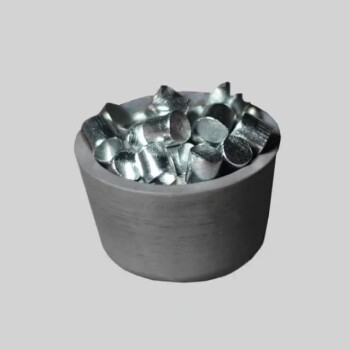
- Boron Nitride (BN) Crucible for Phosphorous Powder Sintered
- Laboratory CVD Boron Doped Diamond Materials
- Electron Beam Evaporation Coating Conductive Boron Nitride Crucible BN Crucible
- Conductive Boron Nitride BN Ceramics Composite for Advanced Applications
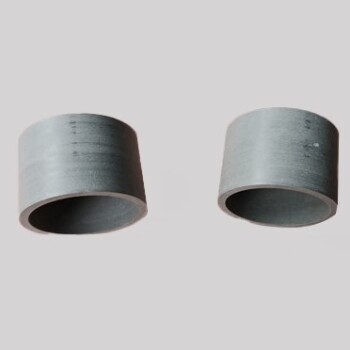
- Boron Nitride (BN) Ceramic Tube
People Also Ask
- Why use Boron Nitride (BN) crucibles in metal infiltration? Ensure sample purity and non-wetting performance.
- Why are Boron Nitride (BN) or Alumina crucibles preferred for Na-flux GaN growth? Optimize Your Crystal Yield
- What is the necessity of using a ceramic crucible as a carrier during BN synthesis? Ensure High-Purity Results
- How much heat can a ceramic crucible take? Find the Right Crucible for Your High-Temp Process
- What is the necessity of using ceramic crucibles in TGA for TClPhMA? Ensure Accurate Thermal Data Integrity