Knowledge How do you sterilize glassware without an autoclave? A Step-by-Step Guide to Dry Heat Sterilization
Author avatar

Tech Team · Kintek Solution

Updated 6 days ago

How do you sterilize glassware without an autoclave? A Step-by-Step Guide to Dry Heat Sterilization


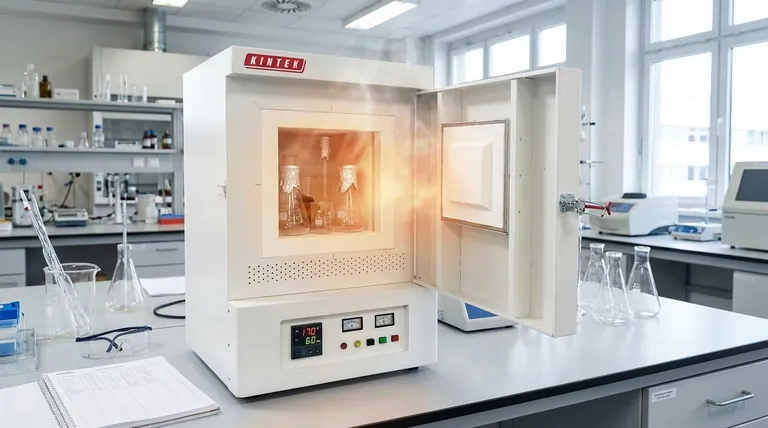
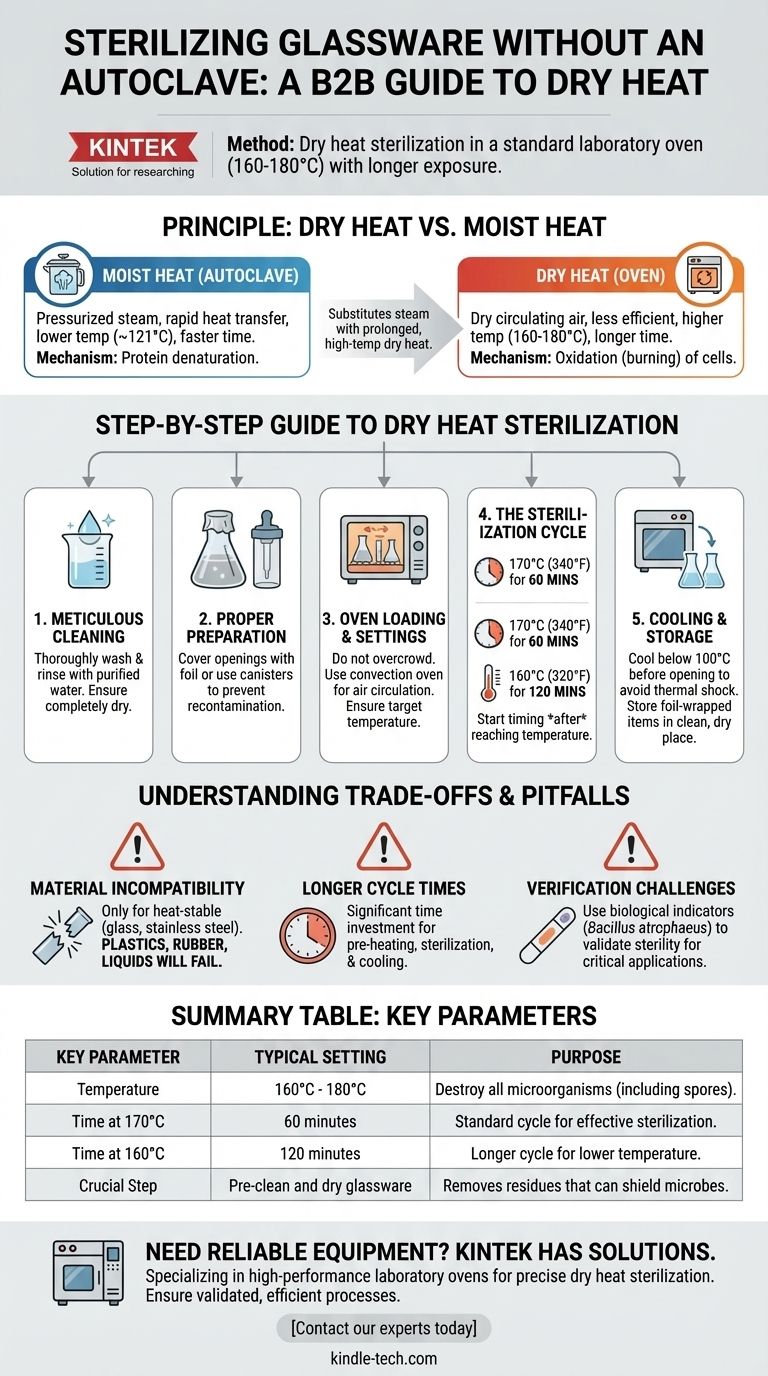
When an autoclave is unavailable, the primary and most reliable method for sterilizing glassware is dry heat sterilization using a standard laboratory oven. This process leverages higher temperatures (typically 160-180°C) and longer exposure times compared to an autoclave to effectively destroy all microorganisms, including resilient bacterial spores.

The core principle is substituting the pressurized steam of an autoclave with prolonged, high-temperature dry heat. While effective for glassware, this method requires stricter parameters—higher temperatures for longer durations—because dry heat transfers energy less efficiently than the moist heat of steam.
How do you sterilize glassware without an autoclave? A Step-by-Step Guide to Dry Heat Sterilization

The Principle: Dry Heat vs. Moist Heat

Why an Oven Isn't a Direct Substitute

An autoclave uses pressurized steam to rapidly transfer thermal energy, allowing it to sterilize at lower temperatures (around 121°C) in shorter times.

A standard oven uses dry, circulating air. Air is a far less efficient conductor of heat than steam, meaning you must compensate with more intense conditions to achieve the same result.

The Mechanism of Dry Heat

Dry heat sterilization works by oxidizing cellular components, essentially burning microorganisms to death. This is a slower process than the protein denaturation caused by moist heat in an autoclave, which is why the time and temperature requirements are significantly higher.

Step-by-Step Guide to Dry Heat Sterilization

Step 1: Meticulous Cleaning

Sterilization can only be achieved on a clean surface. Any residual organic matter can insulate microbes, shielding them from the heat and compromising the process.

Wash glassware thoroughly with an appropriate detergent, rinse multiple times with purified water (e.g., deionized water), and ensure it is completely dry before proceeding.

Step 2: Proper Preparation and Wrapping

To maintain sterility after the cycle, items should be prepared correctly.

Cover the openings of flasks, beakers, and bottles with aluminum foil. For items like pipettes, you can place them in a metal canister or wrap them entirely in foil. This barrier prevents recontamination once the oven door is opened.

Step 3: Oven Loading and Settings

Do not overcrowd the oven. Proper air circulation is critical for ensuring all surfaces reach and maintain the target temperature. Leave adequate space between all items.

The oven used must be capable of maintaining a consistent high temperature. A convection oven, which uses a fan to circulate air, is highly recommended for this purpose.

Step 4: The Sterilization Cycle

The time and temperature for sterilization are inversely related. The clock starts only after the oven has reached the target temperature.

  • 170°C (340°F) for 60 minutes
  • 160°C (320°F) for 120 minutes

For larger or densely packed loads, extending the time is a prudent safety measure to account for heat transfer lag.

Step 5: Cooling and Storage

Do not open the oven door until the cycle is complete and the temperature has dropped below 100°C. A rapid temperature change can cause glassware to crack.

Once cooled, the foil-wrapped, sterile glassware can be stored in a clean, dry, and dust-free environment until needed.

Understanding the Trade-offs and Pitfalls

Material Incompatibility

Dry heat is only suitable for heat-stable materials like glass and stainless steel.

Plastics, rubber seals, and some types of caps will melt or degrade at these high temperatures. Always verify that every component of the item being sterilized can withstand the heat.

Not Suitable for Liquids

Dry heat sterilization is completely inappropriate for liquids, media, or agars. The process would simply boil away the liquid long before sterility is achieved. These items require an autoclave or sterile filtration.

Longer Cycle Times

The entire process, including pre-heating, the sterilization cycle itself, and the cooling period, is significantly longer than a typical autoclave run. This requires careful planning in any workflow.

Verification Challenges

Just as with an autoclave, simply running a cycle does not guarantee sterility. For critical applications, biological indicators (spore strips containing Bacillus atrophaeus) should be included in the load to validate that the process was successful.

Making the Right Choice for Your Goal

To ensure you use the correct method, assess your specific materials and objectives.

  • If your primary focus is sterilizing standard borosilicate glassware (flasks, beakers, bottles): Dry heat sterilization in a convection oven is your most effective and accessible method.
  • If your primary focus is sterilizing items with plastic components (like filter funnels or caps): You must avoid dry heat. Explore chemical sterilization or acquire autoclavable versions of your equipment.
  • If your primary focus is sterilizing liquids or biological media: Dry heat is not an option; you must find access to an autoclave or use pre-sterilized filtration systems.

By understanding these principles, you can confidently achieve reliable glassware sterility, even without an autoclave.

Summary Table:

Key Parameter Typical Setting Purpose
Temperature 160°C - 180°C To destroy all microorganisms, including spores.
Time at 170°C 60 minutes Standard cycle for effective sterilization.
Time at 160°C 120 minutes Longer cycle for lower temperature.
Crucial Step Pre-clean and dry glassware Removes residues that can shield microbes.

Need reliable equipment for your sterilization protocols? KINTEK specializes in high-performance laboratory ovens and consumables designed for precise dry heat sterilization and other critical lab workflows. Ensure your processes are validated and efficient with our trusted solutions. Contact our experts today to find the perfect equipment for your laboratory's needs.

Visual Guide
How do you sterilize glassware without an autoclave? A Step-by-Step Guide to Dry Heat Sterilization Visual Guide

Related Products

People Also Ask

Related Products

1200℃ Muffle Furnace Oven for Laboratory

1200℃ Muffle Furnace Oven for Laboratory

Upgrade your lab with our 1200℃ Muffle Furnace. Achieve fast, precise heating with Japan alumina fibers and Molybdenum coils. Features TFT touch screen controller for easy programming and data analysis. Order now!

Laboratory Scientific Electric Heating Blast Drying Oven

Laboratory Scientific Electric Heating Blast Drying Oven

The desktop fast autoclave sterilizer is a compact and reliable device used for rapid sterilization of medical, pharmaceutical, and research items.

Vacuum Heat Treat and Pressure Sintering Furnace for High Temperature Applications

Vacuum Heat Treat and Pressure Sintering Furnace for High Temperature Applications

Vacuum pressure sintering furnaces are designed for high temperature hot pressing applications in metal and ceramic sintering. Its advanced features ensure precise temperature control, reliable pressure maintenance, and a robust design for seamless operation.

Graphite Vacuum Furnace Negative Material Graphitization Furnace

Graphite Vacuum Furnace Negative Material Graphitization Furnace

Graphitization furnace for battery production has uniform temperature and low energy consumption. Graphitization furnace for negative electrode materials: an efficient graphitization solution for battery production and advanced functions to enhance battery performance.

Horizontal High Temperature Graphite Vacuum Graphitization Furnace

Horizontal High Temperature Graphite Vacuum Graphitization Furnace

Horizontal Graphitization Furnace: This type of furnace is designed with the heating elements placed horizontally, allowing for uniform heating of the sample. It's well-suited for graphitizing large or bulky samples that require precise temperature control and uniformity.

Graphite Vacuum Furnace Bottom Discharge Graphitization Furnace for Carbon Materials

Graphite Vacuum Furnace Bottom Discharge Graphitization Furnace for Carbon Materials

Bottom-out graphitization furnace for carbon materials, ultra-high temperature furnace up to 3100°C, suitable for graphitization and sintering of carbon rods and carbon blocks. Vertical design, bottom discharging, convenient feeding and discharging, high temperature uniformity, low energy consumption, good stability, hydraulic lifting system, convenient loading and unloading.

Large Vertical Graphite Vacuum Graphitization Furnace

Large Vertical Graphite Vacuum Graphitization Furnace

A large vertical high-temperature graphitization furnace is a type of industrial furnace used for the graphitization of carbon materials, such as carbon fiber and carbon black. It is a high-temperature furnace that can reach temperatures of up to 3100°C.

Vacuum Hot Press Furnace Machine for Lamination and Heating

Vacuum Hot Press Furnace Machine for Lamination and Heating

Experience clean and precise lamination with Vacuum Lamination Press. Perfect for wafer bonding, thin-film transformations, and LCP lamination. Order now!

Custom Machined and Molded PTFE Teflon Parts Manufacturer with PTFE Crucible and Lid

Custom Machined and Molded PTFE Teflon Parts Manufacturer with PTFE Crucible and Lid

PTFE crucibles, made from pure Teflon, offer chemical inertness and resistance from -196°C to 280°C, ensuring compatibility with a wide range of temperatures and chemicals. These crucibles feature machine-finished surfaces for easy cleaning and prevention of contamination, making them ideal for precise laboratory applications.

High Purity Pure Graphite Crucible for Electron Beam Evaporation

High Purity Pure Graphite Crucible for Electron Beam Evaporation

A technology mainly used in the field of power electronics. It is a graphite film made of carbon source material by material deposition using electron beam technology.

Engineering Advanced Fine Ceramics Alumina Crucibles (Al2O3) for Thermal Analysis TGA DTA

Engineering Advanced Fine Ceramics Alumina Crucibles (Al2O3) for Thermal Analysis TGA DTA

TGA/DTA thermal analysis vessels are made of aluminum oxide (corundum or aluminum oxide). It can withstand high temperature and is suitable for analyzing materials that require high temperature testing.

Custom PTFE Teflon Parts Manufacturer for Hollow Cleaning Basket and Rack Carrier

Custom PTFE Teflon Parts Manufacturer for Hollow Cleaning Basket and Rack Carrier

The PTFE hollow cleaning flower basket is a specialized laboratory tool designed for efficient and safe cleaning processes. Made from high-quality polytetrafluoroethylene (PTFE), this basket offers exceptional resistance to acids, alkalis, and organic solvents, ensuring durability and reliability in various chemical environments.

Custom PTFE Teflon Parts Manufacturer for PTFE Containers

Custom PTFE Teflon Parts Manufacturer for PTFE Containers

PTFE container is a container with excellent corrosion resistance and chemical inertness.

Custom PTFE Teflon Parts Manufacturer for PTFE Measuring Cylinder 10/50/100ml

Custom PTFE Teflon Parts Manufacturer for PTFE Measuring Cylinder 10/50/100ml

PTFE measuring cylinder are a rugged alternative to traditional glass cylinders. They are chemically inert over a wide temperature range (up to 260º C), have excellent corrosion resistance and maintain a low coefficient of friction, ensuring ease of use and cleaning.

Laboratory High Throughput Tissue Grinding Mill Grinder

Laboratory High Throughput Tissue Grinding Mill Grinder

KT-MT is a high-quality, small, and versatile tissue grinder used for crushing, grinding, mixing, and cell wall breaking in various fields, including food, medical, and environmental protection. It is equipped with 24 or 48 2ml adapters and ball grinding tanks and is widely employed for DNA, RNA, and protein extraction.

Laboratory Vortex Mixer Orbital Shaker Multifunctional Rotation Oscillation Mixer

Laboratory Vortex Mixer Orbital Shaker Multifunctional Rotation Oscillation Mixer

The inching mixer is small in size, mixes quickly and thoroughly, and the liquid is in a vortex shape, which can mix all the test solutions attached to the tube wall.

Vibratory Sieve Shaker Machine Dry Three-Dimensional Vibrating Sieve

Vibratory Sieve Shaker Machine Dry Three-Dimensional Vibrating Sieve

The KT-V200 product focuses on solving common sieving tasks in the laboratory. It is suitable for sieving 20g-3kg dry samples.

Laboratory Vibratory Sieve Shaker Machine Slap Vibrating Sieve

Laboratory Vibratory Sieve Shaker Machine Slap Vibrating Sieve

KT-T200TAP is a slapping and oscillating sieving instrument for laboratory desktop use, with 300 rpm horizontal circular motion and 300 vertical slapping motions to simulate manual sieving to help sample particles pass through better.

Lab Internal Rubber Mixer Rubber Kneader Machine for Mixing and Kneading

Lab Internal Rubber Mixer Rubber Kneader Machine for Mixing and Kneading

Lab internal rubber mixer is suitable for mixing, kneading and dispersing various chemical raw materials such as plastics, rubber, synthetic rubber, hot melt adhesive and various low-viscosity materials.

Laboratory Hybrid Tissue Grinding Mill

Laboratory Hybrid Tissue Grinding Mill

KT-MT20 is a versatile laboratory device used for rapid grinding or mixing of small samples, whether dry, wet, or frozen. It comes with two 50ml ball mill jars and various cell wall breaking adapters for biological applications such as DNA/RNA and protein extraction.


Leave Your Message