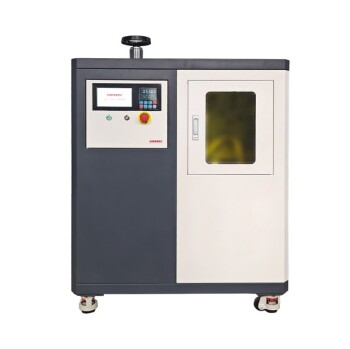
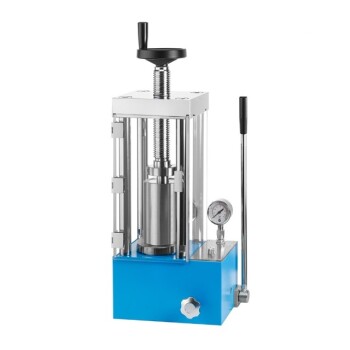
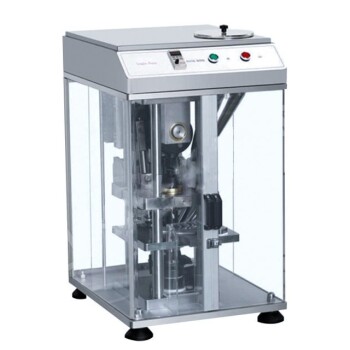
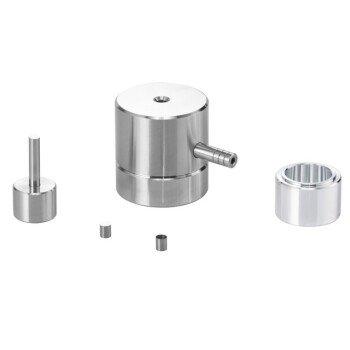
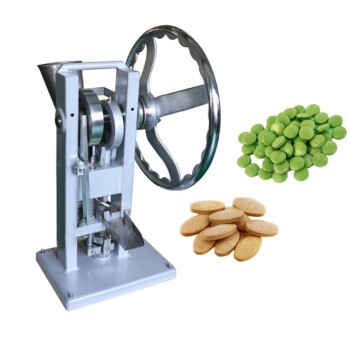
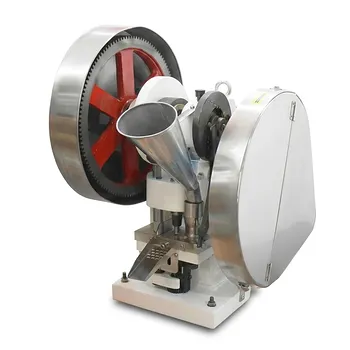
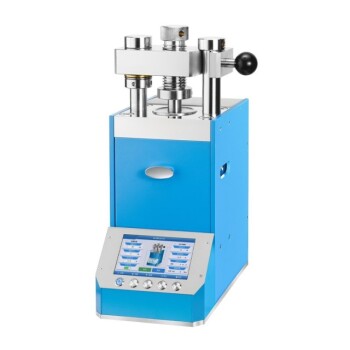
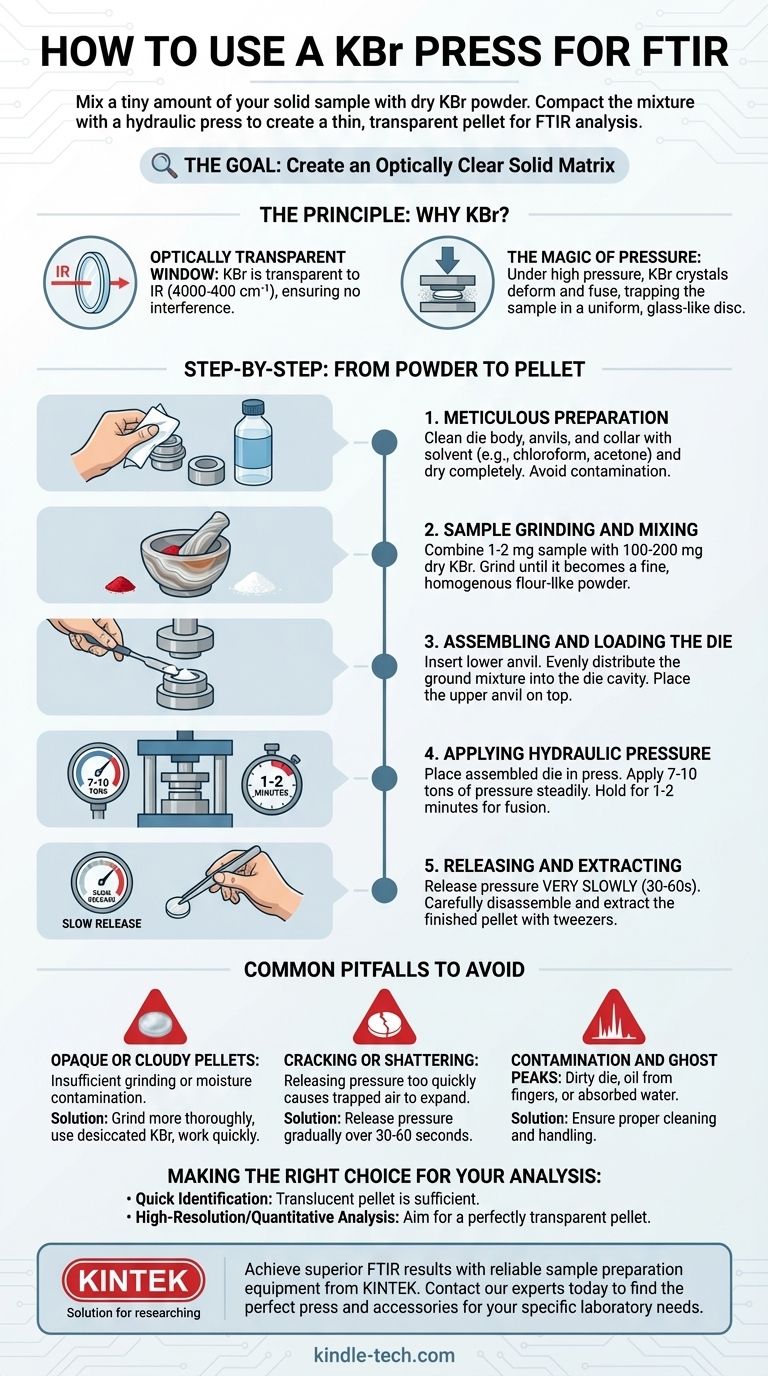
To use a KBr press, you first mix a tiny amount of your finely ground solid sample with dry potassium bromide (KBr) powder. This mixture is then loaded into a specialized die set, which is placed into a hydraulic press. Applying several tons of pressure compacts the powder into a thin, transparent, or translucent pellet, which can then be analyzed using an FTIR spectrometer.
The core objective is not simply to press a disc, but to create an optically clear, solid matrix. A well-made KBr pellet allows infrared light to pass through your sample with minimal scattering, which is the key to obtaining a clean and accurate spectrum.
The Principle: Why KBr?
An Optically Transparent Window
Potassium bromide (KBr) is the standard for this technique because it is transparent to infrared radiation across the most common analytical range (4000-400 cm⁻¹). This ensures the KBr itself does not contribute interfering peaks to your sample's spectrum.
The Magic of Pressure
Under high pressure, KBr exhibits a unique property called plastic flow. The salt crystals deform and fuse together, creating a solid, glass-like disc that traps and immobilizes the particles of your sample in a uniform suspension.
Step-by-Step: From Powder to Pellet
Step 1: Meticulous Preparation
Before you begin, all components of your pellet die must be scrupulously clean. Any residual material or grease will contaminate your sample and appear in the final spectrum.
Clean the die body, anvils (the flat pressing surfaces), and collar with a solvent like chloroform or acetone, then dry them completely with a clean tissue.
Step 2: Sample Grinding and Mixing
This is the most critical step for a high-quality pellet. Your sample must be ground to a particle size smaller than the wavelength of the infrared light to prevent light scattering.
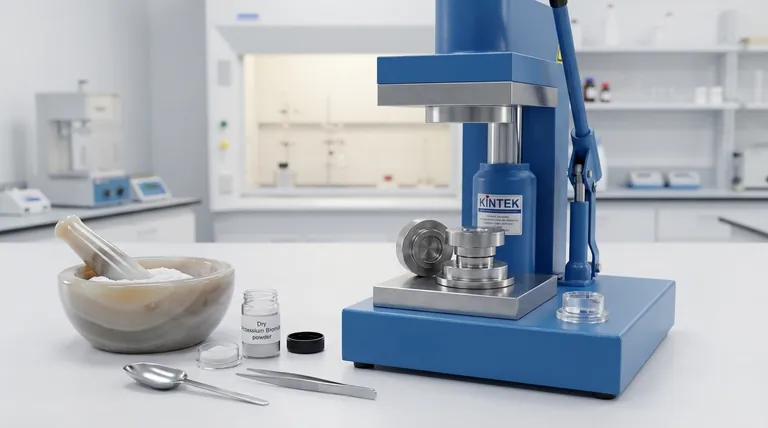
Combine approximately 1-2 mg of your solid sample with 100-200 mg of dry KBr powder in an agate mortar. Grind the mixture with a pestle until it becomes a fine, homogenous powder, similar in consistency to flour.
Step 3: Assembling and Loading the Die
There are several types of dies, but the general principle is the same. Typically, you insert one of the polished anvils into the main body or collar of the die.
Carefully transfer your ground sample mixture into the die cavity, distributing it as evenly as possible across the anvil's surface. Then, insert the second anvil on top of the powder.
Step 4: Applying Hydraulic Pressure
Place the assembled die set into the hydraulic press. Apply pressure slowly and steadily, typically in the range of 7-10 tons, holding it for 1-2 minutes. This allows any trapped air to escape and the KBr to fully fuse.
Step 5: Releasing and Extracting
Release the pressure on the press very slowly. A rapid release can cause the pellet to crack or shatter.
Once the pressure is fully released, carefully disassemble the die. The finished pellet will either be retained within a sample collar or can be gently removed with tweezers for placement in a spectrometer's sample holder. A good pellet will be thin and transparent or uniformly translucent.
Common Pitfalls to Avoid
Opaque or Cloudy Pellets
This is the most common failure mode, often caused by insufficient grinding. If sample particles are too large, they scatter the IR beam, reducing signal and distorting the spectrum. The solution is to grind the sample/KBr mixture more thoroughly.
Moisture is another culprit. KBr is hygroscopic (it readily absorbs water from the air), and water has strong IR absorption bands that can obscure your sample's signals. Always use desiccated KBr and work quickly.
Cracking or Shattering
A pellet that cracks upon removal is usually the result of releasing the hydraulic pressure too quickly. Trapped air expands rapidly, fracturing the delicate disc. Always release pressure gradually over 30-60 seconds.
Contamination and Ghost Peaks
Unwanted peaks in your spectrum often come from contamination. This can be oil from your fingers, residue from a dirty die, or absorbed atmospheric water. Proper cleaning and handling are essential for pure results.
Making the Right Choice for Your Analysis
- If your primary focus is quick, qualitative identification: A translucent, slightly cloudy pellet is often sufficient to identify a compound by its major functional groups.
- If your primary focus is high-resolution or quantitative analysis: You must strive for a perfectly transparent pellet to ensure accurate, reproducible results with a flat baseline.
Ultimately, mastering the KBr press technique is a hands-on skill that transforms your solid sample into a window for infrared analysis.
Summary Table:
| Step | Key Action | Critical Detail |
|---|---|---|
| 1. Preparation | Clean the die set | Use solvent (e.g., acetone) to remove all residue and moisture. |
| 2. Grinding & Mixing | Combine sample with KBr | Grind 1-2 mg sample with 100-200 mg dry KBr to a fine, homogenous powder. |
| 3. Loading the Die | Transfer mixture into die | Distribute powder evenly on the lower anvil before placing the top anvil. |
| 4. Applying Pressure | Use hydraulic press | Apply 7-10 tons of pressure steadily; hold for 1-2 minutes. |
| 5. Extraction | Release pressure and remove pellet | Release pressure slowly (over 30-60 sec) to prevent cracking. |
Achieve superior FTIR results with reliable sample preparation equipment from KINTEK.
Mastering the KBr press technique is essential for obtaining clean, accurate spectra from your solid samples. KINTEK specializes in high-quality laboratory equipment and consumables, including durable hydraulic presses and precision die sets designed specifically for FTIR pellet preparation. Our products help you avoid common pitfalls like cloudy pellets or contamination, ensuring your analysis is both efficient and reproducible.
Ready to enhance your lab's capabilities? Contact our experts today via our Contact Form to find the perfect press and accessories for your specific laboratory needs. Let KINTEK be your partner in precision.
Visual Guide
Related Products
- kbr pellet press 2t
- Laboratory Hydraulic Pellet Press for XRF KBR FTIR Lab Applications
- Automatic Laboratory Hydraulic Press for XRF & KBR Pellet Press
- Round Bidirectional Press Mold for Lab
- Warm Isostatic Press for Solid State Battery Research
People Also Ask
- What is the use of KBr pellets? Achieve Clear FTIR Analysis of Solid Samples
- What measurement methods are commonly used for powder samples in infrared spectroscopy? Optimize Your FTIR Analysis
- How do you make KBr pellets? Master the Art of Creating Clear FTIR Discs for Accurate Analysis
- How do you prepare samples for IR spectroscopy? A Step-by-Step Guide for Solids, Liquids, and Gases
- What is the detailed procedure for preparing a KBr pellet for analysis? Master the Art of Clear Spectroscopic Pellets