Knowledge What is the detailed procedure for preparing a KBr pellet for analysis? Master the Art of Clear Spectroscopic Pellets
Author avatar

Tech Team · Kintek Solution

Updated 2 days ago

What is the detailed procedure for preparing a KBr pellet for analysis? Master the Art of Clear Spectroscopic Pellets


To prepare a KBr pellet for spectroscopic analysis, you must thoroughly mix approximately 0.1% to 1.0% of your solid sample with 200 to 250 mg of fine potassium bromide (KBr) powder. This mixture is finely pulverized, loaded into a 13 mm pellet-forming die, and compressed under a load of approximately 8 tons while under a vacuum to produce a transparent disc.

The Core Objective: The goal is not just to compress powder, but to fuse the KBr into a glass-like, transparent medium. Achieving a vacuum during pressing is critical; without it, trapped air and moisture will result in a brittle, cloudy pellet that scatters light and compromises your data.

The Preparation Phase

Establishing the Correct Ratio

For a standard 13 mm-diameter pellet, start with 200 to 250 mg of fine KBr powder. Add a minute amount of your sample material, typically between 0.1% and 1.0% of the total weight (approximately 1 mg).

Pulverization and Blending

Thoroughly blend the sample and KBr using a mortar and pestle or a grinding mill. The mixture must be pulverized to a very fine grain size, ideally less than 75 µm, to ensure homogeneity.

Moisture Control

KBr is hygroscopic and absorbs water from the air rapidly. Ensure the mixing process is quick and, if possible, performed in a dry environment to prevent the mixture from absorbing significant moisture before pressing.

The Pressing Procedure

Loading the Die

Transfer the pulverized mixture into the pellet-forming die. Ensure the powder is evenly distributed across the face of the die to prevent uneven stress during compression.

Applying the Vacuum

Connect the die to a vacuum pump capable of achieving several mm Hg. Run the vacuum for several minutes before reaching full pressure to degas the mixture, effectively removing trapped air and moisture.

Compressing the Mixture

Apply a force of approximately 8 tons to the die. Maintain this pressure for several minutes while continuing to pull the vacuum. This combination of force and vacuum fuses the powder into a solid, transparent window.

Post-Processing and Handling

Removing the Pellet

Release the pressure and remove the anvils from the die collar. In many setups, the KBr pellet is designed to remain retained inside the metal collar for safe handling.

Mounting for Analysis

Place the collar containing the pellet into a sample holder, such as a V-shaped holder. This assembly fits into the standard slide mount of the spectrometer for analysis.

Cleaning and Disposal

After obtaining your spectra, the pellet can be ejected and saved for future reference. Alternatively, because KBr is water-soluble, the pellet can simply be rinsed out of the collar with water.

Common Pitfalls to Avoid

The "Cloudy Pellet" Issue

If your pellet appears opaque or white rather than transparent, it is usually due to insufficient vacuum or excess moisture. Air pockets left in the matrix scatter light, raising the baseline of your spectrum.

Improper Particle Size

If the sample is not ground finely enough (remaining above 75 µm), the beam will scatter off the large particles. This results in the Christiansen effect, leading to distorted band shapes in the resulting spectrum.

Over-saturation

Adding more than 1.0% sample does not improve signal; it often leads to "bottoming out" (total absorption) of strong bands. KBr spectroscopy requires a very dilute path length.

Making the Right Choice for Your Goal

To ensure your data is reliable, tailor your approach based on your specific analytical requirements:

  • If your primary focus is routine identification: Adhere strictly to the 8-ton load and 1% sample concentration to ensure a robust, easy-to-handle pellet.
  • If your primary focus is high-sensitivity quantitative analysis: Prioritize the vacuum step, ensuring it runs longer to remove all traces of air, providing the clearest possible background.

A perfect KBr pellet should look like a piece of clear glass; if you cannot read text through it, it likely needs to be re-pressed.

Summary Table:

Parameter Recommended Value Purpose
Sample Concentration 0.1% - 1.0% Prevents band saturation
KBr Powder Amount 200 - 250 mg Standard for 13mm pellet
Particle Size < 75 µm Prevents light scattering
Compression Force ~8 Tons Fuses powder into a solid
Vacuum Pressure Several mm Hg Removes air and moisture

Elevate Your Spectroscopic Precision with KINTEK

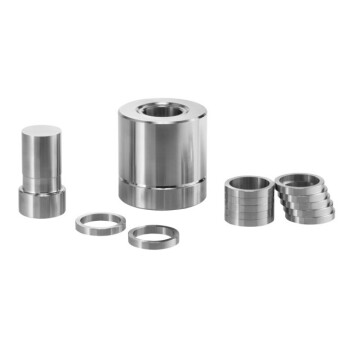
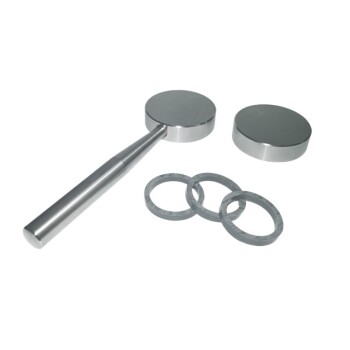
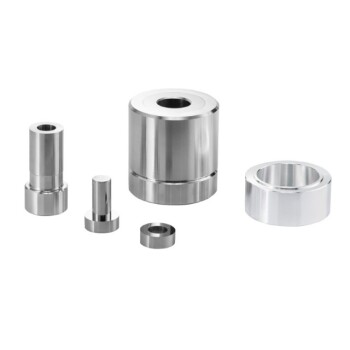
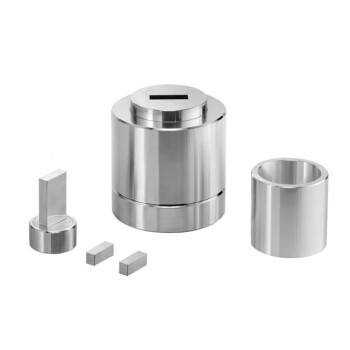
Achieving a glass-clear KBr pellet requires more than just technique; it requires precision-engineered equipment. KINTEK specializes in high-performance laboratory solutions, providing the hydraulic pellet presses, hardened steel dies, and grinding tools essential for flaw-free sample preparation.

From crushing and milling systems to professional-grade pellet dies and vacuum pumps, our portfolio supports researchers in obtaining the most accurate analytical results. Whether you are conducting routine identification or high-sensitivity quantitative analysis, our experts are here to help you select the right tools for your lab.

Ready to improve your pellet quality? Contact KINTEK today for expert guidance and equipment solutions!

Related Products

People Also Ask

Related Products

Automatic Laboratory Hydraulic Press for XRF & KBR Pellet Press

Automatic Laboratory Hydraulic Press for XRF & KBR Pellet Press

Fast and easy xrf sample pellet preparation with KinTek Automatic Lab Pellet Press. Versatile and accurate results for X-ray fluorescence analysis.

Laboratory Manual Hydraulic Pellet Press for Lab Use

Laboratory Manual Hydraulic Pellet Press for Lab Use

Efficient Manure Lab Hydraulic Press with Safety Cover for sample preparation in material research, pharmacy, and electronic industries. Available in 15T to 60T.

Laboratory Hydraulic Press Lab Pellet Press for Button Battery

Laboratory Hydraulic Press Lab Pellet Press for Button Battery

Efficiently prepare samples with our 2T Button Battery Press. Ideal for material research labs and small-scale production. Small footprint, lightweight, and vacuum-compatible.

Heated Hydraulic Press Machine with Heated Plates for Vacuum Box Laboratory Hot Press

Heated Hydraulic Press Machine with Heated Plates for Vacuum Box Laboratory Hot Press

Enhance your lab's precision with our lab press for vacuum box. Press pills and powders with ease and precision in a vacuum environment, reducing oxidation and improving consistency. Compact and easy to use with a digital pressure gauge.

Laboratory Hydraulic Pellet Press for XRF KBR FTIR Lab Applications

Laboratory Hydraulic Pellet Press for XRF KBR FTIR Lab Applications

Efficiently prepare samples with the Electric Hydraulic Press. Compact and portable, it's perfect for labs and can work in a vacuum environment.

Heated Hydraulic Press Machine with Heated Plates for Vacuum Box Laboratory Hot Press

Heated Hydraulic Press Machine with Heated Plates for Vacuum Box Laboratory Hot Press

The lab press for vacuum box is a specialized piece of equipment designed for laboratory use. Its main purpose is to press pills and powders according to specific requirements.

30T 40T Split Automatic Heated Hydraulic Press Machine with Heated Plates for Laboratory Hot Press

30T 40T Split Automatic Heated Hydraulic Press Machine with Heated Plates for Laboratory Hot Press

Discover our split automatic heated lab press 30T/40T for precise sample preparation in material research, pharmacy, ceramics, and electronics industries. With a small footprint and heating up to 300°C, it's perfect for processing under vacuum environment.

Vacuum Cold Mounting Machine for Sample Preparation

Vacuum Cold Mounting Machine for Sample Preparation

Vacuum Cold Mounting Machine for precise sample prep. Handles porous, fragile materials with -0.08MPa vacuum. Ideal for electronics, metallurgy, and failure analysis.

Vacuum Hot Press Furnace Machine for Lamination and Heating

Vacuum Hot Press Furnace Machine for Lamination and Heating

Experience clean and precise lamination with Vacuum Lamination Press. Perfect for wafer bonding, thin-film transformations, and LCP lamination. Order now!

Electric Heated Hydraulic Vacuum Heat Press for Lab

Electric Heated Hydraulic Vacuum Heat Press for Lab

The Electric Vacuum Heat Press is a specialized heat press equipment that operates in a vacuum environment, utilizing advanced infrared heating and precise temperature control for high quality, rugged and reliable performance.

Large Vertical Graphite Vacuum Graphitization Furnace

Large Vertical Graphite Vacuum Graphitization Furnace

A large vertical high-temperature graphitization furnace is a type of industrial furnace used for the graphitization of carbon materials, such as carbon fiber and carbon black. It is a high-temperature furnace that can reach temperatures of up to 3100°C.

Graphite Vacuum Continuous Graphitization Furnace

Graphite Vacuum Continuous Graphitization Furnace

High-temperature graphitization furnace is a professional equipment for graphitization treatment of carbon materials. It is a key equipment for the production of high-quality graphite products. It has high temperature, high efficiency and uniform heating. It is suitable for various high-temperature treatments and graphitization treatments. It is widely used in metallurgy, electronics, aerospace, etc. industry.

Oil Free Diaphragm Vacuum Pump for Laboratory and Industrial Use

Oil Free Diaphragm Vacuum Pump for Laboratory and Industrial Use

Oil-free diaphragm vacuum pump for labs: clean, reliable, chemical-resistant. Ideal for filtration, SPE, and rotary evaporation. Maintenance-free operation.

Dental Porcelain Zirconia Sintering Ceramic Vacuum Press Furnace

Dental Porcelain Zirconia Sintering Ceramic Vacuum Press Furnace

Get precise dental results with Dental Vacuum Press Furnace. Automatic temperature calibration, low noise tray, and touch screen operation. Order now!

Horizontal High Temperature Graphite Vacuum Graphitization Furnace

Horizontal High Temperature Graphite Vacuum Graphitization Furnace

Horizontal Graphitization Furnace: This type of furnace is designed with the heating elements placed horizontally, allowing for uniform heating of the sample. It's well-suited for graphitizing large or bulky samples that require precise temperature control and uniformity.

Vacuum Heat Treat Furnace with Ceramic Fiber Liner

Vacuum Heat Treat Furnace with Ceramic Fiber Liner

Vacuum furnace with polycrystalline ceramic fiber insulation liner for excellent heat insulation and uniform temperature field. Choose from 1200℃ or 1700℃ max. working temperature with high vacuum performance and precise temperature control.

Vacuum Heat Treat Sintering Brazing Furnace

Vacuum Heat Treat Sintering Brazing Furnace

A vacuum brazing furnace is a type of industrial furnace used for brazing, a metalworking process that joins two pieces of metal using a filler metal that melts at a lower temperature than the base metals. Vacuum brazing furnaces are typically used for high-quality applications where a strong, clean joint is required.

Graphite Vacuum Furnace Bottom Discharge Graphitization Furnace for Carbon Materials

Graphite Vacuum Furnace Bottom Discharge Graphitization Furnace for Carbon Materials

Bottom-out graphitization furnace for carbon materials, ultra-high temperature furnace up to 3100°C, suitable for graphitization and sintering of carbon rods and carbon blocks. Vertical design, bottom discharging, convenient feeding and discharging, high temperature uniformity, low energy consumption, good stability, hydraulic lifting system, convenient loading and unloading.

Graphite Vacuum Furnace High Thermal Conductivity Film Graphitization Furnace

Graphite Vacuum Furnace High Thermal Conductivity Film Graphitization Furnace

The high thermal conductivity film graphitization furnace has uniform temperature, low energy consumption and can operate continuously.

Graphite Vacuum Furnace IGBT Experimental Graphitization Furnace

Graphite Vacuum Furnace IGBT Experimental Graphitization Furnace

IGBT experimental graphitization furnace, a tailored solution for universities and research institutions, with high heating efficiency, user-friendliness, and precise temperature control.


Leave Your Message