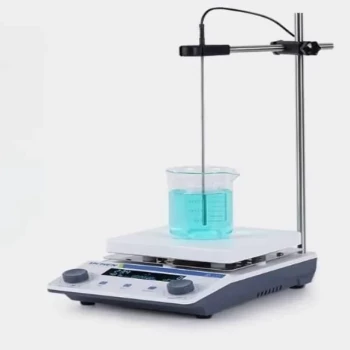
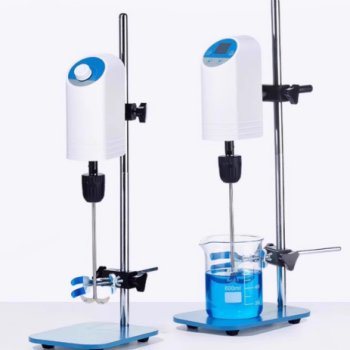
A constant temperature heating and stirring device acts as the critical regulator of reaction kinetics during the polyol synthesis of silver nanospheres. By locking the reaction environment at a precise temperature, such as 125 °C, and maintaining continuous mechanical agitation, the device ensures the controlled reduction of Silver Nitrate (AgNO3) in ethylene glycol. This thermal and mechanical stability allows the dispersant to effectively encapsulate forming particles, preventing the chemical chaos that leads to irregular sizes or clumping.
The synergy between precise thermal regulation and mechanical agitation is the defining factor in seed quality. Without this dual control, reduction rates fluctuate and dispersant coverage fails, resulting in unusable, agglomerated silver particles.
The Physics of Controlled Synthesis
Regulating Reduction Kinetics
Temperature acts as the "accelerator" for the chemical reaction. In this specific synthesis, maintaining a stable 125 °C is essential to control the rate at which Silver Nitrate (AgNO3) reduces to elemental silver.
The Role of Ethylene Glycol
Ethylene glycol functions as both the solvent and the reducing agent in this process. Its ability to facilitate the reduction reaction is temperature-dependent, requiring a constant heat source to perform consistently.
Preventing Reaction Drift
If the temperature fluctuates, the reduction rate changes. This leads to inconsistent nucleation bursts, which creates particles of varying sizes rather than a uniform batch.
The Mechanism of Particle Stabilization
Achieving Homogeneity
Continuous stirring ensures that the chemical concentration remains uniform throughout the vessel. It prevents "hot spots" where reagents might react too quickly or precipitate out of the solution.
Facilitating Encapsulation
The quality of the seed depends on how well the dispersant covers the forming silver nucleus. Stirring brings the dispersant molecules into contact with the nanoparticles immediately upon formation.
Stopping Overgrowth
Effective encapsulation puts a "cap" on the particle's growth. By ensuring the dispersant surrounds the particle efficiently, the device prevents the silver seeds from growing too large or fusing with neighbors (agglomeration).
Common Pitfalls in Synthesis Control
Thermal Hysteresis
A device with poor thermal control may overshoot or undershoot the 125 °C target. These thermal swings disrupt the equilibrium of the reaction, leading to batches with high polydispersity (mixed sizes).
Inconsistent Agitation
If stirring is too slow, reagents may settle, leading to localized concentration gradients. This lack of mixing often results in agglomerated clumps of silver rather than discrete nanospheres.
Optimizing Your Synthesis Process
Achieving high-quality silver seeds requires balancing thermal energy with mechanical distribution.
- If your primary focus is Particle Uniformity: Prioritize a heating device with a PID controller to minimize temperature fluctuations around the 125 °C setpoint.
- If your primary focus is Prevention of Agglomeration: Ensure your stirring speed is high enough to maintain a vortex without causing splashing or introducing air bubbles.
Ultimately, the precision of your hardware directly dictates the consistency of your chemistry.
Summary Table:
| Feature | Function in Ag Nanosphere Synthesis | Impact on Seed Quality |
|---|---|---|
| Precise Temperature | Regulates reduction kinetics of AgNO3 | Ensures uniform nucleation and particle size |
| PID Control | Minimizes thermal hysteresis/fluctuations | Prevents polydispersity (mixed particle sizes) |
| Continuous Stirring | Maintains chemical & thermal homogeneity | Prevents local concentration gradients and hot spots |
| Mechanical Agitation | Facilitates dispersant encapsulation | Prevents overgrowth and particle agglomeration |
Elevate Your Nanomaterial Synthesis with KINTEK
Precision is the backbone of consistent chemical synthesis. At KINTEK, we understand that even a minor temperature drift can compromise your silver nanosphere quality. Our high-performance laboratory equipment, including advanced heating and stirring solutions, high-temperature furnaces, and specialized reactors, is engineered to provide the absolute stability your research demands.
From PTFE-coated magnetic stirrers and ceramics to high-pressure autoclaves and cooling solutions, KINTEK provides the comprehensive tools needed for advanced battery research, material science, and chemical engineering.
Ready to eliminate reaction drift and achieve superior particle uniformity? Contact our experts today to find the perfect equipment configuration for your lab's specific needs.
References
- Emerson Brito Mourão De Oliveira, Marco Aurélio Suller Garcia. Highly Selective Hydrogen Peroxide Production Using an AgPd-Based Electrocatalyst with Ultralow Pd Loading. DOI: 10.1021/acsomega.5c04823
This article is also based on technical information from Kintek Solution Knowledge Base .
Related Products
- Laboratory Small Constant Temperature Heated Magnetic Stirrer Heater and Stirrer
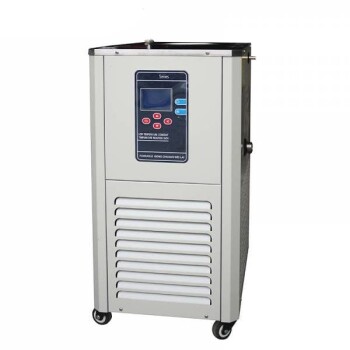
- High Temperature Constant Temperature Heating Circulator Water Bath Chiller Circulator for Reaction Bath
- 100L Heating Chilling Circulator Cooling Water Bath Circulator for High and Low Temperature Constant Temperature Reaction
- 5L Heating Chilling Circulator Cooling Water Bath Circulator for High and Low Temperature Constant Temperature Reaction
- 20L Heating Chilling Circulator Cooling Water Bath Circulator for High and Low Temperature Constant Temperature Reaction
People Also Ask
- What role does a magnetic stirrer with heating play in ZnO nanoparticle synthesis? Precision Control for Quality Results
- What role does a constant temperature heating magnetic stirrer play in MFC-HAp synthesis? Achieve Material Homogeneity
- What is the function of a laboratory magnetic stirrer in Ni–Cr–P electrodeposition? Optimize Ion Transport & Coating
- Why is a laboratory magnetic stirrer required for benzoic acid esters? Boost Reaction Speed & Yield with High RPM
- What role does a laboratory magnetic stirrer play in TiO2 and TiO2-Ag sol preparation? Master Chemical Kinetics