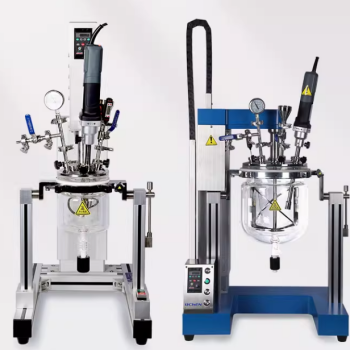
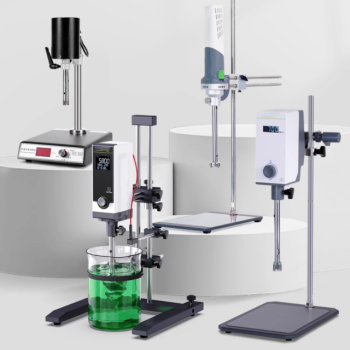
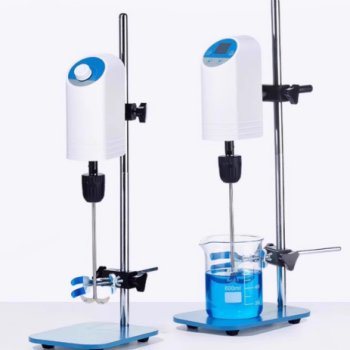
High-power ultrasonic homogenizers are the critical enabling technology for synthesizing magnetic polyurethane nanocomposites because they provide the intense energy required to disrupt nanoparticle clusters. By generating cavitation and mechanical shear forces, this equipment breaks down the strong Van der Waals attraction between ferrite nanoparticles, ensuring they are dispersed at a molecular level within the organic polyurethane matrix.
Core Takeaway The primary function of an ultrasonic homogenizer is to prevent the secondary agglomeration of inorganic nanoparticles. This ensures a uniform distribution of the functional phase, which is the prerequisite for achieving high mechanical strength, biocompatibility, and consistent magnetic response in the final composite material.
The Mechanism of Dispersion
Creating Intense Cavitation
The homogenizer operates by transmitting high-frequency sound waves into the liquid medium. This creates rapid pressure fluctuations that generate microscopic bubbles, a process known as cavitation.
When these bubbles collapse, they release intense localized energy. This energy acts as a powerful wedge, physically separating particles that are clumped together.
Generating Mechanical Shear Forces
Alongside cavitation, the equipment produces high-velocity mechanical shear forces. These forces act on the fluid dynamics of the mixture, further tearing apart particle aggregates.
This combination of cavitation and shear is the only reliable method to overcome the natural tendency of nanoparticles to stick together.
Solving the Agglomeration Problem
Overcoming Van der Waals Forces
Ferrite nanoparticles possess strong Van der Waals forces, which are attractive forces that cause particles to bind to one another.
Without high-power intervention, these forces cause the particles to form clusters or agglomerates. The ultrasonic homogenizer provides the specific energy threshold needed to break these bonds and separate the particles.
Preventing Secondary Agglomeration
Once particles are separated, they are prone to re-clumping, known as secondary agglomeration.
Continuous high-power homogenization keeps the particles suspended and separated during the mixing process. This stability allows the polyurethane matrix to surround each individual nanoparticle before they can re-aggregate.
Enhancing Material Properties
Molecular-Level Uniformity
The ultimate goal is molecular-level uniform dispersion. Instead of having "pockets" of magnetic material, the ferrite is evenly distributed throughout the polyurethane.
This deep integration ensures that the organic and inorganic phases function as a single, cohesive material rather than a mixture of two separate substances.
Boosting Mechanical Strength
When nanoparticles are uniformly dispersed, the interfacial adhesion between the inorganic filler and the polymer matrix improves significantly.
This creates a stronger structure capable of better stress transfer. The material can handle higher physical loads because the reinforcement phase (ferrite) is effectively supporting the matrix (polyurethane).
Ensuring Magnetic Consistency
For magnetic polyurethane, the material's utility depends on a predictable reaction to magnetic fields.
Agglomerated particles create uneven magnetic responses. Ultrasonic homogenization ensures the magnetic response properties are consistent across the entire volume of the material.
Common Pitfalls to Avoid
The Failure of Low-Energy Mixing
Standard mechanical stirring is often insufficient for nanocomposites. It lacks the shear force required to break the sub-100nm bonds held by Van der Waals forces.
Using low-energy methods typically results in a material with weak spots and poor magnetic performance due to clumping.
Incomplete De-agglomeration
If the processing time or power is too low, you may achieve partial dispersion but fail to exfoliate the tightest aggregates.
To maximize barrier properties and mechanical performance, the process must achieve full de-agglomeration, ensuring every nanoparticle is isolated and wetted by the polymer.
Making the Right Choice for Your Goal
To maximize the quality of your organic-inorganic nanocomposites, tailor your processing approach to your specific performance metrics.
- If your primary focus is Mechanical Strength: Ensure your process allows for deep molecular interaction to maximize interfacial adhesion and stress transfer efficiency between the matrix and the reinforcement phase.
- If your primary focus is Magnetic Response: Prioritize preventing secondary agglomeration to guarantee that the ferrite distribution is perfectly homogeneous, eliminating "dead zones" in the magnetic field.
True nanocomposite performance is not achieved by mixing, but by the relentless application of shear force to ensure molecular unity.
Summary Table:
| Feature | Mechanism/Impact | Benefit for Nanocomposites |
|---|---|---|
| Cavitation | Localized energy release via bubble collapse | Disruption of strong Van der Waals forces |
| Shear Force | High-velocity fluid dynamics | Physical separation of nanoparticle aggregates |
| Dispersion | Molecular-level uniform distribution | Elimination of "dead zones" and weak spots |
| Interfacial Adhesion | Improved bond between filler and matrix | Enhanced mechanical strength and stress transfer |
| Magnetic Response | Homogeneous distribution of ferrite phases | Consistent performance across the material volume |
Elevate Your Nanomaterial Synthesis with KINTEK
Achieving molecular-level uniformity in organic-inorganic nanocomposites like magnetic polyurethane requires more than standard mixing—it requires the precision of KINTEK high-power ultrasonic homogenizers. Our advanced laboratory solutions are designed to overcome secondary agglomeration and maximize mechanical strength for your most demanding research applications.
Beyond homogenization, KINTEK specializes in a comprehensive range of laboratory equipment including:
- High-Temperature Solutions: Muffle, tube, vacuum, and CVD furnaces.
- Sample Preparation: Crushing, milling systems, and hydraulic presses (pellet, hot, isostatic).
- Advanced Reactors: High-temperature high-pressure reactors and autoclaves.
- Energy Research: Electrolytic cells, electrodes, and battery research tools.
- Consumables: High-quality PTFE products, ceramics, and crucibles.
Ready to optimize your dispersion process and material performance? Contact KINTEK today to discover how our expertise and equipment can drive your laboratory's success.
References
- Malgorzata Rybczynska, Artur Sikorski. Multicomponent crystals of nimesulide: design, structures and properties. DOI: 10.21175/rad.abstr.book.2023.23.1
This article is also based on technical information from Kintek Solution Knowledge Base .
Related Products
- High Performance Lab Homogenizer for Pharma Cosmetics and Food R&D
- High Shear Homogenizer for Pharmaceutical and Cosmetic Applications
- Laboratory High Throughput Tissue Grinding Mill Grinder
- Lab Sterile Slapping Type Homogenizer for Tissue Mashing and Dispersing
- High Performance Laboratory Stirrers for Diverse Applications
People Also Ask
- Why is a high-performance homogenizer essential for Fe3O4@C9 anode slurries? Boost Battery Performance & Stability.
- What is the primary function of high-performance homogenizers for SAPO-34 MMMs? Ensure Superior Gas Separation Efficiency
- How do lab stirrers & homogenizers ensure uniform distribution? Optimize Your Complex Multiphase Chemical Mixing
- What role does a laboratory homogenizer play in radioactive cesium detection? Ensure Accuracy in Wildlife Sampling
- How does a laboratory automatic masticator or homogenizer facilitate the processing of biofilm samples? Optimize Accuracy