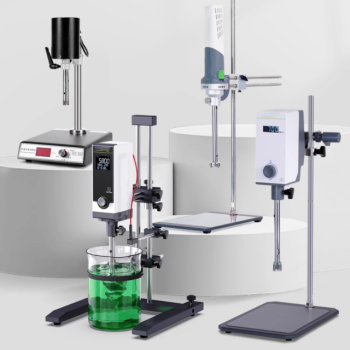
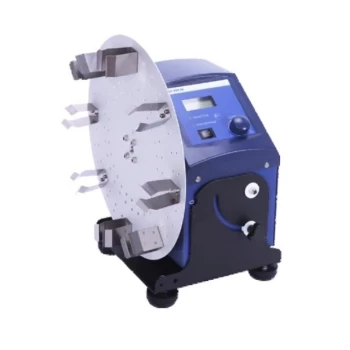
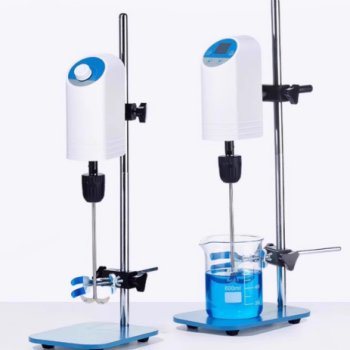
The high-speed homogenizer serves as the primary mechanism for physical intensification during the preparation of functionalized Boron Nitride (m-BN) and Poly(p-phenylene benzobisoxazole) nanofiber (PNF) dispersions. It utilizes extreme shear and circulating forces to forcefully break down nanoparticle agglomerates, ensuring the components are mixed uniformly rather than simply suspended together.
The core function of the homogenizer is to drive molecular-level contact through physical force. By overcoming the natural tendency of nanoparticles to clump, it facilitates the formation of a stable, three-dimensional cross-linked network structure essential for the material's final properties.
The Mechanics of Physical Intensification
Applying Extreme Shear Forces
The homogenizer introduces high-velocity mechanical shear to the mixture. This force is critical for overcoming the van der Waals forces that typically hold nanoparticles together.
Generating Circulating Forces
Beyond simple agitation, the device creates robust circulating forces within the fluid. This ensures that the m-BN is distributed evenly throughout the PNF dispersion, preventing localized concentrations or "hot spots."
Achieving Molecular-Level Integration
Breaking Nanoparticle Agglomerates
Nanoparticles like m-BN naturally tend to cluster into agglomerates, which inhibits their performance. The physical intensification process effectively shatters these clusters, reducing them to their individual constituent particles.
Facilitating Molecular Contact
Once the agglomerates are broken, the homogenizer forces the m-BN into direct contact with the PNF matrix. This proximity is necessary to achieve contact at the molecular level, moving beyond macroscopic mixing to microscopic integration.
Establishing Structural Stability
Forming a 3D Cross-Linked Network
The ultimate goal of this intense homogenization is the creation of a specific architecture. The process enables the components to organize into a stable, three-dimensional cross-linked network structure.
Ensuring Dispersion Stability
By achieving this network, the dispersion becomes physically stable. This prevents the functionalized Boron Nitride from settling or separating out of the PNF solution over time.
Understanding the Trade-offs
Managing Energy Input
While high shear is necessary for dispersion, it introduces significant energy into the system. This "physical intensification" can generate heat, which must be monitored to prevent altering the chemical properties of the functionalized surface.
Balancing Shear vs. Integrity
The force required to break agglomerates is substantial. Operators must balance the need for dispersion against the potential for damaging the aspect ratio of the PNF nanofibers if the shear forces are applied for too long.
Making the Right Choice for Your Process
To maximize the effectiveness of m-BN and PNF dispersions, consider your specific processing goals:
- If your primary focus is material uniformity: Ensure the homogenizer is set to generate sufficient circulating forces to eliminate all localized agglomerates.
- If your primary focus is structural stability: Verify that the processing time is sufficient to allow the formation of the full three-dimensional cross-linked network.
The high-speed homogenizer is not just a mixer; it is the tool that transforms raw components into a cohesive, engineered nanomaterial.
Summary Table:
| Feature | Function in m-BN/PNF Dispersion | Key Benefit |
|---|---|---|
| High Shear Force | Overcomes van der Waals forces | Breaks down nanoparticle agglomerates |
| Circulating Force | Ensures even distribution of m-BN | Prevents localized concentrations |
| Molecular Contact | Drives PNF and m-BN interaction | Enables microscopic integration |
| Network Formation | Establishes 3D cross-linked architecture | Ensures long-term dispersion stability |
Elevate Your Nanomaterial Research with KINTEK Precision
Achieving perfect molecular-level integration requires more than just mixing—it requires precise physical intensification. KINTEK specializes in high-performance laboratory equipment, providing the advanced high-speed homogenizers, ultrasonic processors, and cooling solutions necessary to manage the delicate balance between extreme shear and material integrity.
Whether you are developing functionalized Boron Nitride dispersions or advanced polymer composites, our comprehensive portfolio—including ultra-low temperature freezers, high-temperature furnaces, and specialized reaction vessels—is designed to support your most rigorous R&D workflows.
Ready to optimize your dispersion stability and material uniformity? Contact our technical experts today to find the perfect solution for your laboratory needs.
References
- Lin Tang, Junwei Gu. Flexible and Robust Functionalized Boron Nitride/Poly(p-Phenylene Benzobisoxazole) Nanocomposite Paper with High Thermal Conductivity and Outstanding Electrical Insulation. DOI: 10.1007/s40820-023-01257-5
This article is also based on technical information from Kintek Solution Knowledge Base .
Related Products
- High Shear Homogenizer for Pharmaceutical and Cosmetic Applications
- High Performance Lab Homogenizer for Pharma Cosmetics and Food R&D
- Laboratory High Throughput Tissue Grinding Mill Grinder
- High-Speed Desktop Centrifuge for Blood Sample Processing
- Laboratory Benchtop High Speed Small Centrifuge for Low Temp Serum Separation Dehydration Research
People Also Ask
- Why Use a High Shear Homogenizer for Cathode Slurries? Optimize Double-Layer Solid-State Battery Production
- What is the function of high-shear dispersion equipment in corona-resistant nanocomposites? Elevate Your Insulation
- What is the necessity of using an industrial-grade high-shear homogenizer for biomass washing? Ensure Process Efficiency
- What are the advantages of using a high-shear homogenizer for BED/GMA coatings? Achieve Superior Nano-Dispersion
- What role does a high-shear homogenizer play in ODC catalyst suspensions? Unlock Superior Electrochemical Efficiency