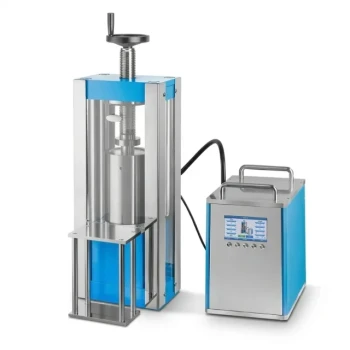
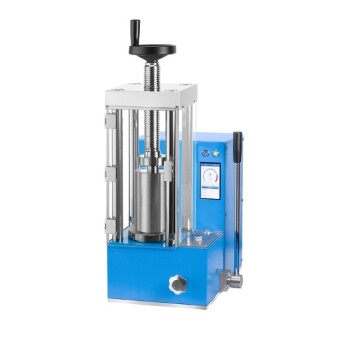
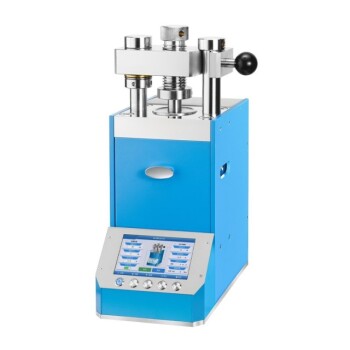
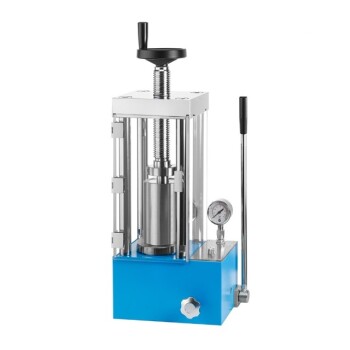
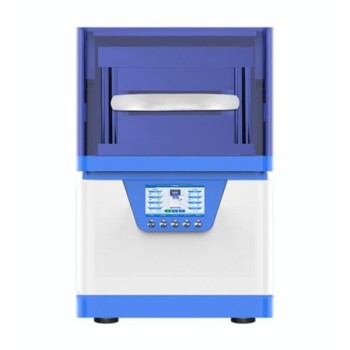
A Hot Isostatic Pressing (HIP) machine facilitates the consolidation of 316L stainless steel powder by subjecting it to simultaneous high temperature and high-pressure gas within a sealed capsule.
This environment forces the metal powder to undergo plastic deformation, creep, and diffusion at the contact points between particles. By applying uniform pressure from all directions, the machine eliminates internal voids and triggers the physical changes necessary to transform loose powder into a fully dense, solid component.
Core Insight: The unique value of the HIP process is not just compression, but the application of isotropic (uniform) pressure. This condition is essential for collapsing internal microporosity to achieve near-theoretical density and driving the specific microstructural reorganization required for high-performance 316L stainless steel.
Creating the Consolidation Environment
The Pressure Vessel Assembly
The HIP machine consists of a high-temperature resistance furnace enclosed within a robust pressure vessel.
This design allows the system to precisely control temperature, pressure, and process time simultaneously. The components are typically loaded into the vessel at cold temperatures, with pressurization occurring in tandem with heating.
The Role of the Inert Medium
To transmit pressure, the machine utilizes an inert gas, typically argon.
Because the gas surrounds the component completely, it applies pressure equally in all directions (isostatic). This ensures that the consolidation is uniform, preventing geometric distortion while the material is being densified.
Mechanisms of Densification
Plastic Deformation and Creep
As the temperature rises and pressure increases, the 316L powder particles become "plastic" or malleable.
The intense pressure forces the particles to yield and deform at their contact points. This mechanism acts to physically close the gaps between particles, effectively collapsing internal voids under the differential pressure.
Diffusion Bonding
Once the particles are mechanically pressed together, the heat facilitates atomic diffusion.
The surfaces of the collapsed voids bond together at the atomic level. This effectively heals defects and creates a solid, continuous material structure free of the porosity often found in other manufacturing methods.
Impact on 316L Microstructure
Dynamic Recrystallization
Beyond simple densification, the HIP environment triggers specific microstructural changes in 316L stainless steel.
The combination of thermal and mechanical stress induces dynamic recrystallization. This process refines the grain structure of the steel, which is critical for mechanical performance.
Formation of Twin Boundaries
The primary physical conditions of HIP also encourage the formation of twin boundaries.
These are specific crystal defects that, in the context of 316L, contribute to the material's overall strength and ductility. These microstructural evolutions are direct results of the isotropic pressure conditions maintained during the cycle.
Understanding the Trade-offs
Cycle Time and Throughput
While HIP produces superior material properties, it is a batch process that requires significant cycle time.
Parts must undergo a full cycle of heating, holding at pressure, and cooling within the vessel. This makes the process slower and potentially more expensive than conventional sintering methods that do not use pressure.
Size Constraints
The consolidation is strictly limited by the dimensions of the pressure vessel.
Large components or high-volume batches must fit within the specific "hot zone" of the furnace. This physical constraint dictates the maximum scale of parts that can be consolidated using this method.
Making the Right Choice for Your Goal
When employing HIP for 316L stainless steel, your specific objectives should dictate your process parameters.
- If your primary focus is Maximum Density: Prioritize the pressure magnitude and hold time to ensure complete collapse of internal voids and diffusion bonding.
- If your primary focus is Mechanical Properties: Focus on precise temperature control to optimize dynamic recrystallization and the formation of twin boundaries without excessive grain growth.
Ultimately, the HIP machine serves as a critical tool for converting 316L powder into high-integrity components suitable for demanding applications like medical implants and aerospace hardware.
Summary Table:
| Feature | Mechanism/Detail | Impact on 316L Stainless Steel |
|---|---|---|
| Pressure Medium | Inert Argon Gas | Provides uniform (isostatic) pressure to prevent distortion |
| Densification | Plastic Deformation & Creep | Collapses internal voids and gaps between powder particles |
| Bonding | Atomic Diffusion | Heals defects to create a continuous, solid material structure |
| Microstructure | Dynamic Recrystallization | Refines grain structure for superior mechanical performance |
| Enhancement | Twin Boundary Formation | Increases the overall strength and ductility of the component |
Elevate Your Material Integrity with KINTEK
Unlock the full potential of your 316L stainless steel components with KINTEK’s advanced Hot Isostatic Pressing (HIP) solutions. Our high-performance pressure vessels and thermal systems are engineered to eliminate porosity, optimize microstructure, and ensure near-theoretical density for the most demanding applications in medical and aerospace industries.
Beyond HIP, KINTEK specializes in a comprehensive range of laboratory equipment, including:
- High-Temperature Furnaces: Muffle, tube, vacuum, and CVD systems for precise thermal processing.
- Hydraulic Presses: Pellet, hot, and isostatic presses for superior powder consolidation.
- Material Research Tools: High-pressure reactors, autoclaves, crushing systems, and cooling solutions.
- Essential Consumables: High-quality ceramics, crucibles, and PTFE products.
Ready to achieve superior mechanical properties? Contact our technical experts today to find the perfect equipment for your laboratory or production needs.
References
- Sandeep Irukuvarghula, Michael Preuß. Evolution of grain boundary network topology in 316L austenitic stainless steel during powder hot isostatic pressing. DOI: 10.1016/j.actamat.2017.04.068
This article is also based on technical information from Kintek Solution Knowledge Base .
Related Products
- Warm Isostatic Press for Solid State Battery Research
- Electric Split Lab Cold Isostatic Press CIP Machine for Cold Isostatic Pressing
- Electric Lab Cold Isostatic Press CIP Machine for Cold Isostatic Pressing
- Automatic High Temperature Heated Hydraulic Press Machine with Heated Plates for Lab
- Automatic Lab Cold Isostatic Press CIP Machine Cold Isostatic Pressing
People Also Ask
- What is the temperature of a warm isostatic press? Achieve Optimal Densification for Your Materials
- What is the function of a Warm Isostatic Press (WIP) in all-solid-state pouch cells? Optimize Battery Density
- Why are Warm Isostatic Presses (WIP) necessary for solid-state batteries? Achieve Atomic-Level Contact
- What advantages does a warm isostatic press offer over a traditional uniaxial press for Li6PS5Cl electrolyte sheets?
- How do warm isostatic presses improve dry electrode performance? Enhance ASSB Conductivity with Heat & Pressure