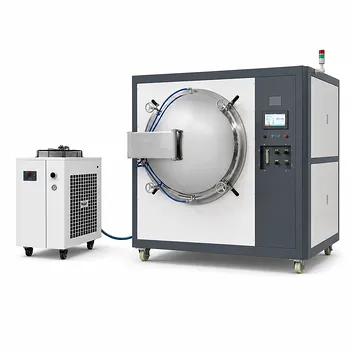
Simultaneous mechanical pressure and thermal energy are the defining mechanisms of a Hot Press Furnace. It addresses the densification challenges of hexagonal Boron Nitride (h-BN) ceramics by applying uniaxial pressure, typically around 30 MPa, directly during the heating process. This approach forces material consolidation in ways that thermal energy alone cannot achieve.
The core challenge of h-BN is its resistance to densification due to strong covalent bonds and a plate-like microstructure. A Hot Press Furnace solves this by inducing viscous and plastic flow, effectively mechanically forcing the material to density where atomic diffusion fails.
Overcoming Structural Barriers
The "House of Cards" Phenomenon
h-BN particles possess a distinct plate-like structure. When these particles are loosely packed, they tend to arrange themselves awkwardly, creating large voids.
This is often described as a "house of cards" effect. This structural arrangement resists densification because the particles physically block one another from settling into a compact form.
Inducing Plastic Flow
Standard sintering relies heavily on heat to bond particles. However, the Hot Press Furnace introduces uniaxial mechanical pressure to this equation.
This pressure physically crushes the "house of cards" structure. It forces the plate-like particles to slide, rotate, and deform, inducing plastic flow that fills the void spaces.
Compensating for Chemical Resistance
Addressing Low Diffusion Coefficients
High-thermal conductivity h-BN is held together by strong covalent bonds. Consequently, it has a very low solid-state self-diffusion coefficient.
Simply put, the atoms in h-BN do not want to move or bond with neighbors, even at high temperatures. Heat alone provides insufficient driving force to close pores.
Mechanical Force as a Catalyst
The Hot Press Furnace compensates for this lack of natural diffusion. By applying external pressure (e.g., 30 MPa), the system mechanically drives the densification process.
This enhances the viscous flow of particles, ensuring high density and improved mechanical performance without requiring the material to possess high natural diffusivity.
Understanding the Trade-offs
Directional Anisotropy
It is critical to note that Hot Pressing applies pressure uniaxially (from one direction).
Because h-BN particles are plate-like, this can cause them to align perpendicularly to the pressing direction. While this increases density, it may lead to anisotropic properties (properties that differ depending on the direction), unlike the uniform isotropy achieved by Hot Isostatic Pressing (HIP).
Processing Efficiency vs. Grain Growth
Hot pressing is highly effective for density but relies on external mechanical force and standard heating rates.
Compared to advanced methods like Spark Plasma Sintering (SPS), which utilizes pulsed currents for rapid heating, hot pressing may require longer cycle times. It does not offer the same level of intrinsic grain-growth inhibition seen in rapid SPS processes.
Making the Right Choice for Your Goal
To determine if a Hot Press Furnace is the correct tool for your h-BN application, evaluate your specific performance metrics:
- If your primary focus is absolute density: Hot pressing is the standard solution for mechanically forcing the "house of cards" structure to collapse.
- If your primary focus is isotropic uniformity: Consider Hot Isostatic Pressing (HIP) to avoid the directional alignment of particles common in uniaxial pressing.
- If your primary focus is fine grain size: Evaluate Spark Plasma Sintering (SPS) to leverage rapid heating that minimizes grain growth.
Select the Hot Press Furnace when you need a reliable, proven method to overcome the low diffusion and structural resistance of h-BN through brute mechanical force.
Summary Table:
| Feature | Challenge in h-BN | Hot Press Furnace Solution | Result |
|---|---|---|---|
| Particle Structure | Plate-like 'House of Cards' | Uniaxial mechanical pressure (30 MPa) | Collapses voids & aligns particles |
| Bonding | Strong covalent bonds | Mechanical force + thermal energy | Induces viscous and plastic flow |
| Diffusion | Low self-diffusion coefficient | External pressure as a catalyst | High densification without high diffusion |
| Uniformity | Structural resistance | Directional consolidation | High density with directional anisotropy |
Elevate Your Material Research with KINTEK Precision
Are you struggling with the densification of advanced ceramics like h-BN? KINTEK specializes in high-performance laboratory equipment, providing the cutting-edge hot press furnaces, Spark Plasma Sintering (SPS) systems, and Hot Isostatic Presses (HIP) required to overcome complex material barriers.
From high-temperature furnaces and hydraulic presses to specialized battery research tools and ceramic consumables, we deliver the precision and durability needed for world-class R&D. Let our experts help you select the perfect system to achieve absolute density and optimal grain size for your specific applications.
Ready to transform your lab’s capabilities? Contact KINTEK today for a consultation!
Related Products
- Hexagonal Boron Nitride HBN Ceramic Ring
- 600T Vacuum Induction Hot Press Furnace for Heat Treat and Sintering
- Hexagonal Boron Nitride HBN Thermocouple Protection Tube
- Vacuum Hot Press Furnace Machine Heated Vacuum Press
- Vacuum Hot Press Furnace Heated Vacuum Press Machine Tube Furnace
People Also Ask
- Why is a hexagonal Boron Nitride (h-BN) layer required for LATP? Protect Your Samples from Carbon Contamination
- What is the necessity of using a ceramic crucible as a carrier during BN synthesis? Ensure High-Purity Results
- Why is Boron Nitride coating used in VHP sintering? Prevent Carbon Diffusion & Ensure Clean Mold Release
- Why are Viton O-rings considered essential consumables for the high-temperature sealing interfaces of microreactors?
- Does ceramic break with heat? The Real Culprit is Thermal Shock