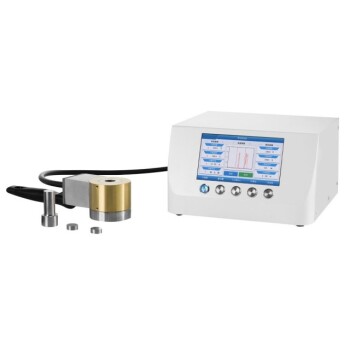
A hot pressing system fundamentally improves Thallium Bromide (TlBr) detectors by utilizing thermomechanical coupling to optimize the crystal's physical structure. By applying high pressure to purified raw materials within a specific high-temperature range, the system facilitates solid-phase molding. This process induces precise lattice orientations and minimizes internal defects, directly resulting in enhanced charge collection efficiency.
Core Insight: The primary function of the hot pressing system is to convert raw TlBr material into a high-density bulk crystal through the simultaneous application of approximately 30 kN of pressure and temperatures between 455-465°C. This dual action eliminates internal stresses and voids, creating the structural uniformity required for high-efficiency photon-counting detectors.
The Mechanics of Solid-Phase Molding
Thermomechanical Coupling
The system does not merely heat the material; it couples thermal energy with mechanical force. It applies a constant axial pressure (typically around 30 kN) while maintaining the material at temperatures near its melting point (455-465°C).
Promoting Plastic Flow
This combination promotes the plastic flow of the TlBr powder. The heat softens the material, while the pressure forces particles to bond, transforming loose, purified powder into a solid, cohesive mass.
Densification of Raw Materials
The process ensures the densification of high-purity raw materials. By compressing the material significantly, the system eliminates voids that would otherwise interrupt the path of charge carriers.
Optimizing Crystal Structure
Controlling Lattice Orientation
Unlike simple melting, hot pressing induces specific lattice orientations within the crystal. This alignment is critical because the electrical properties of semiconductors often depend on the direction of charge travel relative to the crystal lattice.
Eliminating Internal Stress
Standard crystal growth can leave residual stresses that warp the crystal lattice. The stable pressure and precise temperature control of hot pressing effectively relieve these internal stresses, ensuring a relaxed and uniform structure.
Achieving Structural Consistency
The result is a crystal with high structural integrity throughout its depth. Whether the crystal is 2 mm or thicker, the hot pressing ensures that the physical properties are consistent from the surface to the core.
Translating Structure to Performance
Enhanced Charge Collection Efficiency
The reduction of internal defects and lattice misalignments removes "traps" that capture electrons and holes. This allows charges to move freely through the detector, significantly improving charge collection efficiency.
Superior Energy Resolution
With better charge collection, the detector provides a more accurate reading of the energy deposited by incoming radiation. This leads to improved energy resolution, demonstrated by superior peak spectra at specific energy levels (such as 662 keV).
High Gamma-Ray Attenuation
Because the process produces a highly dense crystal without voids, the material's ability to stop and detect gamma rays—its attenuation coefficient—is maximized. This makes the resulting crystals highly suitable for photon-counting applications.
Understanding the Trade-offs
Precision is Critical
This process is highly sensitive to process parameters. Deviating from the 455-465°C range or failing to maintain the 30 kN pressure can fail to induce the correct lattice orientation or leave residual stresses.
Dependence on Material Purity
Hot pressing is a shaping and structuring process, not a purification process. It relies entirely on the quality of the zone-refined raw materials; it cannot improve the chemical purity of low-grade TlBr powder.
Making the Right Choice for Your Goal
To maximize the utility of hot-pressed TlBr crystals, align your processing parameters with your specific detection requirements:
- If your primary focus is High-Resolution Spectroscopy: Prioritize the precision of the cooling phase after the 2-hour hold time to ensure maximum stress relief and the sharpest energy resolution.
- If your primary focus is Manufacturing Yield: Focus on the consistency of the 30 kN hydraulic pressure to ensure structural uniformity across batches of bulk crystals.
By strictly controlling temperature and pressure to induce solid-phase molding, you transform raw TlBr into a detector-grade material capable of high-performance photon counting.
Summary Table:
| Parameter | Target Value | Impact on TlBr Performance |
|---|---|---|
| Temperature Range | 455 - 465°C | Promotes plastic flow and particle bonding near melting point. |
| Axial Pressure | ~30 kN | Ensures high-density densification and eliminates internal voids. |
| Process Action | Solid-Phase Molding | Induces precise lattice orientation and reduces internal stress. |
| Resulting Benefit | Enhanced CCE | Maximizes charge collection efficiency and energy resolution (662 keV). |
Elevate Your Semiconductor Research with KINTEK Precision
Unlock the full potential of your thallium bromide (TlBr) crystals and advanced materials with KINTEK’s high-precision hydraulic presses and hot pressing systems. Designed for demanding laboratory environments, our equipment provides the exact thermomechanical coupling required to eliminate internal stresses and achieve superior lattice uniformity.
Why partner with KINTEK?
- Comprehensive Laboratory Range: From high-temperature furnaces (muffle, vacuum, CVD) to isostatic and hot presses, we provide the tools necessary for advanced material synthesis.
- Optimized Performance: Achieve higher charge collection efficiency and superior energy resolution in your detector-grade materials.
- Tailored Solutions: Whether you need pellet presses, crushing systems, or specialized ceramics and crucibles, we support your entire workflow from raw material to final crystal.
Ready to refine your solid-phase molding process? Contact our technical experts today to find the perfect system for your lab!
References
- Alexander Madumarov, A. I. Svirikhin. Research on properties of superheavy elements copernicium and flerovium in a gas phase chemistry setup. DOI: 10.21175/rad.abstr.book.2023.38.5
This article is also based on technical information from Kintek Solution Knowledge Base .
Related Products
- Automatic Laboratory Hydraulic Press for XRF & KBR Pellet Press
- Automatic Heated Hydraulic Press Machine with Heated Plates for Laboratory Hot Press
- 30T 40T Split Automatic Heated Hydraulic Press Machine with Heated Plates for Laboratory Hot Press
- Automatic High Temperature Heated Hydraulic Press Machine with Heated Plates for Lab
- Manual High Temperature Heated Hydraulic Press Machine with Heated Plates for Lab
People Also Ask
- What is the significance of applying 200 MPa of pressure with a laboratory hydraulic pellet press for composite ceramics?
- What is the role of a laboratory hydraulic pellet press and stainless steel molds in the fabrication of RuO2/NbC anodes?
- How does a laboratory hydraulic pellet press contribute to SiCw/2024 aluminum composite preforms? Optimize Densification
- What is the necessity of using a laboratory hydraulic pellet press in the preparation of biomass fuel pellets? Guide
- What is the function of a laboratory hydraulic pellet press in supercapacitor electrode fabrication? Optimize 3D VNCN.