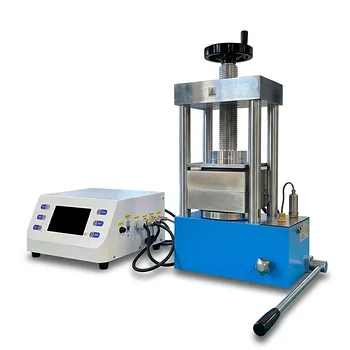
A hydraulic hot press acts as the central mechanism for converting purified thallium bromide (TlBr) raw materials into functional, high-density semiconductor crystals. By applying approximately 30 kN of continuous pressure at a precise temperature range of 455-465°C, the machine forces the raw material to consolidate, achieving the physical density required for radiation detection applications.
The Core Insight The hydraulic hot press does more than simply shape the material; it creates a coupled thermo-mechanical environment. This synergy eliminates internal micro-porosity and regulates crystal orientation, transforming loose powder into a detector-grade solid capable of high-efficiency photon counting.
The Mechanics of Thermo-Mechanical Coupling
To understand how high-quality TlBr crystals are formed, you must look at the specific parameters controlled by the hot press. The process relies on the simultaneous application of two forces.
Precise Temperature Regulation
The process operates within a strictly controlled thermal window of 455-465°C.
This temperature is near the material's melting point, softening the raw material enough to be malleable without losing its chemical integrity.
Continuous Mechanical Pressure
While the material is heated, the hydraulic system applies a continuous axial pressure of approximately 30 kN.
This constant force is maintained throughout the process, which typically lasts for a duration of 2 hours.
The Synergy of Forces
It is the combination of heat and pressure—not just one or the other—that drives the result.
This "thermo-mechanical coupling" ensures that the material is compressed uniformly, promoting tight inter-granular bonding that would not be possible through heating alone.
Structural Transformation of the Crystal
The physical impact of the hot press on the TlBr material is transformative. It changes the internal structure of the semiconductor to prepare it for electronic use.
Achieving Maximum Densification
The primary goal of the hot press is to achieve high-density molding.
The immense pressure eliminates internal micro-porosity and pore defects that naturally occur in the raw material.
Removing these voids is essential for ensuring structural integrity and stable electrical properties in the final device.
Regulating Crystal Orientation
Beyond simple density, the hot press actively guides the crystal orientation.
By controlling the stress field during the 2-hour window, the machine suppresses the formation of new defects during crystal growth.
This results in improved orientation consistency, which is vital for the uniform movement of charge carriers within the semiconductor.
Impact on Detector Performance
The manufacturing steps performed by the hydraulic hot press directly correlate to the performance metrics of the final radiation detector.
Enhancing Energy Resolution
By reducing internal defects and increasing density, the crystals exhibit superior energy resolution.
This allows the final detector to distinguish between different radiation energy levels with high precision.
Boosting Photon Counting Efficiency
The high-density crystals produced by this method possess an excellent gamma-ray attenuation coefficient.
This physical characteristic maximizes the photon counting efficiency, making these crystals ideal for high-performance gamma-ray counters.
Critical Considerations for Process Stability
While hot pressing is highly effective, it relies on maintaining a narrow operational window.
Sensitivity to Temperature Fluctuations
The process requires a temperature stability within a 10-degree range (455-465°C).
Deviating from this range can compromise the densification process or damage the crystal structure, leading to inconsistent detector performance.
The Necessity of Uniform Pressure
The pressure application must be uniform and continuous.
Fluctuations in the 30 kN pressure application can lead to stress fractures or uneven density, introducing the very defects the process is designed to eliminate.
Making the Right Choice for Your Goal
The hydraulic hot press is a specialized tool designed to bridge the gap between raw chemical purity and electronic functionality.
- If your primary focus is material quality: Ensure your process strictly maintains the 455-465°C window to eliminate micro-porosity and ensure dense consolidation.
- If your primary focus is detector performance: Prioritize the consistency of the 30 kN pressure application to optimize crystal orientation for maximum energy resolution.
Success in TlBr formation depends on the rigorous control of this thermo-mechanical environment to turn raw powder into precision sensing elements.
Summary Table:
| Parameter | Specification | Impact on TlBr Crystal |
|---|---|---|
| Temperature Range | 455 - 465°C | Softens material for densification without chemical loss |
| Continuous Pressure | Approx. 30 kN | Eliminates micro-porosity and ensures inter-granular bonding |
| Process Duration | 2 Hours | Regulates crystal orientation and suppresses defect formation |
| Primary Goal | High-Density Molding | Maximizes gamma-ray attenuation and photon counting efficiency |
Elevate Your Semiconductor Research with KINTEK Precision
High-performance TlBr crystals demand rigorous thermo-mechanical control. KINTEK provides industry-leading hydraulic hot presses, pellet presses, and isostatic systems designed to meet the exact temperature and pressure windows required for advanced material synthesis.
Whether you are focusing on high-density molding for radiation detectors or exploring complex crystal growth, our comprehensive range of laboratory equipment—from high-temperature furnaces to high-pressure reactors—ensures your lab achieves repeatable, superior results.
Ready to optimize your densification process? Contact KINTEK today for expert solutions!
References
- Elena Ionela Neacşu, L. Done. ow and intermediate level aqueous radioactive waste treatment in a modular installation. DOI: 10.21175/rad.abstr.book.2023.44.5
This article is also based on technical information from Kintek Solution Knowledge Base .
Related Products
- Automatic High Temperature Heated Hydraulic Press Machine with Heated Plates for Lab
- Manual High Temperature Heated Hydraulic Press Machine with Heated Plates for Lab
- Heated Hydraulic Press Machine with Heated Plates for Vacuum Box Laboratory Hot Press
- 24T 30T 60T Heated Hydraulic Press Machine with Heated Plates for Laboratory Hot Press
- Heated Hydraulic Press Machine with Heated Plates for Vacuum Box Laboratory Hot Press
People Also Ask
- What is a heated hydraulic press used for? Essential Tool for Curing, Molding, and Laminating
- Why is a heated hydraulic press used for warm pressing NASICON green tapes? Optimize Your Solid Electrolyte Density
- Why is a heated laboratory hydraulic press necessary for composite laminates? Achieve Void-Free Structural Integrity
- What is a hot hydraulic press? Harness Heat and Pressure for Advanced Manufacturing
- Why is the heating function of a laboratory hydraulic press essential for MEA assembly in DEFC? Optimize Cell Bonding