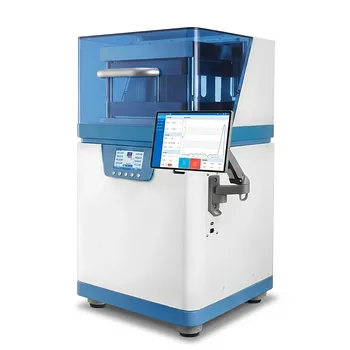
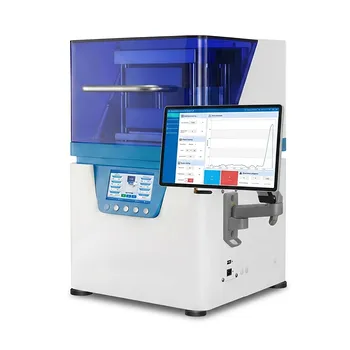
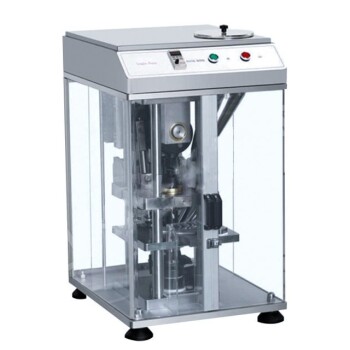
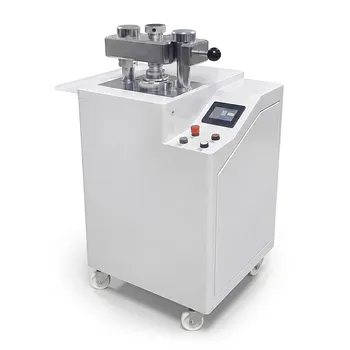
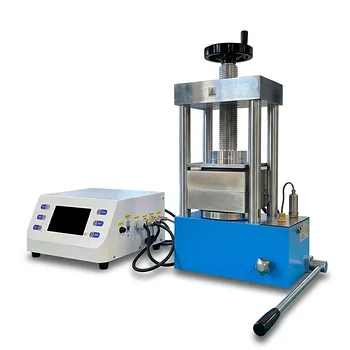
A laboratory hydraulic press prepares powder electrodes by applying precise, uniform vertical pressure to compress catalyst mixtures onto conductive substrates or into dense pellets. This process ensures mechanical stability and minimizes interfacial contact resistance between the active material and the current collector. By creating a tightly packed, cohesive layer, the press allows for accurate and reproducible measurements of electrocatalytic performance, such as Hydrogen Evolution Reaction (HER) and Oxygen Evolution Reaction (OER) rates.
The laboratory hydraulic press is essential for transforming loose catalyst powders into high-performance electrodes by maximizing electrical contact and structural integrity. It bridges the gap between raw material properties and reliable electrochemical data by eliminating internal voids and reducing Ohmic resistance.
Maximizing Electrical Conductivity and Charge Transport
Reducing Inter-particle Contact Resistance
High-pressure compaction forces catalyst particles, binders, and conductive additives like carbon black into intimate contact. This physical molding process eliminates internal voids that would otherwise act as barriers to electron flow.
By creating a dense network of contact points, the press ensures efficient ion transport paths and electron pathways throughout the electrode. This is critical for obtaining reliable ionic conductivity data during impedance testing.
Minimizing Interfacial Resistance at the Substrate
The press ensures the active material layer is firmly bonded to the current collector, whether using nickel foam, copper foil, or FTO glass. This creates excellent Ohmic contact, which significantly reduces the interface resistance between the catalyst and the substrate.
Reducing this resistance allows electrochemical workstations to capture the intrinsic properties of the material. Without proper compaction, the data may be skewed by artifacts resulting from poor electrical contact rather than the catalyst's actual performance.
Ensuring Mechanical Stability Under Operational Stress
Resisting Delamination During Gas Evolution
Electrocatalytic reactions like HER and OER generate gas bubbles that can physically strip loose catalyst particles from the electrode. The high-precision pressure from a hydraulic press ensures the catalyst is securely bonded to the substrate to withstand this mechanical stress.
This structural stability is vital for high-current-density operations. It prevents the active material from shedding, ensuring that the electrode remains functional and the test results remain consistent over long durations.
Consistency in Sample Dimensions and Density
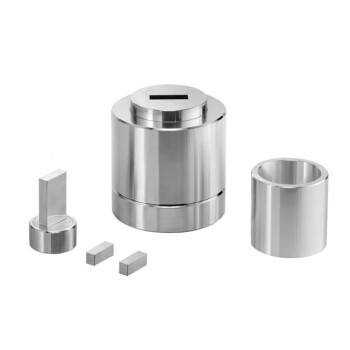
Using specialized molds, a hydraulic press can produce pellets or films with consistent mechanical strength and uniform density. For example, nanostructured powders can be formed into pellets of specific diameters (e.g., 10 mm) and thicknesses.
Uniformity allows researchers to normalize their data accurately. When every sample has the same dimensions and packing density, the resulting electrochemical and photoelectric responses are truly comparable across different experiments.
Understanding the Trade-offs and Limitations
Risk of Nanostructure Damage
Applying excessive pressure can inadvertently crush the delicate nanostructures of certain catalysts. If the morphology of the material is destroyed, the electrochemically active surface area may decrease, leading to a drop in measured performance.
Mass Transport and Porosity Issues
While high pressure improves electrical contact, it can also reduce the porosity of the electrode. If the catalyst layer becomes too dense, reactants may have difficulty reaching the active sites, and product gases may become trapped, hindering mass transport.
Binder Interference
In mixtures containing binders like PTFE, high pressure can cause the binder to spread unevenly or block active sites. Finding the optimal pressure balance is necessary to ensure electrical connectivity without sacrificing the chemical accessibility of the catalyst.
How to Apply This to Your Electrode Preparation
The effectiveness of your electrode depends on matching the pressing parameters to your specific material and testing goals.
- If your primary focus is reducing Ohmic resistance: Utilize precise pressure control (often between 6 and 10 MPa) to ensure the tightest possible contact between the active layer and the current collector.
- If your primary focus is durability during gas evolution: Apply higher, consistent vertical pressure to maximize the mechanical adhesion of the catalyst to irregular substrates like steel mesh or nickel foam.
- If your primary focus is preserving catalyst morphology: Calibrate the press to the minimum pressure required for mechanical stability to avoid crushing sensitive nanostructured features.
- If your primary focus is reproducible impedance data: Use specialized molds to ensure every pellet has identical dimensions and density, facilitating standardized ionic conductivity measurements.
By mastering the application of controlled hydraulic pressure, you transform loose powders into stable, high-performance electrodes capable of yielding definitive electrochemical insights.
Summary Table:
| Key Benefit | Mechanism | Impact on Electrocatalytic Testing |
|---|---|---|
| Enhanced Conductivity | Minimizes inter-particle and interfacial resistance | Ensures accurate charge transport and Ohmic measurements. |
| Mechanical Stability | Creates strong bonding between catalyst and substrate | Prevents catalyst delamination during gas evolution (HER/OER). |
| Data Reproducibility | Produces uniform pellet density and dimensions | Allows for precise normalization of electrochemical data. |
| Structural Control | Precise, adjustable vertical pressure | Balances electrical contact with necessary catalyst porosity. |
Precision Preparation for Superior Electrochemical Insights
Reliable electrocatalytic data begins with high-quality electrode fabrication. KINTEK specializes in precision laboratory equipment designed to bridge the gap between raw catalyst powders and high-performance testing results.
Our extensive portfolio supports every stage of your material research, featuring:
- Hydraulic Presses: A complete range of pellet, hot, and isostatic presses for consistent electrode preparation.
- Electrochemical Tools: Specialized electrolytic cells, electrodes, and battery research consumables.
- Material Processing: Crushing and milling systems, high-temperature furnaces (muffle, vacuum, CVD), and high-pressure reactors.
- Thermal Management: Reliable cooling solutions, including ULT freezers and freeze dryers.
Ready to enhance your lab's efficiency and sample consistency? Contact KINTEK today to discover how our high-pressure systems and lab consumables can optimize your research workflow!
References
- Kang Huang, Yizhong Huang. Self‐Reconstructed Spinel Surface Structure Enabling the Long‐Term Stable Hydrogen Evolution Reaction/Oxygen Evolution Reaction Efficiency of FeCoNiRu High‐Entropy Alloyed Electrocatalyst. DOI: 10.1002/advs.202300094
This article is also based on technical information from Kintek Solution Knowledge Base .
Related Products
- Automatic Laboratory Hot Press 400x400 mm with Programmable High Temperature and Hydraulic Force Control
- Fully Automatic Heated Hydraulic Lab Press for Materials Sintering and Sample Preparation
- Laboratory Hydraulic Press Split Electric Lab Pellet Press
- Single Punch Electric Tablet Press Machine Laboratory Powder Tablet Punching TDP Tablet Press
- Round Bidirectional Press Mold for Lab
People Also Ask
- What is the primary function of a laboratory hot press in MEA assembly? Optimize Fuel Cell Bonding & Performance
- What specific conditions does a laboratory hot press provide for the assembly of fuel cell MEA? Expert Bond Tips.
- How do a laboratory hydraulic hot press and standardized steel molds ensure the quality of WPC test specimens?
- What are the core advantages of using a laboratory hot press to produce Bi2Se3? Achieve 93% Density & High Conductivity
- How does a laboratory heating hydraulic press contribute to the preparation of recycled graphite green bodies? - Optimize Density.