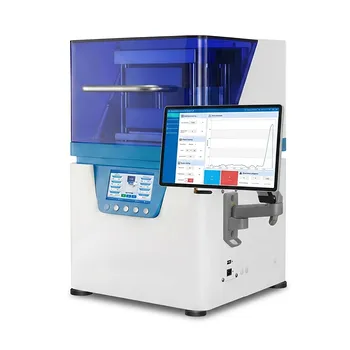
Uniformity and precision are the cornerstones of superhydrophobicity. A laboratory hydraulic press ensures the consistency of superhydrophobic surfaces by delivering continuous, uniform normal pressure during the hot embossing process. This force ensures that the polymer substrate flows perfectly into the mold’s micro-cavities while above its glass transition temperature, eliminating surface density variations and creating a uniform structural morphology across the entire sample.
The central takeaway is that precise, automated pressure control is vital for replicating micro-nano structures with high fidelity. This consistency directly determines the stability and reliability of a material's superhydrophobic performance and contact angle measurements.
The Role of Precision Pressure in Micro-Structure Replication
Achieving Complete Mold Cavity Filling
To create a superhydrophobic surface, a polymer must be heated above its glass transition temperature (Tg) so it can flow into the desired pattern. The hydraulic press provides the steady, high-tonnage force necessary to drive this softened material into the intricate micro-cavities of the mold. Without this continuous pressure, air pockets or incomplete filling would lead to structural defects that compromise water repellency.
Eliminating Surface Density Variations
Consistency relies on every part of the sample behaving identically under test conditions. The press applies a uniform load across the substrate, preventing "dead spots" or areas of low density that could lead to structural collapse or uneven performance. This uniformity ensures that the resulting micro-nano structures are mirrored perfectly across the entire surface area of the sample.
Maintaining Dynamic Stability
During the embossing cycle, materials may shift or compress, leading to potential pressure drops as the polymer settles. Advanced laboratory presses use automated power packs to detect these drops and immediately restore the target pressure level. This constant feedback loop prevents the fluctuations that would otherwise result in inconsistent surface heights or patterns.
Enhancing Material Integrity and Measurement Accuracy
Removing Internal Defects and Micropores
High-pressure hot pressing forces the material to fully melt and rearrange its internal structure at a molecular level. This process eliminates internal micropores and physical defects that could cause premature mechanical failure or uneven surface energy. A dense, defect-free substrate provides a standardized physical basis for both performance testing and biological assessments.
Standardizing Surfaces for Contact Angle Analysis
Superhydrophobicity is defined by the contact angle of a water droplet, which is highly sensitive to surface irregularities. The hydraulic press compresses materials into highly flat, dense tablets, removing the interference caused by loose powders or random surface roughness. This standardization allows researchers to accurately characterize how specific treatments affect wettability without "noise" from the substrate itself.
Understanding the Trade-offs and Limitations
Thermal Constraints and Material Sensitivity
While high pressure and temperature are necessary for flow, exceeding a material's thermal degradation point can ruin the surface chemistry. Precise control is essential, as incorrect settings can lead to "flashing," where material escapes the mold due to excessive force. Users must carefully balance the pressure-temperature-time triad to avoid damaging the delicate micro-scale features they aim to create.
Pressure Distribution Limits
Even with a high-quality press, the parallelism of the platens is a critical factor; if the platens are not perfectly aligned, the pressure will be uneven. This can lead to a gradient of hydrophobicity across a single sample, where one side performs better than the other. Regular calibration and the use of high-stiffness frames are required to mitigate this risk in industrial or high-precision laboratory settings.
Optimizing Your Pressing Process
If your primary focus is consistent contact angle measurements: Ensure the material is pressed into a dense, flat tablet to eliminate surface interference from loose particles or uneven topography.
If your primary focus is high-fidelity micro-structure replication: Utilize a press with automatic pressure maintenance to ensure the mold remains completely filled throughout the heating and cooling phases.
If your primary focus is material durability and longevity: Use high-pressure hot pressing to eliminate internal micropores and create a more robust, defect-free substrate that can withstand environmental stress.
Mastering the interplay of uniform pressure and temperature allows for the creation of reliable, high-performance superhydrophobic surfaces that meet rigorous experimental and industrial standards.
Summary Table:
| Feature | Role in Hot Embossing | Impact on Superhydrophobicity |
|---|---|---|
| Uniform Normal Pressure | Ensures polymer flows into micro-cavities | Eliminates structural defects and density variations |
| Automated Power Packs | Maintains constant pressure during cooling/settling | Guarantees consistent surface height and pattern fidelity |
| High-Pressure Molding | Eliminates internal micropores and defects | Enhances mechanical durability and material integrity |
| Surface Flattening | Compresses material into dense, flat tablets | Standardizes surfaces for accurate contact angle analysis |
Elevate Your Material Research with KINTEK Precision
Achieving the perfect superhydrophobic surface requires more than just heat—it demands the uncompromising precision of KINTEK’s laboratory hydraulic presses. Whether you are performing high-fidelity micro-structure replication via hot pressing or preparing standardized samples with our pellet and isostatic presses, our equipment is engineered to deliver the uniform pressure necessary for consistent, reliable results.
Why partner with KINTEK?
- Comprehensive Solutions: From crushing and milling systems to high-temperature furnaces (CVD, vacuum, muffle) and hydraulic presses, we provide the full workflow for advanced material synthesis.
- Expert Reliability: Our tools are designed to eliminate internal defects and ensure the dynamic stability required for sensitive contact angle measurements.
- Tailored Support: We offer specialized consumables, including PTFE products, ceramics, and crucibles, to complement your high-pressure applications.
Ready to enhance your lab's efficiency and achieve superior material performance? Contact our experts today to find the perfect pressing solution for your application.
References
- Jaishree, Manjeet Singh Goyat. Superhydrophobic coatings by the hot embossing approach: recent developments and state-of-art applications. DOI: 10.1016/j.mtchem.2023.101553
This article is also based on technical information from Kintek Solution Knowledge Base .
Related Products
- Laboratory Hydraulic Press Split Electric Lab Pellet Press
- Laboratory Hydraulic Press Lab Pellet Press Machine for Glove Box
- Laboratory Hydraulic Press Lab Pellet Press for Button Battery
- Automatic Laboratory Hydraulic Pellet Press Machine for Lab Use
- Fully Automatic Heated Hydraulic Lab Press for Materials Sintering and Sample Preparation
People Also Ask
- What role does a laboratory hydraulic press play in platinum recovery research? Enhancing Sample Precision
- What are the specific applications of a lab hydraulic press in biochar evaluation? Optimize density and data accuracy.
- What are the roles of a laboratory hydraulic press and stainless steel molds in the preparation of graphite samples?
- What is the role of a laboratory hydraulic press in electrode prep? Maximize Energy Density & Sealing Precision
- Why must a laboratory hydraulic press equipped with cylindrical molds be used when preparing BZY green bodies? High Density