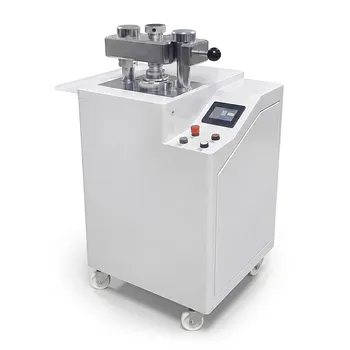
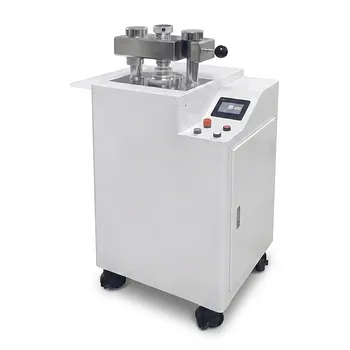
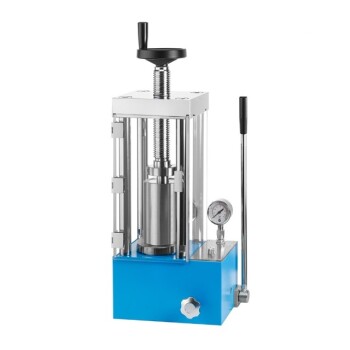
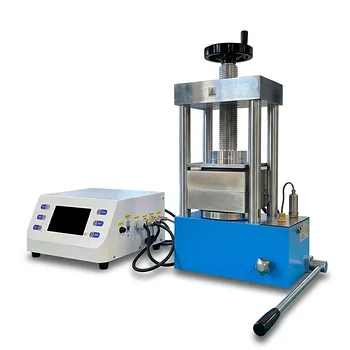
The manual hydraulic pellet press transforms loose biomass into high-efficiency fuel by applying concentrated mechanical force to overcome material elasticity. This process, known as densification, utilizes high pressure (often exceeding 5 MPa) to rearrange loose particles of sawdust, agricultural waste, or coal dust into a solid, compact structure. By significantly increasing the material's energy density, the press creates a durable fuel source that is easier to transport and exhibits superior combustion characteristics compared to raw biomass.
A manual hydraulic pellet press serves as a critical densification tool that converts low-density waste into standardized fuel pellets. This mechanical transformation ensures high energy density and structural stability, providing a foundation for both efficient combustion and precise laboratory research.
The Mechanics of Densification
Overcoming Elastic Recovery
Loose biomass particles naturally possess elasticity, causing them to resist compression and return to their original volume. The manual hydraulic press applies a constant, stable load—such as 100 kg/cm²—to force these particles past their elastic limit. This mechanical pressure ensures the material remains in a compacted state, preventing the pellets from crumbling after the force is removed.
Particle Rearrangement and Bonding
Under intense pressure, the individual fibers and particles within the biomass mixture undergo a physical rearrangement. They are forced into the voids of a mold, where they bond tightly together. While some processes require a binder to facilitate this adhesion, high-pressure manual presses can often achieve sufficient mechanical strength through particle interlocking alone.
Enhancing Fuel Performance Characteristics
Maximizing Energy Density
The primary goal of the pelletizing process is to increase the energy density per unit volume. By compressing loose wood powder or sugarcane bagasse into a dense solid, the press makes the fuel far more efficient to store and transport. This densification allows for a higher concentration of thermal energy in a much smaller physical footprint.
Improving Combustion Stability
A manual hydraulic press produces pellets with reduced porosity, which directly influences how the fuel burns. Lower porosity controls the rate of oxygen penetration, leading to a more stable and lasting release of energy. This result ensures a longer combustion duration and more predictable heat output for the end-user.
The Strategic Role in Research and Development
Determining Optimal Compression Parameters
In laboratory settings, the manual press is indispensable for identifying the optimal forming pressure and holding time for new raw materials. Researchers use various mold types to record how specific biomasses, such as peach pits or sawdust, respond to mechanical force. This data is essential for the eventual design and calibration of large-scale industrial equipment.
Standardizing Experimental Samples
Manual presses allow for the creation of standardized pellets with precise mass-percentage blends of biomass and coal. These uniform samples ensure scientific accuracy during combustion experiments and transport simulations. By creating a consistent physical form, researchers can isolate variables to better understand the chemical behavior of different fuel mixtures.
Understanding the Trade-offs
Scalability and Throughput Limits
While the manual hydraulic press is highly effective for precision and testing, it is not designed for high-volume production. The reliance on manual labor and the single-pellet or small-batch output limits its use to laboratories and small-scale operations. For industrial-scale fuel manufacturing, automated systems are required to maintain consistency at speed.
Sensitivity to Material Composition
The success of the pellet formation is highly dependent on the moisture content and particle size of the raw material. If the biomass is too dry or the particles are too large, even high pressure may fail to create a durable bond without the addition of a chemical binder. This necessitates careful pre-processing of the material before it ever enters the press.
Applying This Technology to Your Project
Recommendations Based on Your Objectives
- If your primary focus is laboratory research and material testing: Use the manual press to precisely control and document the specific pressure requirements for different biomass blends.
- If your primary focus is producing fuel for immediate, small-scale use: Ensure the raw material is finely ground and maintain a consistent holding time in the mold to maximize pellet durability.
- If your primary focus is developing industrial fuel standards: Use the press to create standardized samples for mass-percentage blending experiments to simulate industrial feedstocks accurately.
By mastering the mechanical principles of the manual hydraulic pellet press, you can effectively convert undervalued biomass waste into a reliable, high-performance energy source.
Summary Table:
| Feature | Mechanism | Impact on Biomass Fuel |
|---|---|---|
| Densification | Applies >5 MPa pressure | Increases energy density and reduces transport volume |
| Particle Bonding | Mechanical interlocking | Ensures structural stability and prevents crumbling |
| Porosity Reduction | Elimination of internal voids | Controls oxygen penetration for stable, lasting combustion |
| R&D Precision | Manual load control | Allows determination of optimal forming pressure for new materials |
Elevate Your Biomass Research with KINTEK Precision
At KINTEK, we understand that high-quality biomass fuel begins with precise sample preparation. Whether you are identifying optimal compression parameters or creating standardized experimental samples, our manual hydraulic pellet presses provide the stability and control your laboratory demands.
Beyond pelletizing, KINTEK offers a comprehensive suite of laboratory solutions, including:
- Sample Preparation: Crushing and milling systems, sieving equipment, and high-pressure hydraulic presses (pellet, hot, isostatic).
- Thermal Processing: A wide range of high-temperature furnaces (muffle, tube, vacuum, CVD).
- Advanced Research Tools: Electrolytic cells, high-pressure reactors, and battery research consumables.
Ready to transform your biomass waste into high-performance energy? Contact our experts today to discover how our specialized equipment can enhance your research accuracy and fuel development efficiency.
References
- Akuzuo Uwaoma Ofoefule, Chukwunalu Destiny Mgbadike. Effects of Palm Kernel (Elaeis guineensis) Cake on Sub-Bituminous Coal Briquette for Energy Generation. DOI: 10.3923/tasr.2023.118.130
This article is also based on technical information from Kintek Solution Knowledge Base .
Related Products
- Laboratory Manual Hydraulic Pellet Press for Lab Use
- Laboratory Manual Hydraulic Pellet Press for Lab Use
- Automatic XRF Pellet Press 40 Ton Hydraulic Sample Preparation Press for Fluorescent Spectroscopy Analysis
- Automatic Laboratory Hydraulic Press for XRF & KBR Pellet Press
- Automatic Laboratory Hydraulic Pellet Press Machine for Lab Use
People Also Ask
- What is the role of a laboratory hydraulic pellet press and stainless steel molds in the fabrication of RuO2/NbC anodes?
- What is the necessity of using a laboratory hydraulic pellet press in the preparation of biomass fuel pellets? Guide
- What is the significance of applying 200 MPa of pressure with a laboratory hydraulic pellet press for composite ceramics?
- How does a laboratory hydraulic pellet press contribute to SiCw/2024 aluminum composite preforms? Optimize Densification
- Why use laboratory manual hydraulic presses for semiconductor pellets? Optimize Annealing & Crystalline Quality