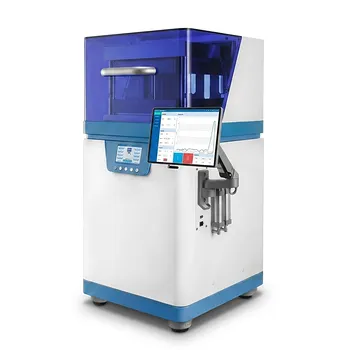
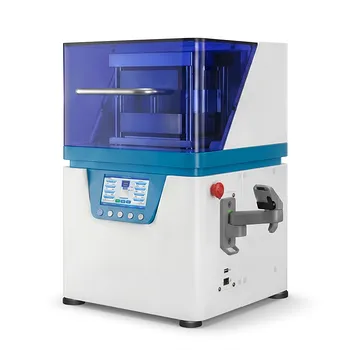
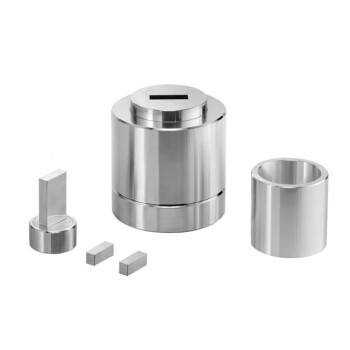
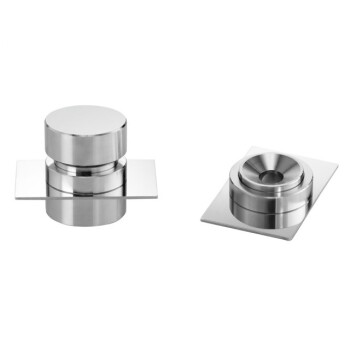
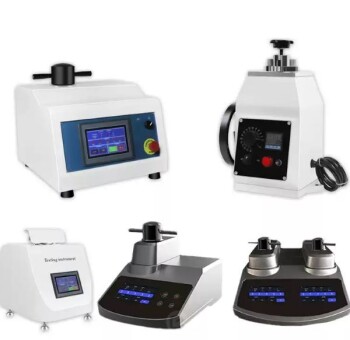
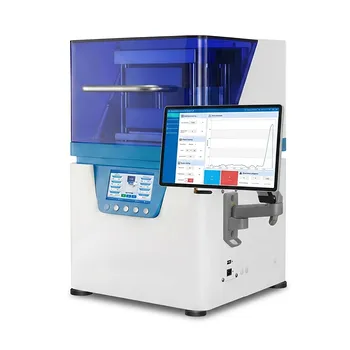
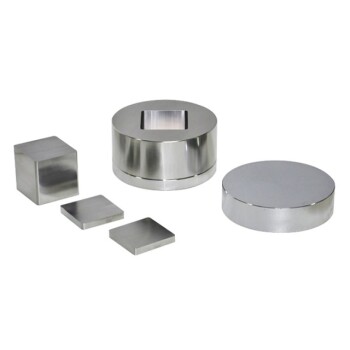
Precision laboratory presses are the foundation of consistent battery research. A precision laboratory press dictates hard carbon electrode quality by applying stable, repeatable pressure to bond active materials, conductive agents, and binders to the current collector. This process directly regulates electrode porosity, minimizes interfacial resistance, and ensures the mechanical stability required for accurate, repeatable electrochemical analysis.
The core value of a precision laboratory press lies in its ability to transform a loose mixture of materials into a structurally sound and electrically efficient electrode. By providing uniform compaction, it eliminates variables that would otherwise compromise the reliability of in-situ testing and performance data.
Optimizing the Microstructure of the Electrode
Precise Control of Porosity and Density
A precision press provides the stable pressure necessary to achieve appropriate porosity within the hard carbon layer. This ensures that the electrolyte can effectively penetrate the electrode while maintaining enough material density to maximize energy storage.
Without this control, inconsistent voids can lead to uneven ion transport, which skews performance results.
Enhancing Charge Transport Rates
By applying high-precision pressure, the press ensures that the active material is tightly bonded to the conductive current collector. This mechanical intimacy significantly reduces interfacial contact resistance, which is the primary barrier to efficient charge transport.
This is especially critical for maintaining performance at high current densities, such as those exceeding 350 mA cm⁻².
Reducing Grain Boundary Resistance
In the context of electrolyte and electrode powders, high-pressure molding (often using forces like 2 tons) compacts particles into dense pellets. This process reduces voids and minimizes grain boundary resistance, which is essential for reflecting the true internal ion transport characteristics of the material.
Ensuring Mechanical Integrity and Stability
Preventing Electrode Delamination
One of the most common failures in electrode preparation is the "peeling" of the active material from the substrate. A precision press ensures a uniform and adjustable pressure—via uniaxial or isostatic methods—to create a robust mechanical bond.
This prevents film peeling during subsequent handling or the volume expansion that occurs during cycling.
Maintaining Surface Uniformity
A high-precision hydraulic press ensures that the electrode achieves a highly consistent density distribution. This creates a flat, defect-free support interface, which is vital for thin films or specialized coatings.
Surface roughness caused by inadequate pressing can lead to non-uniform electrochemical responses and localized hot spots during testing.
The Impact on Analytical Accuracy
Facilitating Reliable In-Situ Testing
For advanced diagnostics, such as in-situ X-ray transmittance or Electrochemical Impedance Spectroscopy (EIS), consistency is paramount. The press maintains the physical integrity required for X-rays to pass through the material uniformly.
In EIS measurements, dense samples ensure tight physical contact with electrodes, allowing for the acquisition of accurate bulk conductivity data.
Standardizing Volumetric Calculations
Accurate control of electrode thickness (e.g., maintaining a precise 7.5 μm average) is essential for calculating volumetric energy and power densities.
Uniform compaction density allows researchers to compare mass loading and thickness accurately across different experimental groups, ensuring that the resulting data is scientifically valid.
Understanding the Trade-offs and Pitfalls
The Risk of Over-Compaction
While high pressure reduces resistance, excessive force can be detrimental. Over-pressing hard carbon can crush the particles or eliminate the pore network entirely, preventing electrolyte access and causing the electrode to fail.
The Problem of Pressure Decay
Lower-quality presses may suffer from pressure decay over time or non-uniform distribution across the platen. This results in an electrode with gradient density, where one side performs differently than the other, leading to unreliable and non-repeatable data.
Material Deformation
Different binders and current collectors have varying mechanical limits. If the pressure is not carefully calibrated to the specific modulus of the materials used, the current collector may stretch or deform, introducing mechanical stress that leads to premature electrode failure.
How to Apply This to Your Laboratory Workflow
Effective electrode preparation requires matching your pressing strategy to your specific research objectives.
- If your primary focus is high-rate performance: Utilize a hydraulic press with fine-tuned pressure increments to minimize interfacial resistance without sacrificing the porosity needed for rapid ion diffusion.
- If your primary focus is accurate material characterization (EIS/In-situ): Prioritize a press that offers long-duration pressure stability to ensure maximum density and grain boundary contact for clear signal acquisition.
- If your primary focus is commercial scalability studies: Use precision thickness gauges in tandem with the press to maintain a consistent 7.5 μm to 15 μm thickness for reliable volumetric energy density calculations.
Ultimately, the precision laboratory press is not just a tool for shaping material, but a critical instrument for ensuring that your electrochemical data reflects the true potential of your hard carbon chemistry.
Summary Table:
| Key Factor | Impact on Electrode Quality | Benefit to Research Data |
|---|---|---|
| Pressure Stability | Ensures uniform compaction & material bonding | High repeatability & consistent results |
| Porosity Control | Regulates electrolyte penetration | Optimized ion transport & energy storage |
| Interfacial Contact | Reduces contact resistance at current collector | Accurate high-rate performance analysis |
| Mechanical Bonding | Prevents delamination and film peeling | Enhanced cycling stability & durability |
| Density Distribution | Eliminates gradient density & localized spots | Standardized volumetric energy density |
Elevate Your Battery Research with KINTEK Precision
Ensure the integrity of your electrochemical data with high-performance laboratory solutions from KINTEK. Our precision hydraulic presses (pellet, hot, and isostatic) are engineered to provide the stable, repeatable pressure necessary for superior hard carbon electrode preparation, minimizing resistance and maximizing mechanical stability.
Beyond electrode preparation, KINTEK offers a comprehensive portfolio designed for advanced material science:
- Thermal Processing: Muffle, tube, rotary, vacuum, CVD, and atmosphere furnaces.
- Material Preparation: Crushing and milling systems, sieving equipment, and high-purity crucibles.
- Specialized Reactors: High-temperature high-pressure reactors and autoclaves.
- Battery Research Tools: Electrolytic cells, electrodes, and essential PTFE/ceramic consumables.
- Cooling & Homogenizing: ULT freezers, freeze dryers, and high-speed shakers.
Don't let equipment variables compromise your findings. Contact KINTEK today to discuss how our laboratory equipment and consumables can streamline your workflow and enhance your research outcomes!
References
- Luis Kitsu Iglesias, Michael F. Toney. Revealing the Sodium Storage Mechanisms in Hard Carbon Pores. DOI: 10.1002/aenm.202302171
This article is also based on technical information from Kintek Solution Knowledge Base .
Related Products
- Automatic Laboratory Heat Press Machine
- Large Format Automatic Laboratory Hot Press 400x400 Plate for Industrial Material Sintering and Polymer Lamination
- Automatic Laboratory Hot Press Machine with Heated Platens 200x200mm Program Control Dual Heating Plates
- Laboratory Hydraulic Press Lab Pellet Press Machine for Glove Box
- Laboratory Hydraulic Press Split Electric Lab Pellet Press
People Also Ask
- What are the core advantages of using a laboratory hot press to produce Bi2Se3? Achieve 93% Density & High Conductivity
- Why is a laboratory hot press necessary for all-solid-state battery assembly? Reduce Impedance and Enhance Performance
- How does a three-stage pressure program affect rice husk particleboards? Optimize Bond Strength & Stability
- What is the primary function of a laboratory hot press in MEA assembly? Optimize Fuel Cell Bonding & Performance
- How does a laboratory hot press improve alloy performance? Optimize Liquid Phase Sintering for High-Strength Materials