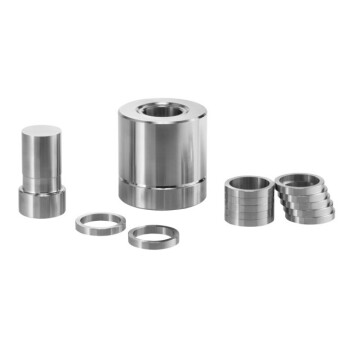
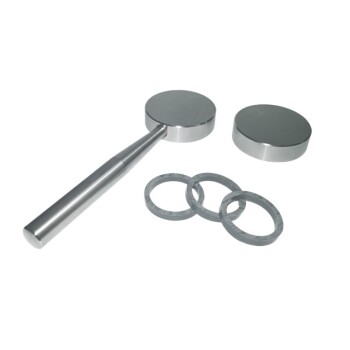
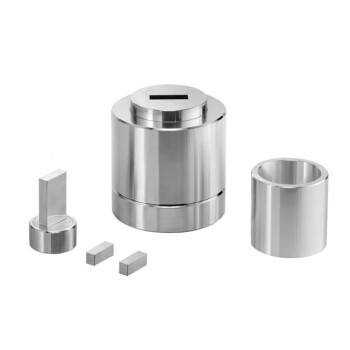
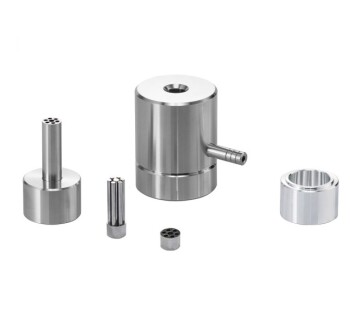
A precision pellet mold serves as the critical containment vessel for transforming loose powders into functional solid-state battery components. By providing rigid lateral constraints and a defined shaping space (typically around 8mm in diameter), it enables the application of high pressures—such as 240 MPa—to consolidate TiS2/LiBH4 materials into dense, uniform pellets.
The mold’s primary function is to translate vertical pressure into structural density without material deformation, creating the highly compacted, sharp-edged layers necessary for efficient ion transport in bulk-type all-solid-state batteries.
The Mechanics of Confinement
Providing Lateral Constraints
The mold acts as a rigid boundary that prevents powder materials from spreading outward during compression.
Without this lateral support, the application of force would simply displace the powder rather than densifying it. This constraint is essential for creating a stable, solid structure from loose TiS2 and LiBH4 particles.
Defining the Shaping Space
The mold provides a specific, fixed volume for the fabrication process, such as an 8mm diameter cavity.
This ensures that the resulting cathode or electrolyte layer meets exact geometric specifications. It eliminates variability in the pellet's footprint, which is crucial for stacking layers in a battery cell.
Achieving Material Integrity
Withstanding High Pressure
Fabricating effective solid-state electrolytes requires immense force to close the gaps between particles.
The precision mold is engineered to withstand pressures as high as 240 MPa. This capability allows you to apply the force necessary to cold-press the powders without damaging the tool or the sample.
Ensuring Component Density
The ultimate goal of using the mold is to produce a "bulk-type" component.
By facilitating high-pressure pressing, the mold forces the TiS2 and LiBH4 powders into a dense state. This reduces porosity, which is critical for maximizing conductivity and structural integrity within the battery.
Creating Neat Edges
A precision mold ensures the final pellet has clean, well-defined boundaries.
"Neatly edged" pellets prevent short circuits and ensure proper contact between the cathode and electrolyte layers. This geometric precision prevents material crumbling at the periphery.
Understanding the Trade-offs
Pressure vs. Tool Durability
While the mold is designed for high pressures (e.g., 240 MPa), it is not indestructible.
Pushing beyond the rated pressure to achieve higher density can deform the mold or cause the pellet to crack upon ejection. You must balance the need for density against the mechanical limits of the steel mold.
Precision vs. Ease of Ejection
The "precision" aspect implies very tight tolerances between the plunger and the die to prevent powder leakage.
However, these tight tolerances can sometimes make ejecting the pressed pellet difficult if the powder is sticky or if the tool is not perfectly aligned. Proper cleaning and alignment are non-negotiable for repeatable results.
Optimizing Your Fabrication Process
To get the most out of your precision pellet mold when working with TiS2/LiBH4 composites:
- If your primary focus is Ion Conductivity: Prioritize safe maximization of pressure (up to the 240 MPa limit) to minimize voids and maximize particle-to-particle contact.
- If your primary focus is Reproducibility: Rely on the fixed diameter constraints to ensure every cathode and electrolyte layer has the exact same surface area for consistent testing data.
By utilizing the mold's lateral constraints and pressure tolerance, you turn raw powder into the high-performance building blocks of a solid-state battery.
Summary Table:
| Feature | Function in TiS2/LiBH4 Fabrication | Benefit to Solid-State Batteries |
|---|---|---|
| Lateral Constraint | Prevents powder spreading during compression | Enables structural stability and high density |
| Defined Volume | Provides fixed diameter (e.g., 8mm) | Ensures geometric precision and layer stacking |
| Pressure Rating | Withstands forces up to 240 MPa | Minimizes porosity for maximum ion conductivity |
| Precision Tolerances | Prevents powder leakage and ensures sharp edges | Reduces short-circuit risks at layer interfaces |
Elevate Your Battery Research with KINTEK Precision
Consistency is the backbone of breakthrough material science. KINTEK specializes in high-performance laboratory equipment, including specialized hydraulic presses (pellet, hot, isostatic) and precision crushing and milling systems designed to prepare your TiS2/LiBH4 powders for excellence. Whether you need robust pellet molds, high-temperature furnaces, or advanced battery research tools, our solutions ensure your solid-state components meet the highest standards of density and conductivity.
Ready to optimize your fabrication process? Contact our experts today to find the perfect tools for your laboratory's needs.
Related Products
- XRF Boric Acid Lab Powder Pellet Pressing Mold for Laboratory Use
- XRF & KBR steel ring lab Powder Pellet Pressing Mold for FTIR
- Ring Press Mold for Lab Applications
- XRF & KBR plastic ring lab Powder Pellet Pressing Mold for FTIR
- Assemble Square Lab Press Mold for Laboratory Applications
People Also Ask
- What is the purpose of using a mold for pellet pressing when preparing catalyst test samples? Ensure Data Consistency
- What is the XRF method of sampling? Achieve Accurate Elemental Analysis with Proper Sample Prep
- What is the XRF pressed pellet method? A Fast, Cost-Effective Sample Prep Guide
- How are samples prepared for XRF analysis? Achieve Accurate and Reliable Results
- How do you make XRF pellets? A 4-Step Guide to Flawless Sample Preparation