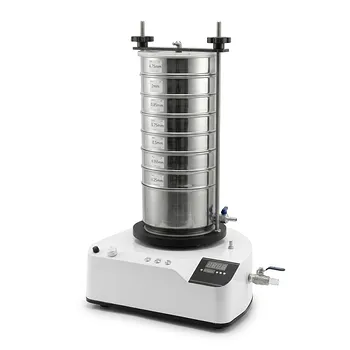
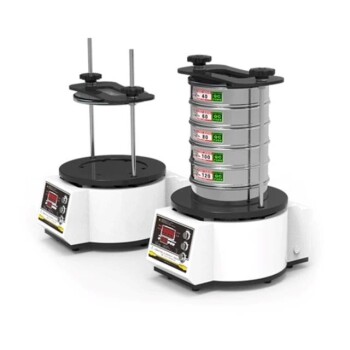
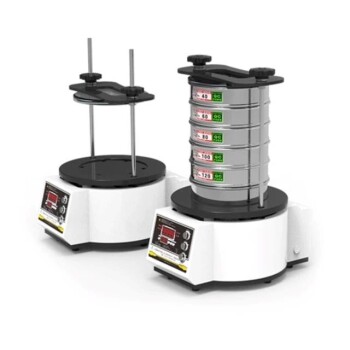
Precision sieving systems are fundamental to feedstock preparation because they rigorously control particle size distribution. By utilizing micropore sieves with specific apertures, these systems ensure that crushed materials—such as corn stover and coal—meet precise physical standards before entering the co-gasification process.
The ultimate value of a precision sieving system lies in its ability to enforce physical consistency across different raw materials. This uniformity is the prerequisite for maintaining even gas flow and stable reaction rates within the gasifier bed.
The Mechanics of Feedstock Control
Micropore Sieving Technology
The core of this system involves the use of micropore sieves featuring various aperture sizes. By passing crushed material through these specific openings, the system filters out particles that do not meet the required dimensional criteria.
Measuring Particle Distribution
This process does more than just separate material; it provides an accurate measurement of the particle size distribution. This data allows operators to verify that the feedstock adheres to the necessary specifications for the reactor.
Handling Material Diversity
In co-gasification, the system must handle distinct materials like crushed corn stover and coal. Precision sieving ensures that despite their different origins and physical properties, both components are brought to a compatible size range.
The Operational Impact on Co-Gasification
Achieving Physical Consistency
The primary output of the sieving process is physical consistency in the feedstock mixture. This uniformity eliminates the variability that occurs when raw materials are crushed but not sorted.
Enabling Uniform Gas Flow
When particle sizes are consistent, the interstitial spaces (gaps) between particles in the gasifier bed are also consistent. This allows for uniform gas flow distribution, preventing channeling or dead zones where gas cannot pass effectively.
Stabilizing Reaction Rates
Consistency in particle size leads to consistency in surface area availability. This stability ensures that chemical reactions occur at predictable and stable rates throughout the gasification process.
The Risks of Inconsistent Feedstock
Compromising Flow Dynamics
Without the accurate control provided by precision sieving, the feedstock mixture will contain random particle sizes. This irregularity disrupts the gas flow distribution, leading to inefficient interaction between the gas and the solid fuel.
Destabilizing the Reactor
If the physical consistency of the corn stover and coal mixture is ignored, reaction rates becomes volatile. The lack of uniform particle size makes it difficult to maintain the steady-state conditions required for efficient gasification.
Optimizing Your Feedstock Strategy
To ensure your co-gasification process operates at peak efficiency, apply the principles of precision sieving to your material preparation:
- If your primary focus is Process Stability: Ensure your sieving system removes outliers to guarantee uniform gas flow through the bed.
- If your primary focus is Reaction Control: Prioritize strict adherence to particle size distribution targets to maintain predictable reaction rates.
By treating particle size control as a critical variable, you turn raw feedstock into a reliable fuel source for consistent energy generation.
Summary Table:
| Feature | Impact on Co-Gasification | Operational Benefit |
|---|---|---|
| Micropore Technology | Precise particle size control | Enforces physical consistency of diverse materials |
| Distribution Data | Measurement of size range | Verifies feedstock adherence to reactor specs |
| Uniform Apertures | Consistent interstitial gaps | Prevents gas channeling and ensures uniform flow |
| Surface Area Control | Predictable reaction surface | Maintains stable and efficient chemical reaction rates |
Optimize Your Co-Gasification Performance with KINTEK
Don’t let feedstock variability compromise your reactor's efficiency. KINTEK specializes in advanced laboratory equipment, including high-precision crushing and milling systems and sieving equipment designed to deliver the exact particle distribution your research or production requires.
Whether you are processing corn stover, coal, or advanced materials, our solutions ensure the physical consistency necessary for stable reaction rates and uniform gas flow. Beyond preparation, we offer a comprehensive range of high-temperature furnaces, high-pressure reactors, and PTFE consumables to support your entire gasification workflow.
Ready to achieve superior process stability? Contact our technical experts today to find the perfect sieving and milling solution for your laboratory.
References
- Anthony Anukam, Edson L. Meyer. Blending Influence on the Conversion Efficiency of the Cogasification Process of Corn Stover and Coal. DOI: 10.1155/2016/3910986
This article is also based on technical information from Kintek Solution Knowledge Base .
Related Products
- Three-dimensional electromagnetic sieving instrument
- Custom PTFE Teflon Parts Manufacturer for PTFE Mesh F4 Sieve
- Laboratory Vibratory Sieve Shaker Machine for Dry and Wet Three-Dimensional Sieving
- Laboratory Test Sieves and Sieving Machines
- Precision Wire Saw Laboratory Cutting Machine with 800mm x 800mm Workbench for Diamond Single Wire Circular Small Cutting
People Also Ask
- Why is sieving equipment essential for the classification of processed bio-activated carbon? Optimize Performance
- What are the limitations of sieving? Understanding the Constraints of Particle Size Analysis
- What are advantages and disadvantages of sieving method? A Guide to Reliable & Cost-Effective Particle Sizing
- How is sieving important? The Critical Role of Particle Size Analysis in Quality Control
- What is sieving and how does it work? A Guide to Accurate Particle Size Analysis