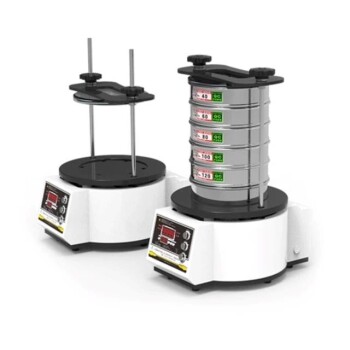
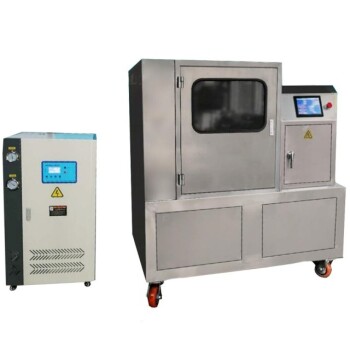
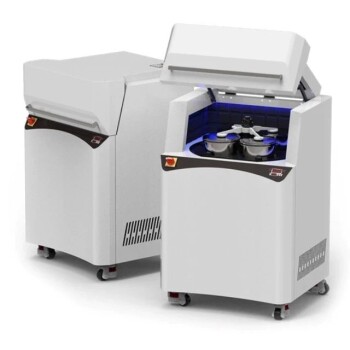
A precision vibration sieving system serves as the critical quality control mechanism for Fe-Al thermal spray feedstocks, specifically by isolating narrow powder fractions such as 38–75 μm from bulk ball-milled mixtures. By strictly filtering the feedstock, the system ensures the material achieves the consistent physical geometry required for stability in high-velocity gas detonation and supersonic spray processes.
Core Takeaway The primary value of precision sieving is the synchronization of the powder’s melting behavior. By eliminating outliers, the system prevents the dual failures of incomplete melting (from large particles) and excessive oxidation (from small particles), directly optimizing coating density and deposition efficiency.
Optimizing Thermal Dynamics and Flow
Ensuring Uniform Heating
In thermal spraying, the thermal history of a particle is dictated by its mass and surface area. A precision sieving system ensures that every particle entering the supersonic flow falls within a strict size tolerance.
When particles are uniform in size, they heat at the same rate. This uniformity is essential for achieving a consistent molten state across the entire spray stream.
Maintaining Material Flowability
Inconsistent particle sizes often lead to clogging or irregular pulsing in the feed lines. This is particularly detrimental in gas detonation spraying, where precise timing is required.
By extracting a narrow fraction of powder, the sieving system guarantees predictable material flowability. This ensures a constant, uninterrupted supply of feedstock to the gun, stabilizing the entire deposition process.
Impact on Coating Quality and Performance
Maximizing Deposition Efficiency
Deposition efficiency refers to the percentage of sprayed powder that actually adheres to the substrate.
When particles are properly sieved, they are less likely to bounce off the substrate (due to being unmelted) or vaporize before impact (due to being too small). Precision sieving maximizes the volume of powder that contributes to the final coating.
Enhancing Coating Density and Structure
The consistency of the feedstock directly determines the packing density of the coating.
A uniform particle distribution leads to a denser coating structure with fewer voids. Furthermore, consistent particle sizing improves the initial bonding strength, creating a more durable and cohesive layer.
Understanding the Risks of Improper Sizing
The Danger of Undersized Particles
If the sieving process fails to remove the "fines" (particles below the target range), the coating quality suffers immediately.
Small particles heat up too quickly in the thermal plume. This leads to excessive oxidation, introducing brittle oxides into the coating that weaken its structural integrity.
The Problem with Oversized Particles
Conversely, particles that exceed the specified mesh range (e.g., larger than 75 μm) possess too much thermal mass.
These particles often suffer from incomplete melting. When they impact the substrate, they create weak points and surface roughness rather than splatting and bonding effectively.
Making the Right Choice for Your Goal
To maximize the performance of your Fe-Al thermal spray projects, align your sieving parameters with your specific operational needs:
- If your primary focus is Process Stability: Prioritize removing irregular shapes and fines to ensure consistent flowability and prevent nozzle clogging during gas detonation.
- If your primary focus is Coating Integrity: Enforce a strict upper and lower limit (narrow fraction) to prevent oxidation and ensure every particle fully melts before impact.
Precision sieving is not just about sorting; it is the fundamental step that defines the thermal behavior and ultimate success of the coating application.
Summary Table:
| Impact Factor | Benefit of Precision Sieving | Risk of Improper Sizing |
|---|---|---|
| Thermal Dynamics | Uniform heating rates & consistent molten state | Incomplete melting or excessive oxidation |
| Material Flow | Smooth, constant feed; no nozzle clogging | Clogging, pulsing, and process instability |
| Coating Density | High packing density with minimal voids | Increased porosity and structural weak points |
| Deposition Efficiency | Maximized adherence to the substrate | Material loss via bounce-off or vaporization |
| Coating Purity | Reduced oxide inclusions from fine particles | Brittle coating layers and poor bonding |
Precision is the foundation of high-performance thermal spray coatings. At KINTEK, we specialize in advanced crushing, milling, and precision sieving equipment designed to ensure your Fe-Al feedstocks meet the strictest size tolerances. Whether you are aiming for superior process stability or maximum coating integrity, our comprehensive range of laboratory solutions—from vibratory sieves and hydraulic presses to high-temperature furnaces—empowers your research and production. Contact us today to discover how KINTEK’s expert tools can enhance your material consistency and deposition efficiency!
References
- C. Senderowski. Nanocomposite Fe-Al Intermetallic Coating Obtained by Gas Detonation Spraying of Milled Self-Decomposing Powder. DOI: 10.1007/s11666-014-0086-1
This article is also based on technical information from Kintek Solution Knowledge Base .
Related Products
- Laboratory Vibratory Sieve Shaker Machine for Dry and Wet Three-Dimensional Sieving
- Vibratory Sieve Shaker Machine Dry Three-Dimensional Vibrating Sieve
- Laboratory Test Sieves and Vibratory Sieve Shaker Machine
- Laboratory Vibratory Sieve Shaker Machine Slap Vibrating Sieve
- Laboratory Wet Three-Dimensional Vibratory Sieve Shaker Machine
People Also Ask
- How does a laboratory vibratory sieve shaker facilitate the microstructural study of gas-atomized alloy powders?
- What role does a laboratory vibrating sieve shaker play in the LiFePO4 powder processing workflow? Ensure Batch Quality
- Why use a vibratory sieve shaker for PET powder? Achieve Precise Particle Size Control for Chemical Research
- What is the principle of vibratory sieve shaker? Achieve Accurate Particle Size Analysis
- What is the function of a vibratory sieve shaker? Achieve Precise Particle Size Analysis