Knowledge How does a roll press work? A Deep Dive into Continuous Compaction Technology
Author avatar

Tech Team · Kintek Solution

Updated 5 days ago

How does a roll press work? A Deep Dive into Continuous Compaction Technology


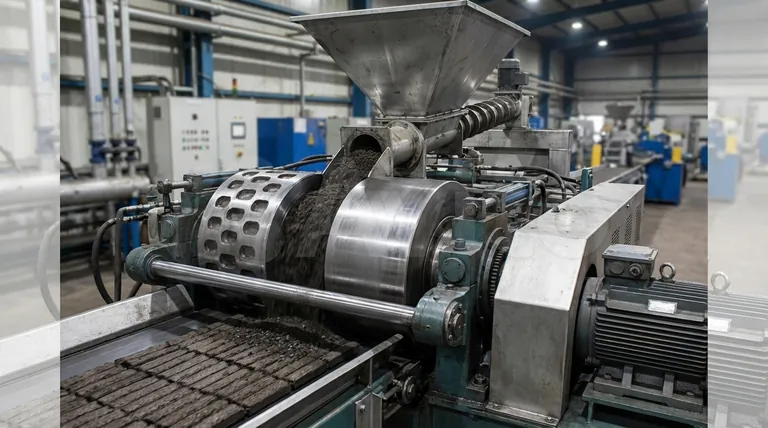
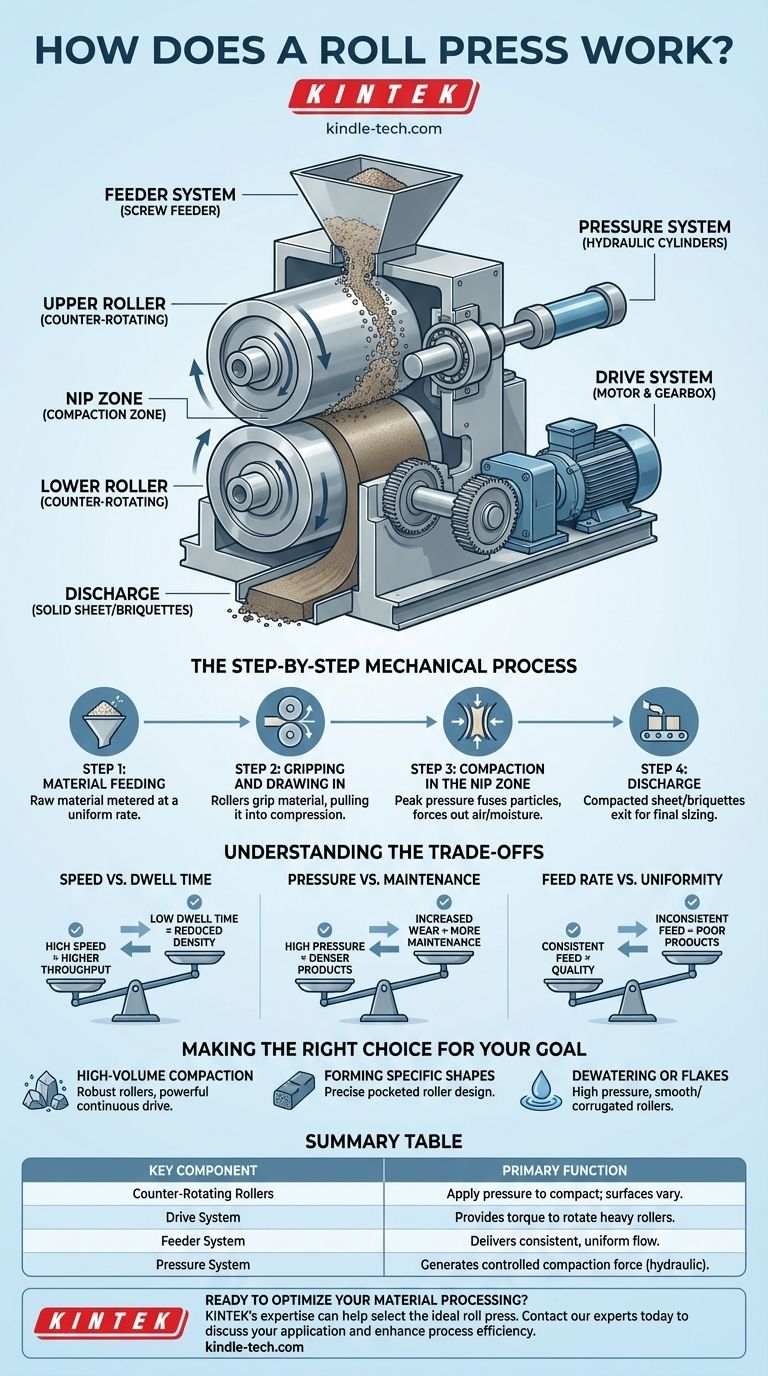
At its core, a roll press is a machine of continuous mechanical pressure. It functions by drawing material between two large, counter-rotating rollers. As the material passes through the narrowing gap between them—a zone known as the nip—it is subjected to immense force, compacting it into a denser, solid form.

The essential principle of a roll press is its ability to transform a continuous flow of loose material into a compacted sheet or briquette. Unlike a press that operates in cycles, the roll press works constantly, making it a highly efficient solution for high-throughput industrial processes.
How does a roll press work? A Deep Dive into Continuous Compaction Technology

The Core Components of a Roll Press

To understand the process, it's essential to recognize the key components that work in unison.

The Counter-Rotating Rollers

These are the heart of the machine. Their surfaces can be smooth for creating dense sheets, corrugated for flakes, or pocketed (indented) for producing precisely shaped briquettes.

The Drive System

A powerful motor and gearbox assembly provides the torque needed to turn the heavy rollers against the immense resistance of the material being compacted. The synchronization of these rollers is critical.

The Feeder System

This mechanism, often a screw feeder, is responsible for delivering a consistent and even flow of raw material into the gap above the rollers. The quality of the final product is highly dependent on the feeder's performance.

The Pressure System

While the rollers provide the mechanical action, the compressive force itself is typically generated by a hydraulic system. Hydraulic cylinders push one of the roller bearings, forcing the rollers together with a controlled, consistent pressure.

The Step-by-Step Mechanical Process

The operation is a seamless, four-stage flow that repeats continuously as long as material is supplied.

Step 1: Material Feeding

Raw material is loaded into a hopper and the feeder system meters it, ensuring it is introduced to the rollers at a predictable and uniform rate.

Step 2: Gripping and Drawing In

As the rollers turn inward, they grip the loose material and pull it down into the compression zone. The angle at which this happens is known as the "nip angle."

Step 3: Compaction in the Nip Zone

The gap between the rollers narrows to its minimum point. Here, the pressure peaks, forcing air or moisture out of the material and fusing the individual particles together into a solid, densified mass.

Step 4: Discharge

The newly formed solid sheet or stream of briquettes exits from the bottom of the rollers. It may then fall onto a conveyor or into a breaker to be sized for its final application.

Understanding the Trade-offs

The efficiency of a roll press is not absolute; it's a balance of competing factors that must be managed.

Speed vs. Dwell Time

Increasing the rotational speed of the rollers increases throughput, which is often desirable. However, this reduces the "dwell time"—the duration the material is under maximum pressure—which can negatively impact the final density and strength of the product.

Pressure vs. Maintenance

Higher hydraulic pressure leads to denser, stronger products. But this elevated force dramatically increases the rate of wear on the roller surfaces and bearings, leading to more frequent and costly maintenance cycles.

Feed Rate vs. Uniformity

An inconsistent feed is the most common cause of poor results. Over-feeding can choke the press and strain the drive motor, while under-feeding results in poorly formed, low-density products.

Making the Right Choice for Your Goal

The optimal setup for a roll press depends entirely on the desired outcome.

  • If your primary focus is high-volume compaction (e.g., minerals, fertilizers): You need robust, wear-resistant roller surfaces and a powerful, reliable drive system capable of continuous, high-pressure operation.
  • If your primary focus is forming specific shapes (briquetting coal or charcoal): The design and precision of the roller pockets are paramount, as they directly define the shape, size, and quality of the final product.
  • If your primary focus is dewatering or creating flakes: A combination of high pressure with smooth or corrugated rollers is essential to squeeze out liquid efficiently or shear the material into the desired form.

Ultimately, mastering a roll press application is about achieving the perfect equilibrium between feed rate, roller speed, and applied pressure.

Summary Table:

Key Component Primary Function
Counter-Rotating Rollers Apply pressure to compact material; surfaces can be smooth, corrugated, or pocketed.
Drive System Provides the torque to rotate the heavy rollers against material resistance.
Feeder System Delivers a consistent and uniform flow of raw material into the press.
Pressure System Typically hydraulic, it generates the controlled force needed for compaction.

Ready to Optimize Your Material Processing?

Understanding the mechanics of a roll press is the first step. Implementing the right one for your specific material and throughput goals is what delivers real results. Whether you need high-volume compaction, precise briquetting, or efficient dewatering, KINTEK's expertise in lab equipment and consumables can help you select and maintain the ideal roll press for your laboratory or industrial needs.

Contact our experts today to discuss your application and discover how KINTEK can enhance your process efficiency and product quality.

Visual Guide
How does a roll press work? A Deep Dive into Continuous Compaction Technology Visual Guide

Related Products

People Also Ask

Related Products

Single Punch Electric Tablet Press Machine Laboratory Powder Tablet Punching TDP Tablet Press

Single Punch Electric Tablet Press Machine Laboratory Powder Tablet Punching TDP Tablet Press

The single-punch electric tablet press is a laboratory-scale tablet press suitable for corporate laboratories in pharmaceutical, chemical, food, metallurgical and other industries.

Automatic Heated Hydraulic Press Machine with Heated Plates for Laboratory Hot Press 25T 30T 50T

Automatic Heated Hydraulic Press Machine with Heated Plates for Laboratory Hot Press 25T 30T 50T

Efficiently prepare your samples with our Automatic Heated Lab Press. With a pressure range up to 50T and precise control, it's perfect for various industries.

Rubber Vulcanizer Vulcanizing Machine Plate Vulcanizing Press for Lab

Rubber Vulcanizer Vulcanizing Machine Plate Vulcanizing Press for Lab

The Plate vulcanizing press is a kind of equipment used in the production of rubber products, mainly used for the vulcanization of rubber products. Vulcanization is a key step in rubber processing.

Metallographic Specimen Mounting Machine for Laboratory Materials and Analysis

Metallographic Specimen Mounting Machine for Laboratory Materials and Analysis

Precision metallographic mounting machines for labs—automated, versatile, and efficient. Ideal for sample prep in research and quality control. Contact KINTEK today!

Single Punch Tablet Press Machine and Mass Production Rotary Tablet Punching Machine for TDP

Single Punch Tablet Press Machine and Mass Production Rotary Tablet Punching Machine for TDP

Rotary tablet punching machine is an automatic rotating and continuous tableting machine. It is mainly used for tablet manufacturing in the pharmaceutical industry, and is also suitable for industrial sectors such as food, chemicals, batteries, electronics, ceramics, etc. to compress granular raw materials into tablets.

Double Plate Heating Press Mold for Lab

Double Plate Heating Press Mold for Lab

Discover precision in heating with our Double Plate Heating Mold, featuring high-quality steel and uniform temperature control for efficient lab processes. Ideal for various thermal applications.

Touchscreen Automatic Vacuum Heat Press

Touchscreen Automatic Vacuum Heat Press

Precision vacuum heat press for labs: 800°C, 5-ton pressure, 0.1MPa vacuum. Ideal for composites, solar cells, aerospace.

Single Punch Manual Tablet Press Machine TDP Tablet Punching Machine

Single Punch Manual Tablet Press Machine TDP Tablet Punching Machine

Single punch manual tablet punching machine can press various granular, crystal or powdery raw materials with good fluidity into disc-shaped, cylindrical, spherical, convex, concave and other various geometric shapes (such as square, triangle, ellipse, capsule shape, etc.), and can also press products with text and patterns.

Powerful Plastic Crusher Machine

Powerful Plastic Crusher Machine

KINTEK's powerful plastic crusher machines process 60-1350 KG/H of diverse plastics, ideal for labs and recycling. Durable, efficient, and customizable.

Lab Plastic PVC Calender Stretch Film Casting Machine for Film Testing

Lab Plastic PVC Calender Stretch Film Casting Machine for Film Testing

The cast film machine is designed for the molding of polymer cast film products and has multiple processing functions such as casting, extrusion, stretching, and compounding.

Single Punch Electric Tablet Press Machine TDP Tablet Punching Machine

Single Punch Electric Tablet Press Machine TDP Tablet Punching Machine

The electric tablet punching machine is a laboratory equipment designed for pressing various granular and powdery raw materials into discs and other geometric shapes. It is commonly used in pharmaceutical, healthcare products, food, and other industries for small batch production and processing. The machine is compact, lightweight, and easy to operate, making it suitable for use in clinics, schools, laboratories, and research units.

Lab Blown Film Extrusion Three Layer Co-Extrusion Film Blowing Machine

Lab Blown Film Extrusion Three Layer Co-Extrusion Film Blowing Machine

Lab blown film extrusion is mainly used to detect the feasibility of film blowing of polymer materials and the colloid condition in the materials, as well as the dispersion of colored dispersions, controlled mixtures, and extrudates;

Electrode Polishing Material for Electrochemical Experiments

Electrode Polishing Material for Electrochemical Experiments

Looking for a way to polish your electrodes for electrochemical experiments? Our polishing materials are here to help! Follow our easy instructions for best results.

Laboratory Sterilizer Lab Autoclave Herbal Powder Sterilization Machine for Plant

Laboratory Sterilizer Lab Autoclave Herbal Powder Sterilization Machine for Plant

The herbal powder sterilization autoclave machine for Chinese medicine uses saturated steam for effective sterilization. It utilizes the heat and penetrative properties of steam, achieves sterilization after heat preservation, and maintains a good drying effect with a dedicated drying system.

Liquid Nitrogen Cryogenic Grinder Mill Cryomill Airflow Ultrafine Pulverizer

Liquid Nitrogen Cryogenic Grinder Mill Cryomill Airflow Ultrafine Pulverizer

Discover the Liquid Nitrogen Cryogenic Grinding Machine, perfect for lab use, ultra-fine pulverization, and preserving material properties. Ideal for pharmaceuticals, cosmetics, and more.

Small Injection Molding Machine for Lab Use

Small Injection Molding Machine for Lab Use

The small injection molding machinehas fast and stable movements; good controllability and repeatability, super energy saving; the product can be automatically dropped and formed; the machine body is low, convenient for feeding, easy to maintain, and no height restrictions on the installation site.

Laboratory Vibratory Sieve Shaker Machine for Dry and Wet Three-Dimensional Sieving

Laboratory Vibratory Sieve Shaker Machine for Dry and Wet Three-Dimensional Sieving

KT-VD200 can be used for sieving tasks of dry and wet samples in the laboratory. The screening quality is 20g-3kg. The product is designed with a unique mechanical structure and an electromagnetic vibrating body with a vibration frequency of 3000 times per minute.

Inclined Rotary Plasma Enhanced Chemical Vapor Deposition PECVD Equipment Tube Furnace Machine

Inclined Rotary Plasma Enhanced Chemical Vapor Deposition PECVD Equipment Tube Furnace Machine

Introducing our inclined rotary PECVD furnace for precise thin film deposition. Enjoy automatic matching source, PID programmable temperature control, and high accuracy MFC mass flowmeter control. Built-in safety features for peace of mind.

High Energy Planetary Ball Mill Machine for Laboratory Horizontal Tank Type

High Energy Planetary Ball Mill Machine for Laboratory Horizontal Tank Type

The KT-P2000H uses a unique Y-axis planetary trajectory, and utilizes the collision, friction and gravity between the sample and the grinding ball.

Mini Planetary Ball Mill Machine for Laboratory Milling

Mini Planetary Ball Mill Machine for Laboratory Milling

Discover the KT-P400 desktop planetary ball mill, ideal for grinding and mixing small samples in the lab. Enjoy stable performance, long service life, and practicality. Functions include timing and overload protection.


Leave Your Message