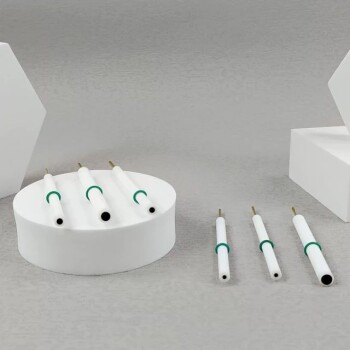
The saturated silver/silver chloride (Ag/AgCl) electrode ensures accuracy by providing a stable, reproducible reference potential essential for defining the absolute potential of the Ni-Cr working electrode. In high-temperature environments (specifically around 363 K), it functions in tandem with a Luggin capillary salt bridge and specific thermal correction factors. This combination effectively mitigates liquid junction potentials and thermal fluctuations, allowing for the precise generation of voltage-dependent kinetic curves.
Core Takeaway Achieving measurement accuracy at high temperatures requires more than just a stable electrode; it demands a system-level approach to thermal management. The Ag/AgCl electrode delivers reliable data only when liquid junction potentials are physically managed via a salt bridge and mathematically adjusted using specific thermal correction factors.
The Foundation of Potential Stability
Establishing a Fixed Benchmark
To accurately measure the behavior of a Ni-Cr alloy, you must measure its absolute potential against a value that does not change. The Ag/AgCl electrode provides this fixed benchmark (approximately +199 mV relative to a standard hydrogen electrode).
The Role of Saturation
The stability of this electrode comes from its construction: a silver wire coated in silver chloride immersed in a solution saturated with potassium chloride (KCl) and AgCl. This saturation ensures the chemical environment around the reference wire remains constant, preventing drift in the baseline potential even during extended testing.
Managing High-Temperature Challenges
Mitigating Thermal Fluctuations
High-temperature experiments, such as those conducted at 363 K, introduce thermodynamic noise that can distort electrochemical readings. By using a saturated Ag/AgCl electrode, researchers can isolate the working electrode's response from these environmental variables.
The Luggin Capillary Salt Bridge
Accuracy in these specific tests relies heavily on the use of a Luggin capillary salt bridge. This component physically bridges the gap between the reference electrode and the Ni-Cr working electrode, minimizing the ohmic drop and interference in the solution.
Understanding the Trade-offs
Liquid Junction Potentials
A major source of error in electrochemical testing is the liquid junction potential—a voltage difference generated at the interface of two different electrolyte solutions. While the Ag/AgCl electrode is stable, it cannot eliminate this physics-based phenomenon on its own.
The Necessity of Thermal Correction
It is critical to understand that raw data from high-temperature tests may still contain artifacts. The primary reference indicates that accuracy is only ensured when specific thermal correction factors are applied. Relying solely on the electrode without applying these mathematical corrections to account for the temperature difference (e.g., at 363 K) will result in inaccurate kinetic curves.
Making the Right Choice for Your Goal
To ensure your Ni-Cr alloy characterization is valid, apply the following principles based on your specific objectives:
- If your primary focus is plotting kinetic curves: Ensure you utilize a Luggin capillary salt bridge to physically offset liquid junction potentials during the sweep.
- If your primary focus is absolute potential accuracy: You must apply the specific thermal correction factors relevant to your testing temperature (e.g., 363 K) to adjust the raw reference values.
Success in high-temperature electrochemistry lies in the rigorous combination of physical stability and mathematical correction.
Summary Table:
| Feature | Function in High-Temp Testing | Impact on Accuracy |
|---|---|---|
| Saturated Ag/AgCl | Provides a fixed +199 mV benchmark | Prevents baseline drift and potential fluctuations |
| Luggin Capillary | Bridges reference and working electrodes | Minimizes ohmic drop and liquid junction potential |
| Thermal Correction | Mathematical adjustment for temp (e.g., 363 K) | Eliminates thermodynamic noise and calculation errors |
| KCl/AgCl Saturation | Maintains constant chemical environment | Ensures reproducibility across extended test durations |
Elevate Your Electrochemical Research with KINTEK Precision
Don't let thermal drift or liquid junction potentials compromise your research data. KINTEK specializes in high-performance laboratory solutions designed for the most demanding environments. Whether you are characterizing Ni-Cr alloys or developing next-generation energy storage, our comprehensive portfolio—including advanced electrolytic cells, precision electrodes, high-temperature furnaces, and specialized battery research tools—provides the stability and accuracy you need.
Why choose KINTEK?
- Precision Engineering: Our electrodes and salt bridges are designed to minimize ohmic drop and maximize reproducibility.
- Complete System Solutions: From ULT freezers and cooling solutions to high-pressure reactors and furnaces, we equip your entire workflow.
- Expert Support: We help researchers select the right consumables, from PTFE products to high-purity ceramics and crucibles.
Achieve superior measurement accuracy today. Contact our specialists to discuss your high-temperature testing requirements!
References
- Penghao Xiao, Brandon C. Wood. Atomic-scale understanding of oxide growth and dissolution kinetics of Ni-Cr alloys. DOI: 10.1038/s41467-024-54627-x
This article is also based on technical information from Kintek Solution Knowledge Base .
Related Products
- Reference Electrode Calomel Silver Chloride Mercury Sulfate for Laboratory Use
- Gold Disc Electrode
- Copper Sulfate Reference Electrode for Laboratory Use
- Gold Electrochemical Sheet Electrode Gold Electrode
- Metal Disc Electrode Electrochemical Electrode
People Also Ask
- What is the function of a reference electrode? Master Precision in Three-Electrode Reactor Reconstruction
- What is the recommended maintenance for the filling solution of a reference electrode? A Guide to Stable & Accurate Readings
- Which electrode is used as a ground reference? Master the Key to Accurate Electrochemical Measurements
- What is the reference electrode in potentiometry? The Key to Stable & Accurate Measurements
- Which electrode is used as a reference? A Guide to Accurate Electrochemical Measurements