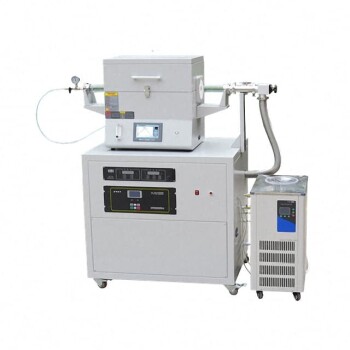
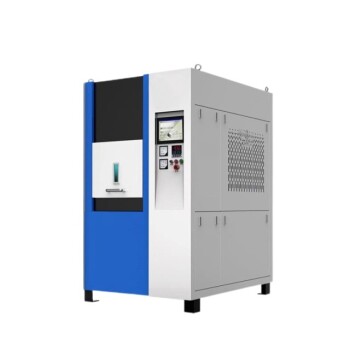
Precision is achieved through compartmentalized control. A three-zone split atmosphere furnace ensures accuracy by independently regulating heating elements across three distinct sections. This design creates a highly uniform temperature field, ensuring the specimen's gauge length stays exactly at the target 200°C without significant thermal gradients.
By isolating control into three zones, this furnace architecture prevents heat loss at the specimen ends, ensuring that observed phenomena like dynamic strain aging are genuine material responses, not artifacts of temperature variation.
Achieving Thermal Uniformity
The primary challenge in high-temperature tensile testing is not just reaching a specific temperature, but maintaining it evenly across the entire specimen.
Independent Zone Regulation
The furnace is divided into three sections, typically a top, center, and bottom zone. Each zone possesses its own independent heating elements and control mechanisms.
Counteracting End-Loss Effects
In single-zone furnaces, heat often escapes through the mounting grips at the ends of the specimen, creating a "cool" gradient at the top and bottom.
The three-zone system compensates for this by allowing the outer zones to output more heat than the center zone. This balances the thermal profile and ensures the environment is consistent from top to bottom.
Stabilizing the Gauge Length
The most critical area of the specimen is the gauge length, where the deformation occurs.
By creating a uniform temperature field, the furnace ensures that every millimeter of the gauge length experiences the exact same thermal conditions throughout the test.
Critical Applications in Material Science
The necessity for such rigorous temperature control at 200°C is driven by specific material behaviors that are highly sensitive to thermal fluctuation.
Dynamic Strain Aging
Dynamic strain aging is a phenomenon where materials strengthen or harden during deformation due to the interaction of solute atoms with dislocations.
This mechanism is temperature-dependent. If the temperature varies across the specimen, the strain aging data will be inconsistent and unreliable.
Thermal Recovery of Irradiation Damage
Researchers often use these furnaces to study how materials recover from damage caused by irradiation.
This recovery process is governed by thermal energy. Precise temperature control is required to accurately correlate the degree of recovery with the specific temperature of 200°C.
Understanding the Trade-offs
While three-zone furnaces offer superior precision, they introduce complexities that must be managed to ensure data integrity.
Calibration Complexity
With three independent controllers, the setup requires careful calibration to ensure the zones work in harmony rather than fighting each other.
An improperly tuned PID controller in one zone can induce a gradient rather than eliminate it, potentially skewing the test results more than a passive system would.
Equipment Overhead
These systems require more thermocouples and control loops than standard furnaces. This increases the maintenance requirement to ensure all three zones are reading and responding accurately.
Making the Right Choice for Your Goal
When configuring your testing setup for high-temperature analysis, align your equipment choice with your specific research objectives.
- If your primary focus is dynamic strain aging: Ensure your zone controllers are tuned to react quickly to load changes, as thermal consistency is vital to isolate solute atom interactions.
- If your primary focus is irradiation recovery: Prioritize the stability of the gauge length temperature over long durations to accurately track the slow recovery of material properties.
Detailed thermal control is the only way to transform high-temperature data from a rough estimate into a scientific certainty.
Summary Table:
| Feature | Single-Zone Furnace | Three-Zone Split Furnace |
|---|---|---|
| Temperature Control | Uniform regulation across the whole unit | Independent control for Top, Center, and Bottom zones |
| Thermal Uniformity | Susceptible to heat loss at ends/grips | Compensates for end-loss to create a flat thermal profile |
| Gauge Length Accuracy | Possible gradients affecting deformation | Guaranteed consistent temperature across specimen length |
| Best Used For | Basic heating and general heat treatment | Dynamic strain aging and irradiation recovery studies |
| Complexity | Low; single PID loop | High; three synchronized PID control loops |
Elevate Your Material Research with KINTEK Precision
Don't let thermal gradients compromise your critical data. KINTEK specializes in advanced laboratory solutions, offering a comprehensive range of high-performance three-zone split atmosphere furnaces, vacuum systems, and CVD/PECVD equipment designed for the most demanding research environments.
Whether you are studying dynamic strain aging or irradiation recovery, our thermal processing experts can provide you with the precision tools needed for scientific certainty. From high-temperature furnaces and hydraulic presses to PTFE products and ceramics, we equip your lab with excellence.
Ready to achieve superior thermal uniformity? Contact KINTEK today to discuss your specific testing requirements and find the perfect furnace for your laboratory.
References
- Donna Post Guillen, Yaqiao Wu. Thermomechanical Properties of Neutron Irradiated Al3Hf-Al Thermal Neutron Absorber Materials. DOI: 10.3390/ma16165518
This article is also based on technical information from Kintek Solution Knowledge Base .
Related Products
- Rotary Tube Furnace Split Multi Heating Zone Rotating Tube Furnace
- 1200℃ Controlled Atmosphere Furnace Nitrogen Inert Atmosphere Furnace
- 1700℃ Controlled Atmosphere Furnace Nitrogen Inert Atmosphere Furnace
- Split Chamber CVD Tube Furnace with Vacuum Station Chemical Vapor Deposition System Equipment Machine
- 1400℃ Controlled Atmosphere Furnace with Nitrogen and Inert Atmosphere
People Also Ask
- What are the advantages of using a rotary tube furnace for MoVOx catalysts? Elevate Uniformity and Crystallinity
- What are the process advantages of using a rotary tube furnace for WS2 powder? Achieve Superior Material Crystallinity
- Why is a rotary tube furnace preferred over a fixed tube furnace for the carbonization of asphaltenes? Superior Quality
- Why is a rotary tube furnace recommended for the calcination stage of potassium vanadium oxide catalysts? Optimize Purity
- What is a rotary tube furnace? Achieve Superior Uniformity for Powders and Granules