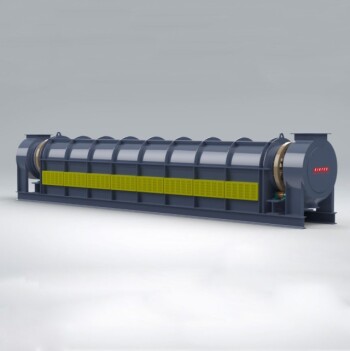
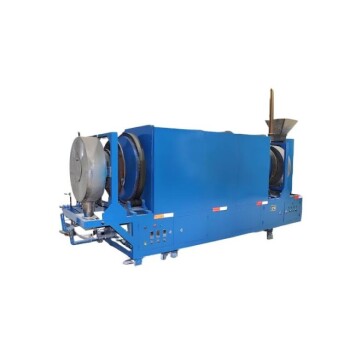
A tube calcination furnace acts as the critical activation chamber for the Mn-Ce-Mo/LDPC catalyst. It provides a strictly controlled oxidative atmosphere, typically at 400°C, which forces the thermal decomposition of manganese nitrate, cerium nitrate, and ammonium molybdate precursors into their active metal oxide forms. This specific thermal environment is responsible for driving the chemical interaction between these oxides, creating the necessary active centers for performance.
The furnace is not merely a heat source; it is a structural engineering tool that converts raw precursors into a cohesive active phase, defining the lattice structure and surface acidity essential for low-temperature catalytic performance.
The Mechanism of Phase Transformation
Thermal Decomposition of Precursors
The primary function of the furnace is to facilitate the breakdown of chemical precursors. Under a controlled oxidative atmosphere, manganese nitrate, cerium nitrate, and ammonium molybdate lose their volatile components.
This process transforms these raw compounds into their respective metal oxides. Without this specific thermal decomposition, the materials would remain inert and chemically unavailable for catalysis.
Promoting Oxide Interaction
Beyond simple decomposition, the furnace promotes the interaction between manganese, cerium, and molybdenum oxides.
By maintaining a steady temperature of 400°C, the furnace allows these distinct oxides to integrate. This results in the formation of specific active centers rather than isolated, independent oxide clusters.
Structural Rearrangement
Heat treatment facilitates the rearrangement of metal ions within the crystal lattice.
As volatile components are removed, the remaining atoms settle into a stable structure. This establishes the defined surface area and pore structure required for reactants to access the catalyst's active sites.
Impact on Catalyst Performance
Creating Surface Acidity
The interaction between the metal oxides, driven by the calcination process, directly influences the surface acidity of the final material.
Specific surface acidities are crucial for the adsorption of reactants. The tube furnace ensures these acidic sites are distributed correctly across the catalyst surface.
Enabling Low-Temperature Efficiency
The ultimate goal of this thermal preparation is to achieve high NOx conversion efficiency.
Because of the precise lattice structures formed during calcination, the Mn-Ce-Mo/LDPC catalyst becomes highly active within a low-temperature window of 120-200°C. This low-temperature activity is a direct result of the active phases stabilized by the furnace.
Understanding the Trade-offs
The Risk of Sintering
While heat is necessary for activation, excessive heat or uncontrolled heating rates can be detrimental.
If the temperature exceeds the optimal range or ramps up too quickly, sintering can occur. This leads to grain coarsening, which drastically reduces the specific surface area and destroys the fine pore structure necessary for activity.
Atmosphere Sensitivity
The furnace must maintain a strictly controlled oxidative atmosphere.
If the atmosphere fluctuates or lacks sufficient oxygen, the precursors may not fully decompose, or the metal oxides may form in the wrong oxidation states. This results in a catalyst with poor structural integrity and reduced conversion efficiency.
Optimizing Catalyst Preparation
If your primary focus is Maximum Activity:
- Ensure the furnace maintains a precise isothermal stage at 400°C to maximize the interaction between manganese, cerium, and molybdenum oxides without inducing thermal degradation.
If your primary focus is Structural Stability:
- Prioritize a controlled heating rate to allow for the orderly removal of volatiles, preventing the collapse of pores or the coarsening of grains associated with rapid thermal shock.
If your primary focus is Reproducibility:
- Strictly regulate the oxidative atmosphere flow within the tube to guarantee uniform surface acidity and lattice formation across every batch.
Correctly utilizing the tube calcination furnace turns a mixture of nitrates and molybdates into a high-precision tool for environmental remediation.
Summary Table:
| Process Stage | Function in Catalyst Preparation | Impact on Active Phase |
|---|---|---|
| Precursor Decomposition | Breaks down nitrates/molybdates at 400°C | Converts inert precursors into active metal oxides |
| Oxide Interaction | Facilitates integration of Mn, Ce, and Mo | Creates specific active centers and surface acidity |
| Structural Control | Manages lattice rearrangement and porosity | Establishes surface area for low-temperature activity |
| Atmosphere Control | Provides steady oxidative environment | Ensures correct oxidation states and structural integrity |
Elevate Your Catalyst Research with KINTEK Precision
Unlock superior low-temperature catalytic performance with KINTEK’s advanced tube calcination furnaces. Our high-temperature systems provide the precise isothermal control and oxidative atmosphere regulation required to synthesize high-activity Mn-Ce-Mo/LDPC catalysts without the risk of sintering.
From high-temperature reactors and muffle furnaces to specialized crushing, milling, and pellet pressing equipment, KINTEK offers a comprehensive laboratory portfolio for advanced materials science. Partner with KINTEK today to ensure batch-to-batch reproducibility and optimize your catalyst’s surface acidity.
→ Contact Our Technical Experts Now
References
- Tao Zhou, Hua Zhang. Mn-Ce catalysts/LDPC Modified by Mo for Improving NH3-SCR Performance and SO2 Resistance at Low Temperature. DOI: 10.3390/met13050938
This article is also based on technical information from Kintek Solution Knowledge Base .
Related Products
- 1200℃ Split Tube Furnace with Quartz Tube Laboratory Tubular Furnace
- 1400℃ Laboratory High Temperature Tube Furnace with Alumina Tube
- 1700℃ Laboratory High Temperature Tube Furnace with Alumina Tube
- Laboratory Vacuum Tilt Rotary Tube Furnace Rotating Tube Furnace
- High Temperature Alumina (Al2O3) Furnace Tube for Engineering Advanced Fine Ceramics
People Also Ask
- What functions does a laboratory high-temperature tube furnace perform? Master Catalyst Synthesis & Carbonization
- What roles does a high-temperature tube furnace play in the synthesis of N/O co-doped carbon? Master Precise Doping
- What are the primary applications of muffle and tube furnaces in photocatalysts? Optimize Metal Loading & Support Synthesis
- Why is a high-temperature tube furnace required for the production of biochar from tobacco straw? Expert Pyrolysis Guide
- How does a high-temperature tube furnace influence 253MA steel? Master Microstructure & High-Temp Creep Resistance