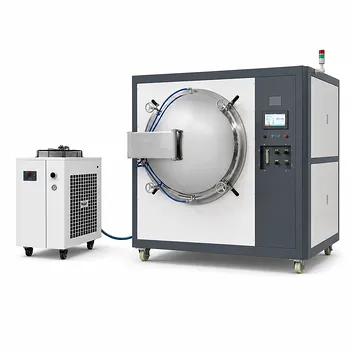
Vacuum drying provides a critical balance between efficient solvent removal and material preservation. By operating at reduced pressures, this method allows Polyaniline (PANI) to be dried at a relatively low temperature, typically around 60°C. This prevents the structural degradation and oxidation often caused by conventional high-heat drying methods, ensuring the material retains its essential conductive properties.
The primary value of a vacuum drying oven lies in its ability to lower the boiling point of residual solvents, enabling thorough drying without subjecting sensitive conductive polymers to damaging thermal stress.
Preserving Chemical and Structural Integrity
Preventing Polymer Degradation
Polyaniline is highly sensitive to thermal stress. Subjecting PANI to high temperatures in a standard oven can cause the polymer chains to break down or degrade.
By utilizing a vacuum environment, you can effectively remove moisture and solvents at 60°C. This low-temperature approach preserves the fundamental chemical structure of the polymer.
Eliminating Oxidation Risks
Conductive polymers like PANI rely on a specific chemical state to maintain their electrical properties. Exposure to oxygen at high temperatures accelerates oxidation, which acts as an impurity and disrupts conductivity.
The vacuum oven removes air from the chamber, creating an oxygen-deficient environment. This ensures that the material dries without undergoing unwanted chemical reactions that would compromise its electromagnetic shielding properties.
Protecting the Conductive Network
For PANI to function effectively, its internal conductive network must remain intact. Aggressive thermal drying can cause these delicate networks to collapse or become disjointed.
Vacuum drying is a gentler process that removes volatiles without physical disruption. This helps maintain the continuous pathways required for efficient electron transport.
Enhancing Composite Material Quality
Efficient Solvent Removal
Post-treatment often involves removing stubborn, high-boiling-point organic solvents. Under normal atmospheric pressure, removing these would require temperatures high enough to damage the PANI matrix.
The vacuum environment significantly lowers the boiling point of these solvents. This allows them to evaporate rapidly and completely, even at safe, lower temperatures.
Protection of Metallic Fillers
When PANI is used in composites—such as those containing metallic nano-fillers like Copper or Nickel—oxidation becomes a dual threat. High-heat drying in air can oxidize these metals, rendering them non-conductive or non-magnetic.
Vacuum drying prevents the oxidation of these metallic fillers. This ensures that the synergistic effects of the composite (such as combined electrical conductivity and magnetism) are fully realized.
Preservation of Porous Structures
Many PANI composites rely on a microporous structure for performance. Rapid, high-heat evaporation can cause capillary stresses that collapse these pores.
The controlled environment of a vacuum oven mitigates this risk. It preserves the internal microporous structure, which is vital for applications requiring high surface area or adsorption activity.
Understanding the Trade-offs
Equipment Complexity and Cost
While superior in results, vacuum drying requires more complex equipment than standard convection ovens. You must manage vacuum pumps, seals, and pressure regulation, which increases initial setup costs and maintenance requirements.
Throughput Limitations
Vacuum drying is predominantly a batch process. Unlike continuous conveyor ovens used in some industrial applications, vacuum ovens must be loaded, sealed, pumped down, and then vented. This can create bottlenecks in high-volume manufacturing environments where speed is the priority over precision.
Making the Right Choice for Your Goal
To determine if vacuum drying is the correct post-treatment for your PANI project, consider your specific performance targets:
- If your primary focus is Electrical Conductivity: Prioritize vacuum drying to prevent oxidation of the polymer backbone and any metallic fillers.
- If your primary focus is Structural Integrity: Use vacuum drying to remove solvents at low temperatures (60°C), preventing pore collapse and thermal degradation.
Ultimately, vacuum drying is the standard for PANI post-treatment because it decouples the drying process from the damaging effects of high heat and oxygen.
Summary Table:
| Feature | Benefit for PANI & Composites | Key Outcome |
|---|---|---|
| Reduced Pressure | Lowers solvent boiling points | Thorough drying at safe 60°C |
| Oxygen-Free Environment | Prevents polymer & metal filler oxidation | Maintains high electrical conductivity |
| Low-Temp Drying | Minimizes thermal stress on polymer chains | Preserves chemical/structural integrity |
| Gentle Volatile Removal | Reduces capillary stress and pore collapse | Protects microporous structures |
Precision is paramount when working with sensitive materials like Polyaniline. KINTEK provides industry-leading vacuum drying solutions designed to preserve the conductivity and structural integrity of your advanced polymers. Whether you require sophisticated vacuum ovens, high-temperature furnaces, or specialized crushing and milling systems, our comprehensive portfolio is engineered for excellence in laboratory and industrial research. Enhance your material performance and secure reliable results—contact KINTEK today for expert guidance and tailored equipment solutions!
References
- Ethem İlhan Şahin, Mehriban Emek. Wollastanit/PANI/Kolemanit Kompozitlerin Elektromanyetik Kalkanlama Etkinliği. DOI: 10.31590/ejosat.816145
This article is also based on technical information from Kintek Solution Knowledge Base .
Related Products
- 56L Vertical Laboratory Vacuum Drying Oven
- 23L Laboratory Vacuum Drying Oven
- Laboratory Scientific Electric Heating Blast Drying Oven
- Benchtop Laboratory Vacuum Freeze Dryer
- Dental Porcelain Zirconia Sintering Ceramic Vacuum Press Furnace
People Also Ask
- Why is a laboratory vacuum drying oven recommended for rice straw residues? Protect Your Biomass Integrity
- What role does a laboratory vacuum drying oven play in the preparation of modified multi-walled carbon nanotubes?
- What is the importance of using a laboratory vacuum drying oven? Preserving Slow-Release Microcapsule Integrity
- Why is a Laboratory Vacuum Drying Oven recommended for PBAT microspheres? Protect Sensitive Polymer Integrity
- What role does a laboratory vacuum drying oven play in processing nanoparticle powder samples? Protect Sample Integrity