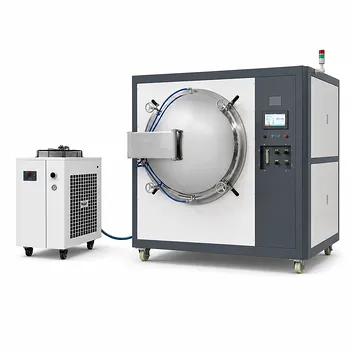
A vacuum hot press furnace facilitates the densification of Cu-18Ni-2W alloys by subjecting the material to a simultaneous combination of high thermal energy and mechanical force within a protected environment. Specifically, the furnace applies temperatures ranging from 800 to 900°C alongside an axial pressure of 20 to 30 MPa. This synergistic approach accelerates atomic diffusion and forces particle rearrangement, effectively eliminating internal porosity that conventional sintering cannot remove.
While standard sintering relies solely on heat to bond particles, vacuum hot pressing utilizes mechanical pressure as an additional driving force. This dual-action process physically collapses voids and induces dynamic recrystallization, ensuring a high-density structure with superior mechanical properties.
The Mechanics of Pressure-Assisted Sintering
Simultaneous Heat and Force
The core advantage of this furnace is the application of uniaxial pressure (typically via a hydraulic ram) at the same time the alloy is heated.
For Cu-18Ni-2W, the system maintains a specific pressure window, often optimized around 28 MPa, while the alloy sits at sintering temperatures.
Accelerating Atomic Diffusion
Pressure acts as a catalyst for the bonding process. By mechanically forcing particles together, the distance atoms must travel to bond is reduced.
This lowers the energy barrier for diffusion, allowing the material to densify faster and more completely than it would under heat alone.
Plastic Deformation
The mechanical load causes plastic deformation of the powder particles. This physical shape change increases the contact area between particles, creating a continuous metal skeleton.
Optimizing Microstructure and Properties
Elimination of Internal Pores
The primary goal of densification is removing voids. The axial pressure effectively squeezes out porosity, resulting in a near-theoretical density.
This creates a bulk material that is significantly more robust than the "green compacts" formed by cold-press methods.
Dynamic Recrystallization
The combination of heat and stress triggers dynamic recrystallization. This is a restorative process that modifies the grain structure during deformation.
This leads to a refined microstructure with an average grain size typically between 10 and 12 micrometers.
Balancing Thermal and Mechanical Traits
By refining the grain size and reducing the number of grain boundaries, the process optimizes the electron scattering rate.
This allows the Cu-18Ni-2W alloy to achieve high tensile strength without sacrificing its essential high thermal conductivity or melting point.
Environmental and Tooling Controls
The Role of Graphite Molds
The alloy powder is contained within graphite molds during the process. These molds define the shape of the specimen (e.g., 50 mm diameter).
Crucially, these molds must possess high hot-hardness to transmit the hydraulic pressure uniformly to the powder without failing under the intense 900°C heat.
Oxidation Inhibition
The vacuum environment is non-negotiable for this alloy. It removes oxygen from the chamber, preventing the formation of oxide layers on the powder particles.
Without a vacuum, oxidation would inhibit the diffusion process and weaken the final bond between particles.
Understanding the Trade-offs
Process Variable Sensitivity
Success depends on the precise synchronization of temperature and pressure.
If the pressure is applied too early or the temperature exceeds the optimal window, you risk excessive grain growth, which can degrade the mechanical strength despite high density.
Production Constraints
Unlike continuous belt furnaces used for mass production, vacuum hot pressing is a batch process limited by the size of the graphite die.
It is a high-cost, lower-volume solution best reserved for components where material integrity and density are the absolute highest priorities.
Making the Right Choice for Your Goal
To maximize the potential of Cu-18Ni-2W, you must tailor the furnace parameters to your specific performance requirements.
- If your primary focus is structural integrity: Prioritize a pressure setting near the upper limit (30 MPa) to ensure maximum pore closure and plastic deformation for a high-strength continuous skeleton.
- If your primary focus is conductivity: strictly monitor the temperature cap (900°C) and cooling rates to refine grain size (10-12 $\mu$m), which optimizes electron scattering and thermal performance.
By leveraging the synergy of thermal and mechanical energy, you transform the Cu-18Ni-2W powder into a robust, high-performance component that exceeds the capabilities of conventional sintering.
Summary Table:
| Parameter | Optimal Range | Impact on Alloy |
|---|---|---|
| Sintering Temperature | 800 - 900°C | Accelerates atomic diffusion & triggers recrystallization |
| Axial Pressure | 20 - 30 MPa | Induces plastic deformation & eliminates internal pores |
| Environment | Vacuum | Prevents oxidation and ensures clean particle bonding |
| Grain Size | 10 - 12 μm | Balances high tensile strength with thermal conductivity |
Elevate Your Material Integrity with KINTEK
Ready to achieve near-theoretical density for your high-performance alloys? KINTEK specializes in advanced laboratory equipment, offering precision vacuum hot press furnaces and a comprehensive range of crushing, milling, and hydraulic press systems tailored for rigorous research and production.
Whether you are refining Cu-Ni-W alloys or exploring next-gen ceramics, our portfolio—including high-temperature furnaces (muffle, tube, rotary), CVD systems, and essential consumables like graphite crucibles and PTFE products—provides the reliability your lab demands.
Maximize your densification results today. Contact our specialists to find the perfect solution for your application!
Related Products
- Vacuum Hot Press Furnace Heated Vacuum Press Machine Tube Furnace
- 600T Vacuum Induction Hot Press Furnace for Heat Treat and Sintering
- Vacuum Hot Press Furnace Machine Heated Vacuum Press
- Vacuum Hot Press Furnace Machine for Lamination and Heating
- Vacuum Heat Treat and Pressure Sintering Furnace for High Temperature Applications
People Also Ask
- What advantages does a vacuum hot press furnace provide for LSLBO ceramic electrolytes? Achieve 94% Relative Density
- What role does a Vacuum Hot Press (VHP) furnace play in the densification of austenitic stainless steel 316 composites?
- What are the advantages of using a vacuum hot pressing furnace? Superior Densification for 2024Al/Gr/SiC Composites
- What are the advantages of a vacuum hot press furnace for LTPO solid electrolytes? Boost Density and Conductivity
- What core processing conditions does a vacuum hot press furnace provide? Achieve High-Density Cu-SiC/Diamond Composites