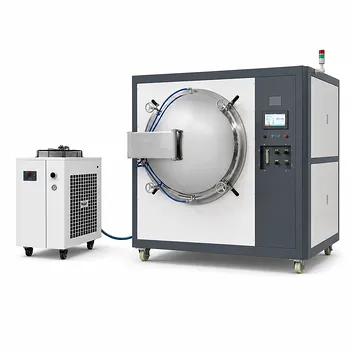
The vacuum hot pressing furnace facilitates the densification of Aluminum/Boron Carbide (Al/B4C) composites by creating a synchronized environment of high temperature, high vacuum, and mechanical pressure. Specifically, by applying 30 MPa of pressure at 680°C, the furnace forces liquid-phase aluminum to fill interstitial voids between particles while the vacuum actively removes adsorbed gases to prevent oxidation. This synergy drives the material to a relative density of 99.22% and significantly strengthens the bonding between the metal matrix and the ceramic reinforcement.
The Core Insight Heat alone is often insufficient for densifying composites because trapped gases and surface tension create barriers. Vacuum hot pressing solves this by using mechanical force to physically squeeze liquid metal into microscopic gaps while simultaneously creating a contaminant-free environment to ensure atomic-level bonding.
The Triple-Action Densification Mechanism
To understand how this equipment achieves such high density, we must break down the three distinct forces acting on the material simultaneously.
1. The Role of High Vacuum
The vacuum environment is the foundation of the process. Before heat is applied, the vacuum removes adsorbed gases trapped within the powder mixture and between particle surfaces.
For Al/B4C composites, this is critical because it prevents the oxidation of the aluminum matrix. By maintaining a clean environment, the furnace ensures that the liquid aluminum can bond directly to the B4C particles without an interfering oxide layer.
2. Thermal Activation and Liquid Phase
The furnace raises the temperature to 680°C. Since the melting point of aluminum is approximately 660°C, this creates a liquid phase within the composite.
At this temperature, the aluminum matrix creates a molten bath surrounding the solid Boron Carbide particles. This liquid state is essential for filling the complex geometries and voids inherent in powder mixtures.
3. Mechanical Driving Force
Heat and vacuum prepare the material, but mechanical pressure (30 MPa) is the driver of densification.
While liquid aluminum can flow, surface tension and friction often prevent it from penetrating the smallest pores naturally. The external uniaxial pressure physically forces the liquid aluminum into these gaps, overcoming resistance that gravity or capillary action alone could not.
How Microstructure is Transformed
The combination of these forces results in specific physical changes at the microscopic level.
Particle Rearrangement
The applied pressure forces solid B4C particles to shift and rotate. This rearrangement minimizes the distance between particles, creating a tighter packed structure before the liquid phase even fully solidifies.
Elimination of Internal Pores
As the liquid aluminum is pressurized, it fills the remaining voids left by the rearranging particles. This process, known as viscous flow, effectively eliminates internal porosity, pushing the material to near-theoretical density (99.22%).
Strengthened Interfacial Bonding
Because the vacuum has removed contaminants and prevented oxidation, the liquid aluminum contacts the B4C surfaces directly. The combination of heat and pressure promotes strong adhesion at these interfaces, which is vital for the mechanical strength of the final composite.
Understanding the Trade-offs
While vacuum hot pressing is highly effective, it introduces specific constraints that you must consider for your project.
Geometric Limitations
The pressure is applied uniaxially (from one direction). This generally limits the shapes you can produce to simple geometries, such as flat plates, pucks, or cylinders. Complex 3D shapes usually require post-process machining.
Processing Speed
Unlike continuous casting or extrusion, vacuum hot pressing is a batch process. It requires time to pump down the vacuum, heat the chamber, dwell for sintering, and cool down, which limits throughput for high-volume manufacturing.
Making the Right Choice for Your Goal
To maximize the benefits of vacuum hot pressing for your Al/B4C composites, align your process parameters with your specific objectives.
- If your primary focus is Maximum Density: Ensure your pressure is maintained at 30 MPa or higher throughout the liquid phase (680°C) to mechanically overcome any wetting resistance between the ceramic and metal.
- If your primary focus is Material Purity: Prioritize the vacuum quality during the pre-heating stage to fully evacuate adsorbed gases before the aluminum melts and traps them.
- If your primary focus is Mechanical Strength: Focus on the cooling phase after the dwell time; controlled cooling under pressure can prevent residual stresses from forming at the Al/B4C interface.
True densification is not just about melting the metal; it is about using pressure to force that metal into every microscopic void while a vacuum guarantees a clean bond.
Summary Table:
| Parameter | Role in Densification | Key Outcome |
|---|---|---|
| High Vacuum | Removes adsorbed gases & prevents oxidation | Clean, atomic-level bonding |
| 680°C Heat | Creates a liquid aluminum phase | Enables flow into interstitial voids |
| 30 MPa Pressure | Overcomes surface tension & friction | Forces liquid metal into microscopic gaps |
| Resulting Density | Reaches near-theoretical maximum | 99.22% relative density achieved |
Maximize Your Material Performance with KINTEK
Precision densification requires more than just heat—it requires the specialized synergy of vacuum and mechanical force. KINTEK provides state-of-the-art laboratory equipment, including advanced hot pressing systems, vacuum furnaces, and hydraulic presses, engineered specifically for the demanding requirements of metal-matrix composites and battery research.
Whether you are producing high-density Al/B4C plates or developing next-generation ceramics, our comprehensive range of high-temperature solutions and cooling systems ensures your materials meet the most rigorous standards.
Ready to elevate your composite manufacturing? Contact our technical experts today to find the perfect furnace or press for your application!
Related Products
- Vacuum Hot Press Furnace Heated Vacuum Press Machine Tube Furnace
- 600T Vacuum Induction Hot Press Furnace for Heat Treat and Sintering
- Vacuum Hot Press Furnace Machine Heated Vacuum Press
- Vacuum Hot Press Furnace Machine for Lamination and Heating
- Vacuum Heat Treat and Pressure Sintering Furnace for High Temperature Applications
People Also Ask
- What advantages does a vacuum hot press furnace provide for LSLBO ceramic electrolytes? Achieve 94% Relative Density
- What role does a Vacuum Hot Press (VHP) furnace play in the densification of austenitic stainless steel 316 composites?
- What are the advantages of using a vacuum hot pressing furnace? Superior Densification for 2024Al/Gr/SiC Composites
- What are the advantages of a vacuum hot press furnace for LTPO solid electrolytes? Boost Density and Conductivity
- What core processing conditions does a vacuum hot press furnace provide? Achieve High-Density Cu-SiC/Diamond Composites